
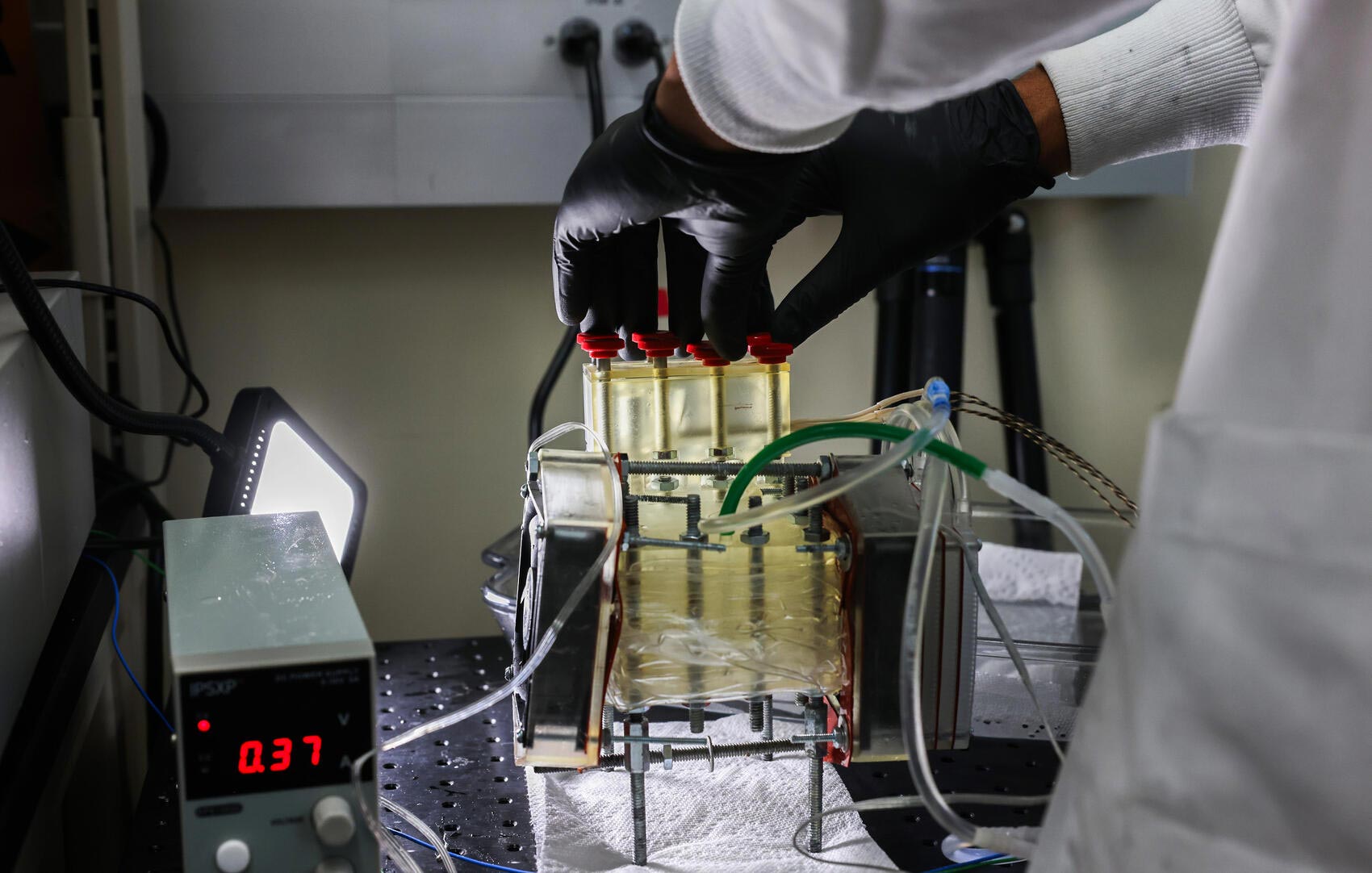
Researchers at UNLV have developed a groundbreaking technology that efficiently extracts large amounts of water from the air, even in extremely low-humidity conditions.
Inspired by natural processes observed in tree frogs and air plants, this technology utilizes a hydrogel membrane and can be powered by solar energy, offering a sustainable water source for arid regions.
Transforming Air Into Water
Turning the air around us into drinking water has long seemed like a marvel, closer to science fiction than reality—especially when it comes to capturing a sustainable amount from dry, low-humidity environments.
However, amid a worsening megadrought impacting water supplies across the Southwest, researchers at the University of Nevada, Las Vegas (UNLV) have developed a groundbreaking technology that can pull significant amounts of water from even arid air. Their findings were published on October 22 in the Proceedings of the National Academy of Sciences (PNAS).
Advancements in Atmospheric Water Harvesting
Leading this innovative project is UNLV mechanical engineering professor H. Jeremy Cho, who, along with his team, has introduced a fundamentally new approach to atmospheric water harvesting—transforming water vapor in the air into a usable form. Unlike existing technologies, which produce low yields and struggle below 30% humidity, this new method is designed to perform efficiently even in extremely dry conditions.
“This paper really establishes that you can capture water at a very fast rate,” said Cho. “We can start to forecast how big of a system we would need to produce a set amount of water. If I have one square meter, which is around three feet by three feet, we can generate about a gallon of water per day in Las Vegas, and up to three times more in humid environments.”
Nature-Inspired Water Capture
This technology and approach has been tested outdoors in Las Vegas, and is effective down to 10% humidity. It directly captures water in a liquid salt solution that is suitable for subsequent processing into drinking water or energy production, enabling new capabilities for arid regions.
A key ingredient in the process is a hydrogel membrane “skin.” The inspiration for this material comes from nature – specifically tree frogs and air plants, which use a similar technique to transport water from ambient air into a liquid for internal storage.
“We took that biological idea and tried to do it in our own way,” he said. “There are so many cool things happening in nature – you just have to look around, learn, and be inspired.”
Solar Power Enhances Sustainability
Additionally, the research demonstrates that atmospheric water harvesting can be solar-powered. Thanks to the frequent sunlight experienced in places such as the Las Vegas Valley – which averages 300 sunny days a year sunlight can provide enough energy to reduce the theoretical and eventual cost for generating water.
“Our water resources are depleting and our planet’s climate is changing,” said Cho. “To reach sustainability, we have to change our habits. This whole idea seemed like science fiction, but this is possible, and we’re actually doing it.”
Commercial Application of Water Harvesting Technology
The research is already being put into practical use in the form of WAVR Technologies, Inc. Cho co-founded this UNLV startup, making devices capable of capturing water vapor from the air around us for commercial and individual uses.
WAVR is the premiere university business spinoff from the National Science Foundation (NSF) Regional Innovation Engines program aimed at bringing to market technologies that address regional sustainability and climate concerns.
Reference: “High-yield atmospheric water capture via bioinspired material segregation” by Yiwei Gao, Areianna Eason, Santiago Ricoy, Addison Cobb, Ryan Phung, Amir Kashani, Mario R. Mata, Aaron Sahm, Nathan Ortiz, Sameer Rao and H. Jeremy Cho, 22 October 2024, Proceedings of the National Academy of Sciences.
DOI: 10.1073/pnas.2321429121
Never miss a breakthrough: Join the SciTechDaily newsletter.
Follow us on Google and Google News.
3 Comments
Extracting water from the air? Nice work if you can get it. But wouldn’t it make more sense to desalinate water from the abundant seas, which we are constantly assured are rising and will eventually drown us all?
Near a coast where conditions are dry, sure. Otherwise the energy costs of transfer can become prohibitive.
Change our habits indeed, like stop all motorized vehicles, stop pumping water into homes, stop putting raw sewage into our rivers, all these modern conveniences should have a stop button. Everyone knows that knowledge shall increase at the time of the end, didn’t say youhave to follow evil…..