
Protein ORAI1 fuels oral cancers—and may provide a promising therapeutic target.
An essential protein that acts as a gatekeeper for calcium entering cells promotes the growth of oral cancer and generates pain, according to a new study published on September 5 in the journal Science Signaling led by researchers at NYU College of Dentistry.
Targeting this protein—the ORAI1 calcium channel—could provide a new approach to treating oral cancer, which causes persistent pain that worsens as it progresses.
“Our results show that the ORAI1 channel fuels the growth of oral cancer tumors and produces an abundance of molecules that, once secreted, interact with neurons resulting in an increased sensitivity to pain,” said Ga-Yeon Son, a postdoctoral fellow in the Department of Molecular Pathobiology at NYU College of Dentistry and the study’s first author.
The Keepers of the Gates of Heaven
ORAI calcium channels—named after the three sisters in Greek mythology who guarded the gates of heaven at Mount Olympus—play an important role in controlling how much calcium enters cells.
“These calcium channels can be a source of good or bad for cells,” said Rodrigo Lacruz, professor of molecular pathobiology at NYU College of Dentistry and the study’s senior author.
“Calcium entering cells is necessary for many good things, but too much calcium for a long time has the opposite effect.”
Calcium channels have been linked to various cancers, especially cancer progression, but few studies have looked at the role of ORAI1 in cancer and pain.
“Calcium influx through ORAI1 channels has been well known to contribute to the regulation of gene expression by activating gene transcription factors in the cells. Notably, our investigation extends its function in regulating gene expression to altering oral cancer pain,” said Son.
Less ORAI1, Less Cancer Growth and Pain
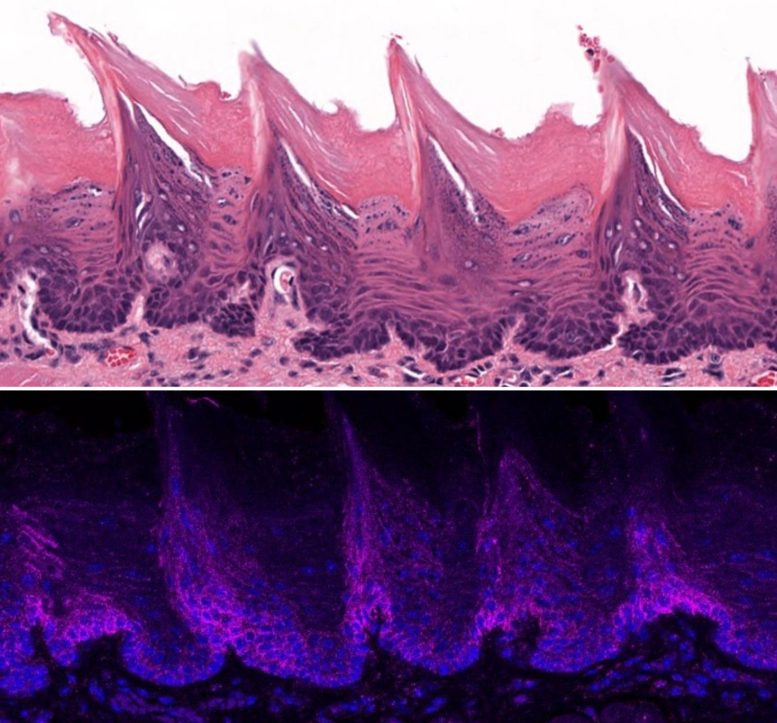
The researchers first analyzed tissue samples from human oral cancer tumors and healthy tongues. They found that the ORAI1 gene, which contains instructions for creating the ORAI1 calcium channel, was heavily overexpressed in the tumors but not in healthy tissue.
They then examined human oral cancer cells and found that activating the ORAI1 calcium channel (but not other calcium channels) caused a large influx of calcium into cancer cells. This influx resulted in the increase of a calcium-dependent enzyme called matrix metalloprotease 1 (MMP1) that is secreted outside of cancer cells. MMP1 is abundant in multiple types of cancer, including oral cancer, where its overexpression is associated with metastasis and poor prognosis.
Removing the ORAI1 gene from oral cancer cells changed the course of the disease in animal studies. When mice were inoculated with cancer cells lacking the ORAI1 gene, tumors grew more slowly and were less painful.
“These findings demonstrate an important role for ORAI1 in oral cancer progression and pain, but what is the mechanism? We wondered if MMP1 could be the messenger relaying pain,” said Lacruz.
In collaboration with NYU Pain Research Center scientists Rajesh Khanna and Yi Ye, the team looked at the levels of MMP1 expressed in the fluid surrounding oral cancer cells and saw that cells lacking the ORAI1 gene secreted less MMP1 into the surrounding fluid. They combined the fluid with neurons from the trigeminal ganglia, a collection of nerves in the face that transmit pain in oral cancer. The fluid from cancer cells without the ORAI1 gene did not elicit a strong response from the neurons, but the MMP1-rich fluid from cells with ORAI1 evoked an increase in action potentials, the necessary signal for pain transmission.
“This gives us evidence that an abundance of MMP1 may generate increased sensitivity to pain,” said Lacruz.
The researchers also ran experiments with abnormal but non-cancerous cells. When they overexpressed the ORAI1 gene in these non-invasive cells, they became invasive, raising the possibility that ORAI1 could play a role in cells switching from non-cancerous to cancerous cells.
Potential Treatment Pathways
Several FDA-approved drugs block the ORAI1 calcium channel, but they have not yet been tested in oral cancer. In future studies, the researchers will see whether nanoparticles can be loaded with an ORAI-blocking drug and precisely delivered into the tongues of animal models to stop oral cancer progression and pain.
“In light of the ongoing opioid crisis, our study paves the way for validating novel pain treatments in oral cancer,” said Rajesh Khanna, director of the NYU Pain Research Center, professor of molecular pathobiology at NYU Dentistry, and a co-author of the study.
“Ultimately, our hope is that targeting the ORAI1 channel in oral cancer can prevent or delay the progression from oral epithelial dysplasia to oral cancer tumors and concurrently alleviate the pain burden experienced by oral cancer patients,” added Son.
Reference: “The Ca2+ channel ORAI1 is a regulator of oral cancer growth and nociceptive pain” by Ga-Yeon Son, Nguyen Huu Tu, Maria Daniela Santi, Santiago Loya Lopez, Guilherme H. Souza Bomfim, Manikandan Vinu, Fang Zhou, Ariya Chaloemtoem, Rama Alhariri, Youssef Idaghdour, Rajesh Khanna, Yi Ye and Rodrigo S. Lacruz, 5 September 2023, Science Signaling.
DOI: 10.1126/scisignal.adf9535
Additional study authors include Nguyen Huu Tu, Maria Daniela Santi, Santiago Loya Lopez, and Guilherme H. Souza Bomfim of NYU College of Dentistry; Manikandan Vinu, Ariya Chaloemtoem, Rama Alhariri, and Youssef Idaghdour of NYU Abu Dhabi; and Fang Zhou of NYU Langone Health.
The research was supported by the National Institute of Dental and Craniofacial Research (DE027981, DE027679, R01DE029493), National Institutes of Health HEAL Initiative (R01DE032501), National Institute of Neurological Disorders and Stroke (NS098772, NS120663), and National Institute on Drug Abuse (DA042852).
Never miss a breakthrough: Join the SciTechDaily newsletter.
Follow us on Google and Google News.