
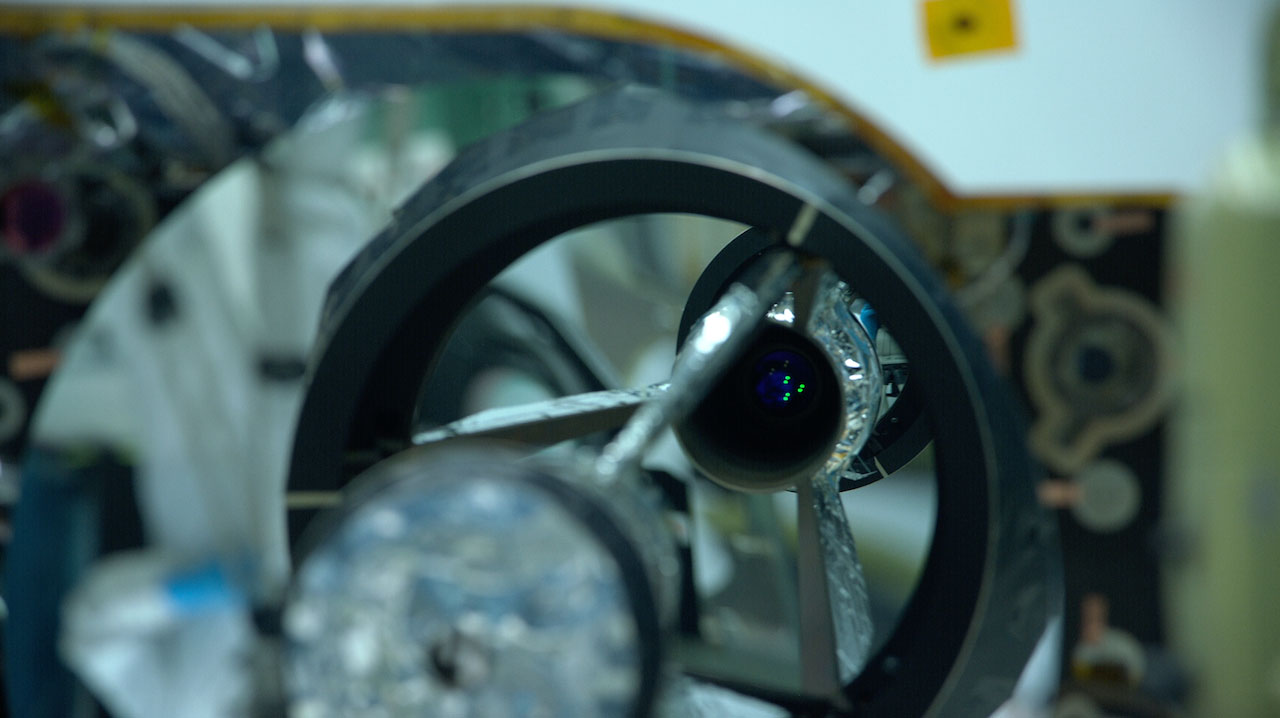
A first-of-its-kind laser instrument designed to map the world’s forests in 3-D is moving toward an earlier launch to the International Space Station than previously expected.
The Global Ecosystem Dynamics Investigation – or GEDI, pronounced like “Jedi,” of Star Wars fame – instrument is undergoing final integration and testing this spring and summer at NASA’s Goddard Space Flight Center in Greenbelt, Maryland. The instrument is expected to launch aboard SpaceX’s 16th commercial resupply services mission, targeted for late 2018. GEDI is being led by the University of Maryland, College Park; the instrument is being built at NASA Goddard.
From its perch on the exterior of the orbiting laboratory, GEDI will be the first space-borne laser instrument to measure the structure of Earth’s tropical and temperate forests in high resolution and three dimensions. Credit: NASA’s Goddard Space Flight Center/LK Ward
“Scientists have been planning for decades to get comprehensive information about the structure of forests from space to deepen our understanding of how this structure impacts carbon resources and biodiversity across large regions and even globally, as well as a host of other science issues,” said Ralph Dubayah, GEDI principal investigator and a professor of geographical sciences at the University of Maryland. “This is why seeing the instrument built and racing toward launch is so exciting.”
From its perch on the exterior of the orbiting laboratory, GEDI will be the first space-borne laser instrument to measure the structure of Earth’s tropical and temperate forests in high resolution and three dimensions. These measurements will help fill in critical gaps in scientists’ understanding of how much carbon is stored in the world’s forests, the potential for ecosystems to absorb rising concentrations of carbon dioxide in Earth’s atmosphere, and the impact of forest changes on biodiversity.
GEDI will accomplish its science goals through an ingenious use of light. The instrument is a lidar, which stands for light detection and ranging. It captures information by sending out laser pulses and then precisely measuring the light that is reflected back.
GEDI’s three lasers will produce eight ground tracks – two of the lasers will generate two ground tracks each, and the third will generate four. As the space station and GEDI orbit Earth, laser pulses will reflect off clouds, trees and the planet’s surface. While the instrument will gather height information about everything in its path, it is specifically designed to measure forests. The amount and intensity of the light that bounces back to GEDI’s telescope will reveal details about the height and density of trees and vegetation, and even the structure of leaves and branches within a forest’s canopy.
NASA has flown multiple Earth-observing lidars in space, notably the ICESat (Ice, Cloud and land Elevation Satellite) and CALIPSO (Cloud-Aerosol Lidar and Infrared Pathfinder Satellite Observation) missions. But GEDI will be the first to provide high-resolution laser ranging of Earth’s forests.
“GEDI originally was scheduled to launch aboard a resupply mission in mid-2019, but the team at Goddard who is building and testing GEDI was always on track to deliver a finished instrument by the fall of this year,” said Project Manager Jim Pontius, making the move to an earlier resupply mission feasible. The team is now preparing to put GEDI through a battery of pre-launch tests to ensure it is ready to withstand the rigors of launch and operating in space.
NASA selected the proposal for GEDI in 2014 through the Earth Venture Instrument program, which is run by NASA’s Earth System Science Pathfinder (ESSP) office. ESSP oversees a portfolio of projects ranging from satellites, instruments on the space station, and suborbital field campaigns on Earth that are designed to be lower-cost and more focused in scope than larger, free-flying satellite missions.
Never miss a breakthrough: Join the SciTechDaily newsletter.
Follow us on Google and Google News.