
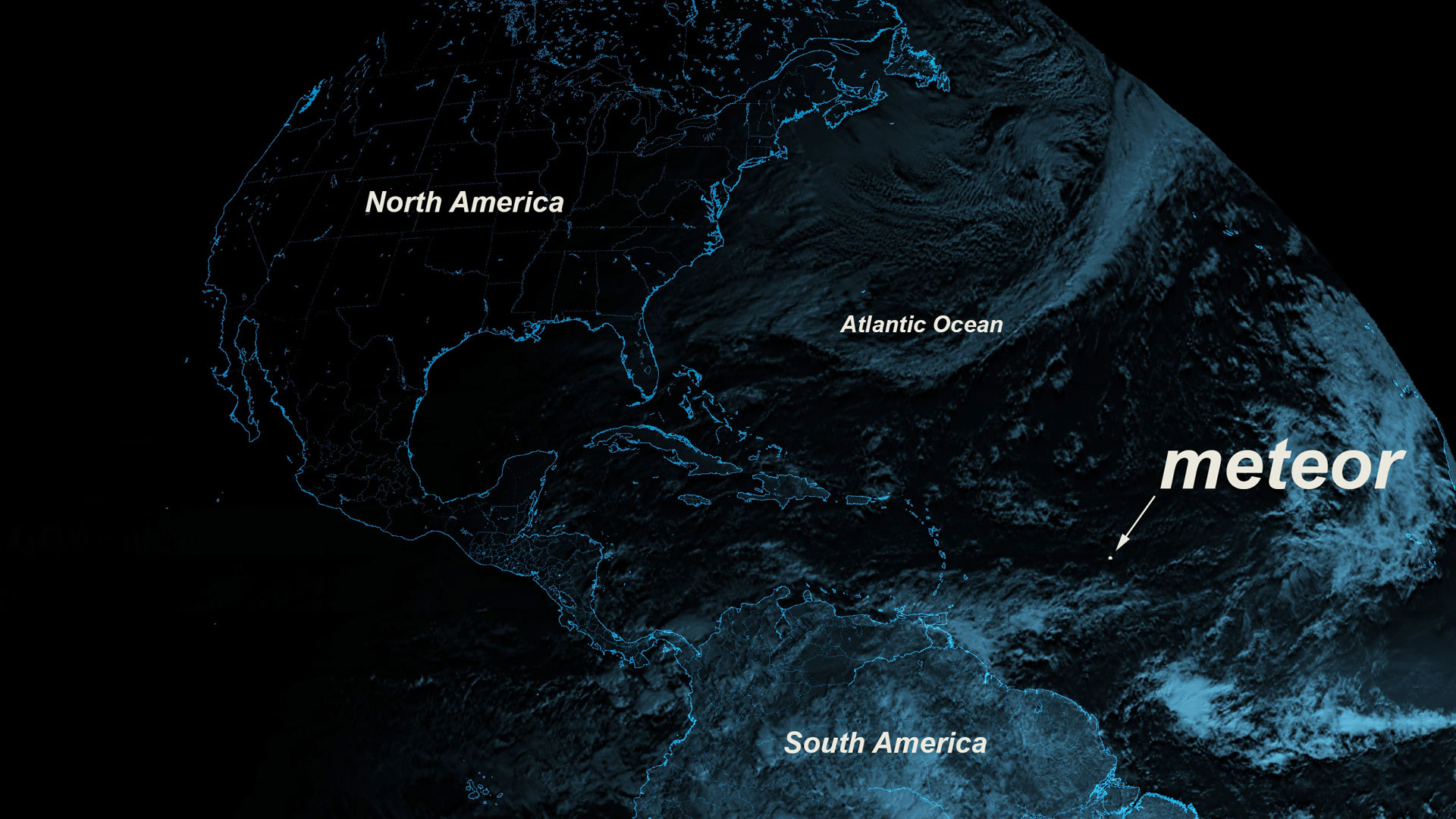
NASA’s efforts to better understand asteroid impacts has found unexpected support from a new satellite sensor designed to detect lightning. New research published in the journal Meteoritics and Planetary Science finds that the new Geostationary Lightning Mapper, or GLM, on two weather satellites is able to pick up signals of meteors in Earth’s atmosphere.
“GLM detects these meteors when they become brighter than the full Moon,” says lead author and meteor astronomer Peter Jenniskens of the SETI Institute and NASA’s Ames Research Center in California’s Silicon Valley. “Meteors that bright are called ‘bolides’ and they are caused mainly by the impact of small asteroids.”
Jenniskens’ work on meteors contributes to the NASA Ames Asteroid Threat Assessment Program, which helps improve the information for impact prediction warnings by studying how asteroids fragment as they travel through the atmosphere.
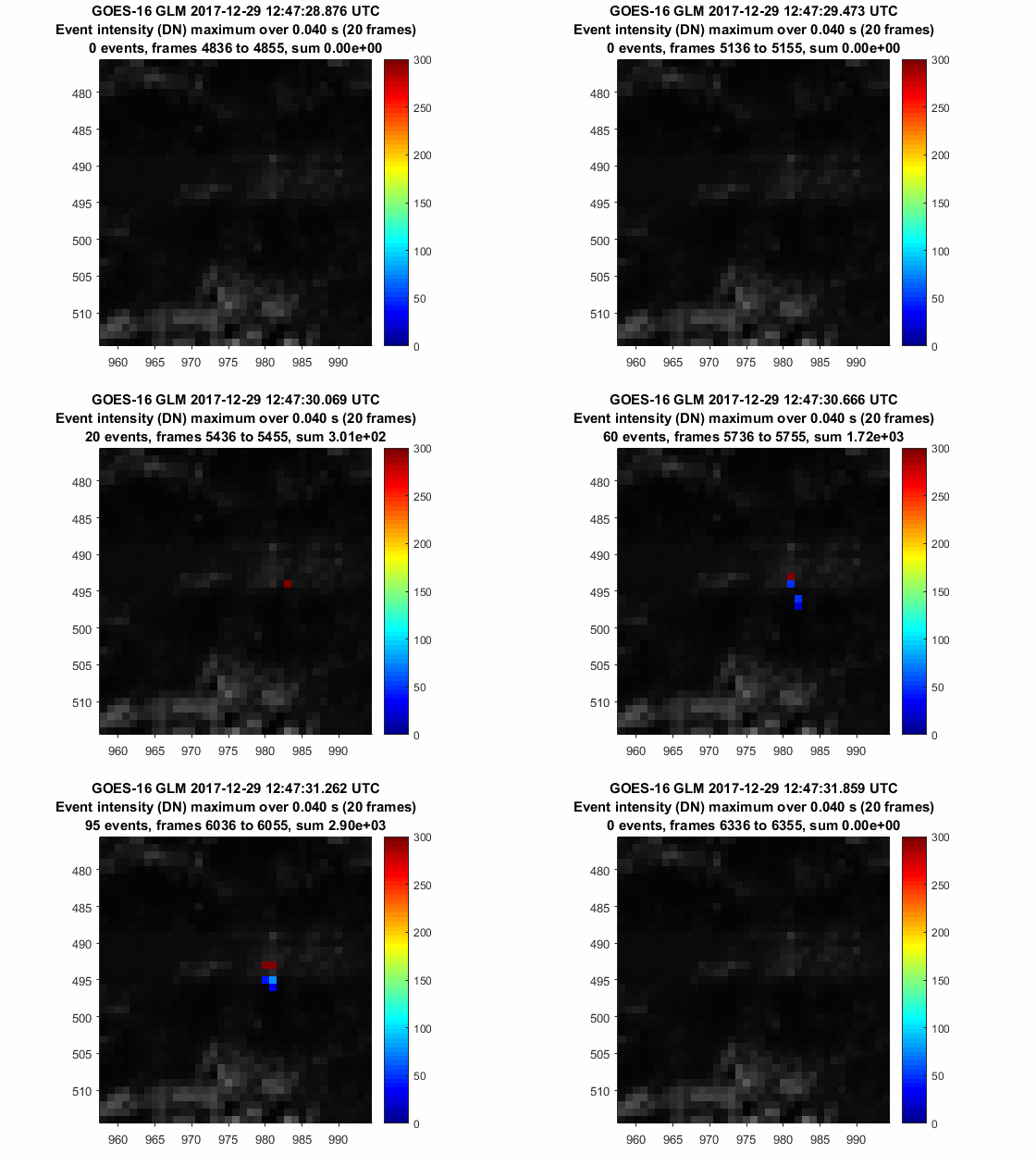
“The range of altitudes over which asteroids deposit their kinetic energy — the energy of their motion — determines how dangerous the shock waves are that can cause damage on the ground,” says Eric Stern, a research scientist at Ames who is the entry modeling lead for the program. “The light profiles derived from GLM data are slated now to be used in a future version of NASA’s automated bolide reporting system.”
The Geostationary Lightning Mapper, built by Lockheed Martin, was designed for mapping lightning flashes over vast geographic regions. The instrument captures 500 images per second of Earth from geostationary orbit, in which the satellite is always in the same position with respect to the rotating Earth, more than 22,000 miles up.
“The instrument views Earth in only a narrow range of wavelengths of light,” said Samantha Edgington, GLM chief scientist at Lockheed Martin, who led the effort to develop the processing pipeline that now provides lightning data to weather forecasters. “Since most of the light is blocked, we were surprised to see how readily the instrument detected the meteors.”
GLM is one of several instruments onboard the new Geostationary Operational Environmental Satellites-16 and -17, which are operated by the National Atmospheric and Oceanic Administration.
“Although most lightning flashes are very brief, the relatively long-duration signals of bolides are not filtered out of the data,” said NOAA physical scientist Scott Rudlosky. “That’s because GLM also was designed to measure a longer-lasting lightning type that is known to play a key role in lightning-ignited wildfires.”
The ten bolides discussed in the paper were observed with the first GLM instrument on board GOES-16, which was launched in November 2016.
“The first bolide we found in GLM data was on February 6, 2017; more than 500 people reported seeing this event over Wisconsin that day,” said Jenniskens. “Meteorites likely fell in Lake Michigan but were never recovered.”
Other detected bolides show different manners of fragmentation. They include one that caused a meteorite fall in Canada and another large, explosive event over the western Atlantic Ocean of a rare size that occurs only once a year.
The Asteroid Threat Assessment Program is funded by the NASA Planetary Defense Coordination Office. The scientific paper is available online in the journal Meteoritics and Planetary Science.
Reference: “Detection of meteoroid impacts by the Geostationary Lightning Mapper on the GOES‐16 satellite” by Peter Jenniskens, Jim Albers, Clemens E. Tillier, Samantha F. Edgington, Randolph S. Longenbaugh, Steven J. Goodman, Scott D. Rudlosky, Alan R. Hildebrand, Lincoln Hanton, Fabio Ciceri, Richard Nowell, Esko Lyytinen, Donald Hladiuk, Dwayne Free, Nicholas Moskovitz, Len Bright, Christopher O. Johnston and Eric Stern, 15 July 2018, Meteoritics and Planetary Science.
DOI: 10.1111/maps.13137
Never miss a breakthrough: Join the SciTechDaily newsletter.
Follow us on Google and Google News.