
Close Menu
    Facebook X (Twitter) Instagram
    SciTechDaily
    • Biology
    • Chemistry
    • Earth
    • Health
    • Physics
    • Science
    • Space
    • Technology
    Facebook X (Twitter) Pinterest YouTube RSS
    SciTechDaily
    Home»Space»Gemini Reveals Outflowing Gas from Supermassive Black Hole Nuclei
    Space

    Gemini Reveals Outflowing Gas from Supermassive Black Hole Nuclei

    By Megan Watzke, Harvard-Smithsonian Center for AstrophysicsJune 7, 2018No Comments2 Mins Read
    Facebook Twitter Pinterest Telegram LinkedIn WhatsApp Email Reddit
    Share
    Facebook Twitter LinkedIn Pinterest Telegram Email Reddit
    Outflows in the Narrow Line Region of Bright Seyfert Galaxies
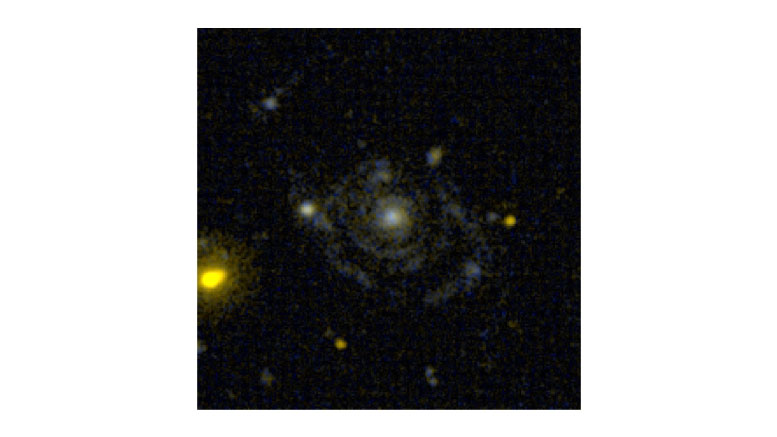
    An image of the galaxy Markarian 348 in the ultraviolet. Its active nucleus powers outflowing atomic gas, and new observations of it and four similar galaxies have been able to image the outflow as well as a rotating gas component. NASA/GALEX

    Supermassive black holes at the nuclei of most galaxies, including our Milky Way, develop gradually as material accretes onto the seed black hole. The physical processes that drive this growth – the so-called feeding and feedback processes – occur in the vicinity of the galaxy nucleus. When the accretion becomes active, radiation is emitted that illuminates and ionizes the gas in the vicinity of the nucleus. Accretion disc winds can interact with the gas to produce outflowing gas that is observed to reach velocities of hundreds of km/sec. Relativistic jets of particles emanating from the black hole can also interact with his material. These various kinds of feedback are essential to avoid producing overly massive galaxies.

    Clear evidence for all these processes has been detected in their optical emission lines of ionized atoms, whose velocities can be measured. However it has been much hard to obtain spatial information about the geometry of the excited gas. CfA astronomer Martin Elvis and nine colleagues used the Gemini eight-meter telescope and a powerful new instrument that records both high-resolution spatial (as small as a few hundred light-years in size) and velocity information. The team studied five relatively nearby galaxies known to have active black hole nuclei with bright atomic emission. They discovered that in all cases the gas has two major components, one rotating and one outflowing. But otherwise the galaxies are all somewhat different: in one the gas rotates opposite to its stars, in another only one lobe of the outflow can be seen, and there are other differences as well. The new paper is just the first in a series expected to probe and model in detail how nuclear black holes grow.

    Reference: “Outflows in the Narrow-Line Region of Bright Seyfert Galaxies – I. GMOS-IFU Data” by I. C. Freitas, R. A. Riffel, T. Storchi-Bergmann, M. Elvis, A. Robinson, D. M. Crenshaw, N. M. Nagar, D. Lena, H. R. Schmitt, and S. B. Kraemer, 5 February 2018, MNRAS.
    DOI: 10.1093/mnras/sty303

    Never miss a breakthrough: Join the SciTechDaily newsletter.
    Follow us on Google and Google News.

    Astronomy Astrophysics Black Hole
    Share. Facebook Twitter Pinterest LinkedIn Email Reddit

    Related Articles

    NASA Investigates an “Old Faithful” Active Galaxy That Erupts Every 114 Days

    Unexpected Discovery: Hubble Space Telescope Uncovers Concentration of Small Black Holes

    Deepening Mystery: Astronomers on the Hunt for a Missing Supermassive Black Hole [Video]

    When Galaxies Collide: How Galactic Collisions Can Starve Massive Black Holes

    Massive Stellar Triples Leading to Sequential Binary Black-Hole Mergers

    Astronomers Discover Earliest Supermassive Black Hole and Quasar in the Universe – 1000x More Luminous Than the Milky Way

    Most Distant Quasar Discovered Sheds Light on How Supermassive Black Holes Grow

    Deepening Astronomical Mystery: On the Hunt for a Missing Giant Black Hole

    Supermassive Black Hole’s Dust Ring May Be Casting Shadows From Heart of a Galaxy

    Leave A Reply Cancel Reply

    • Facebook
    • Twitter
    • Pinterest
    • YouTube

    Don't Miss a Discovery

    Subscribe for the Latest in Science & Tech!

    Trending News

    Tea or Coffee? Your Daily Choice Could Affect Osteoporosis Risk

    Vitamin C May Fight Cancer in a Surprising Way

    Hidden Earthquake Threat: Oregon’s Fault May Be Closer to the Surface Than Scientists Thought

    Scientists Discover Hidden Sleep Switch That Boosts Brainpower, Builds Muscle, and Burns Fat

    Ancient Mega-Floods Once Ripped Across Mars and Left This Giant Scar

    Scientists Discover Cheap, Natural Remedy for High Blood Pressure

    Earth’s Upper Atmosphere Is Cooling Fast and Scientists Finally Know Why

    32,000 Olympic Pools of Magma Nearly Erupted Beneath Atlantic Island

    Follow SciTechDaily
    • Facebook
    • Twitter
    • YouTube
    • Pinterest
    • Newsletter
    • RSS
    SciTech News
    • Biology News
    • Chemistry News
    • Earth News
    • Health News
    • Physics News
    • Science News
    • Space News
    • Technology News
    Recent Posts
    • Ancient Roman Gold Mines Discovered in Spain’s Pyrenees
    • Ancient DNA Reveals How Farming Spread and Nearly Broke a Civilization
    • 146,000-Year-Old Discovery Rewrites the Story of Human Creativity
    • The Type of Alcohol You Drink Could Affect How Long You Live
    • 19-Year Study Reveals the Surprising Truth About Sitting and Dementia
    Copyright © 1998 - 2026 SciTechDaily. All Rights Reserved.
    • Science News
    • About
    • Contact
    • Editorial Board
    • Privacy Policy
    • Terms of Use

    Type above and press Enter to search. Press Esc to cancel.