
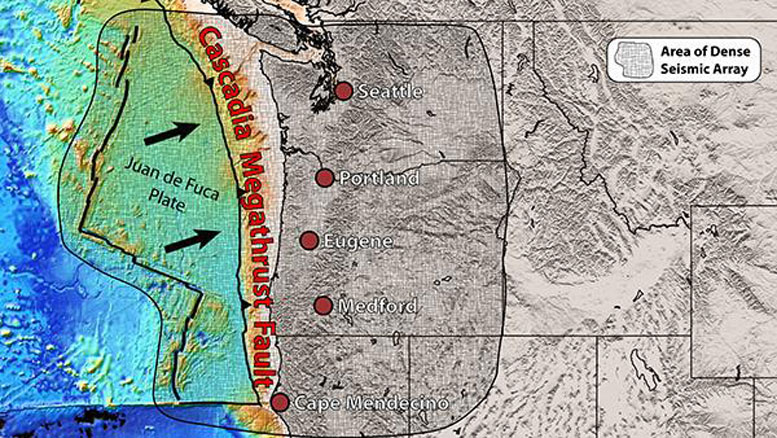
New seismic data provide structural basis for strong earthquakes that strike at both ends of the Pacific Northwest fault zone.
With four years of data from 268 seismometers on the ocean floor and several hundred on land, researchers have found anomalies in the upper mantle below both ends of the Cascadia Subduction Zone. They may influence the location, frequency, and strength of earthquake events along the U.S. Pacific Northwest.
The anomalies, which reflect regions with lower seismic wave velocities than elsewhere beneath the fault line, point to pieces of the Earth’s upper mantle that are rising and buoyant because of melting rock and possibly elevated temperatures, said Miles Bodmer, a University of Oregon doctoral student who led a study now online as an accepted paper by the journal Geophysical Research Letters.
The 620-mile (1,000 kilometers) subduction zone, which hasn’t experienced a massive lengthwise earthquake since 1700, is where the Juan de Fuca ocean plate dips under the North American continental plate. The fault zone stretches just offshore from northern Vancouver Island to Cape Mendocino in northern California.
The mantle is rising under the southern Gorda deformation zone at the north edge of the San Andreas Fault and under the Olympic Peninsula and southern Vancouver Island.
“What we see are these two anomalies that are beneath the subducting slab in the northern and southern parts of the subduction zone,” Bodmer said. “These regions don’t have the same behavior as the entire fault. There are three segments that have their own distinct geological characteristics. The north and south segments have increased locking and increased tremor densities.”
Locking refers to how strongly two plates stick. “If they are stuck together tightly, as is the case here, they are building up stress, and you have the potential for the release of that stress, or energy, in large earthquake events,” Bodmer said.
Such quakes, while strong, are below that of the 9-plus magnitude event projected should all of Cascadia rupture at once, he said. Locking is much weaker in Cascadia’s central section, which includes most of Oregon, where infrequent, smaller quakes tend to occur from creeping along the plates.
Tremor refers to long-duration seismic signals often seen at subduction zones. “These happen deep and take more time than a typical earthquake as they rumble to release energy,” Bodmer said.
The findings won’t help earthquake forecasting, but they do point to the need for real time onshore-offshore seismic monitoring and geodetic analyses, such as from GPS to help plot spatial coordinates, of the anomalies as a next step in that direction, said co-author Douglas R. Toomey, a seismologist in the UO Department of Earth Sciences.
The study helps to make sense of Cascadia’s historical record of earthquake, he said.
The junction of the Cascadia-San Andreas faults, Toomey said, contains a lot of complexity and is the most seismically active part of contiguous North America. Seismic history also shows more earthquake activity in the Puget Sound area than in central Oregon. Both regions accumulate energy that eventually is released in large earthquakes, he said.
“Our study is worse news for Portland northward to Seattle and for southern Cascadia, but central Cascadia is not off the hook,” said Toomey, who also is lead investigator for the Oregon component of ShakeAlert, the West Coast early warning network. “More frequent earthquakes to the north and south are seen in historical seismicity patterns. This research helps to understand that.”
The study involved deep imaging, similar to CAT scans, using different forms of seismic waves coming from distant earthquakes moving through the Earth.
The ocean-bottom seismic stations, from which data were retrieved every 10 months, were part of the National Science Foundation-funded Cascadia Initiative. Older data from numerous onshore studies in the western United States also were included in the analysis.
In addition to helping to understand Cascadia’s historical earthquake record, the anomalies, Bodmer said, suggest that the two buoyant ends help to modulate plate coupling forces.
“We’re looking at structures deep within the Earth and finding evidence suggesting that they are influencing the megathrust faults and controlling where we see increases in locking and segmentation,” Bodmer said. “Knowing the timing and path of the seismic signals, we can look at velocity variation and equate that to the structures. With large offshore data sources, we might be able to better understand how a large rupture in the south might extend into central Oregon.”
Reference: “Buoyant Asthenosphere Beneath Cascadia Influences Megathrust Segmentation” by Miles Bodmer, Douglas R. Toomey, Emilie E. E. Hooft and Brandon Schmandt, 11 July 2018, Geophysical Research Letters.
DOI: 10.1029/2018GL078700
Never miss a breakthrough: Join the SciTechDaily newsletter.
Follow us on Google and Google News.
6 Comments
This is an excellent addition to the understanding of this plate, offshore of Oregon and Washington! Data for the past several years from earthquakes in the area did not always agree with the current published understandings for the Juan de Fuca plate. This week’s earthquake swarm on 7/24/2018 needed a little more insight to understand the activity.
Sadly, no matter how much evidence about the coming mega quake is reported by scientists dedicated to their work, societies in the Pacific Northwest will not do enough to be ready. Older buildings will not be retrofitted to comply with current seismic building codes. Public roads, bridges and overpasses will not be retrofitted, either. The recovery period might be as long as two years in some locales, and some areas may be abandoned … like Portland. The cost of rebuilding on the large areas of unstable soil in the Portland area may be so costly it will be more feasible to build elsewhere.
What effect does this have on the crust? https://www.ssec.wisc.edu/data/geo/#/animation?satellite=fy2e&end_datetime=latest&n_images=24&coverage=fd&channel=04&image_quality=gif&anim_method=javascript
The only up side I can see is that a lot of the left wing voters along the coast will be relieved of voting.
How will this affect Alaska as far as land movement? I know economically will hurt us.
Human politics do not matter when pent up energy is released from geological plates. I am sure that one’s loyalty to the political left or right will matter little when a 35′ or higher tsunami comes for a visit; a slab of concrete or rock tumbles down on one’s vehicle; or a bridge collapses, with one on it! Such a callous comment!