
Close Menu
    Facebook X (Twitter) Instagram
    SciTechDaily
    • Biology
    • Chemistry
    • Earth
    • Health
    • Physics
    • Science
    • Space
    • Technology
    Facebook X (Twitter) Pinterest YouTube RSS
    SciTechDaily
    Home»Space»Ghostly Cosmic Face Captured by Hubble [Video]
    Space

    Ghostly Cosmic Face Captured by Hubble [Video]

    By ESA/Hubble Information CentreOctober 28, 2019No Comments4 Mins Read
    Facebook Twitter Pinterest Telegram LinkedIn WhatsApp Email Reddit
    Share
    Facebook Twitter LinkedIn Pinterest Telegram Email Reddit
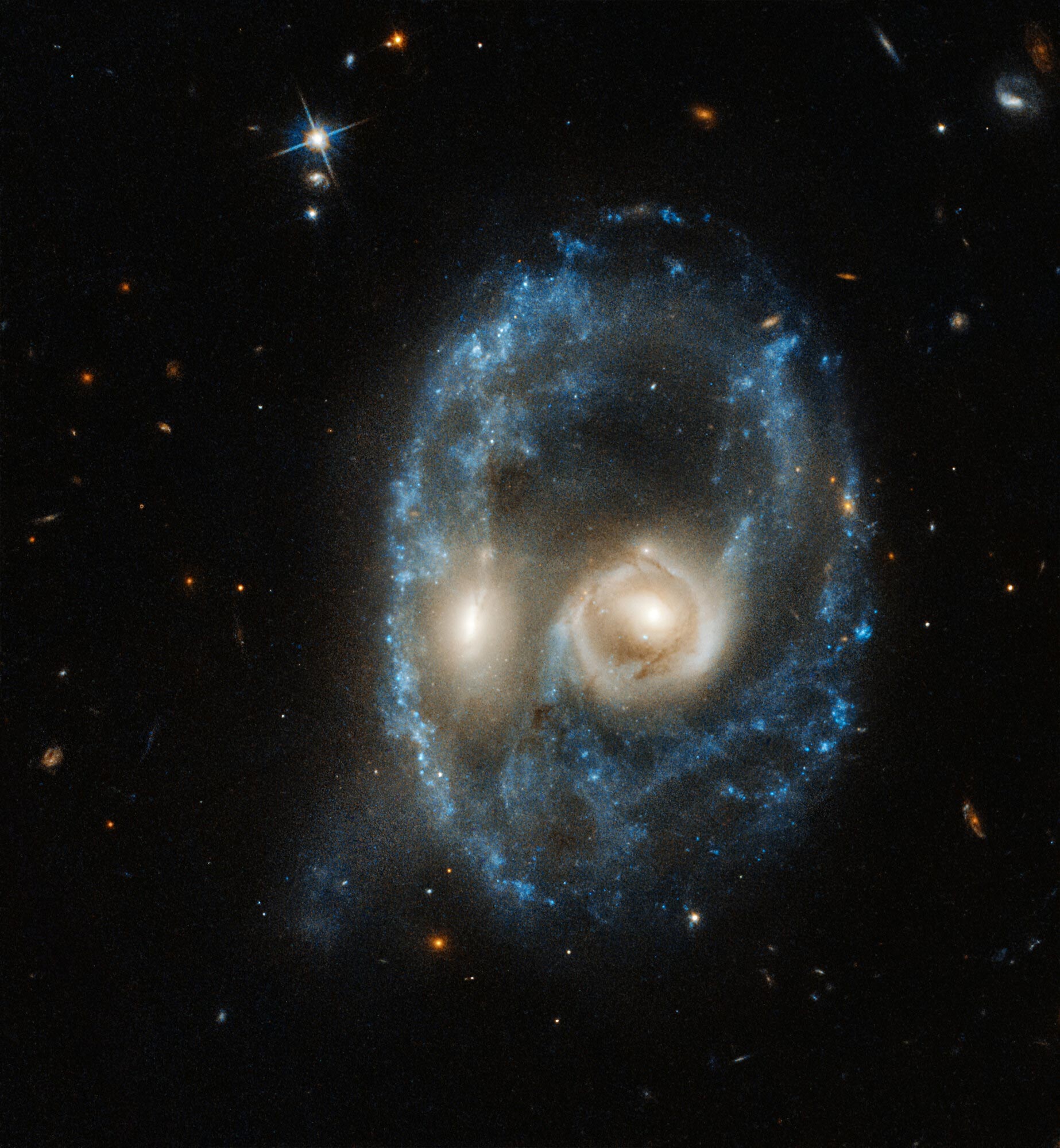
    Hubble Space Telescope Ghostly Face
    This new image from the NASA/ESA Hubble Space Telescope captures two galaxies of equal size in a collision that appears to resemble a ghostly face. This observation was made on 19 June 2019 in visible light by the telescope’s Advanced Camera for Surveys. Residing 704 million light-years from Earth, this system is cataloged as Arp-Madore 2026-424 (AM 2026-424) in the Arp-Madore “Catalogue of Southern Peculiar Galaxies and Associations.”
    Credit: NASA, ESA, J. Dalcanton, B.F. Williams, and M. Durbin (University of Washington)

    In celebration of Halloween, this new image from the NASA/ESA Hubble Space Telescope captures two galaxies of equal size in a collision that appears to resemble a ghostly face. This observation was made on 19 June 2019 in visible light by the telescope’s Advanced Camera for Surveys.

    Although galaxy collisions are common — especially in the early universe — most are not head-on impacts like the collision that likely created this Arp-Madore system 704 million light-years from Earth. This violent encounter gives the system an arresting ring structure, but only for a short amount of time. The crash has pulled and stretched the galaxies’ discs of gas, dust, and stars outward, forming the ring of intense star formation that shapes the “nose” and “face” features of the system.


    This video pans over Arp-Madore 2026-424 (AM 2026-424) as observed by the NASA/ESA Hubble Space Telescope. This image shows the collision of two galaxies of equal size and was taken on 19 June 2019 in visible light by the telescope’s Advanced Camera for Surveys.

    Ring galaxies are rare, and only a few hundred of them reside in our larger cosmic neighborhood. The galaxies have to collide at just the right orientation so that they interact to create the ring, and before long they will have merged completely, hiding their messy past.
    Wide Field View of Arp Madore 2026 424
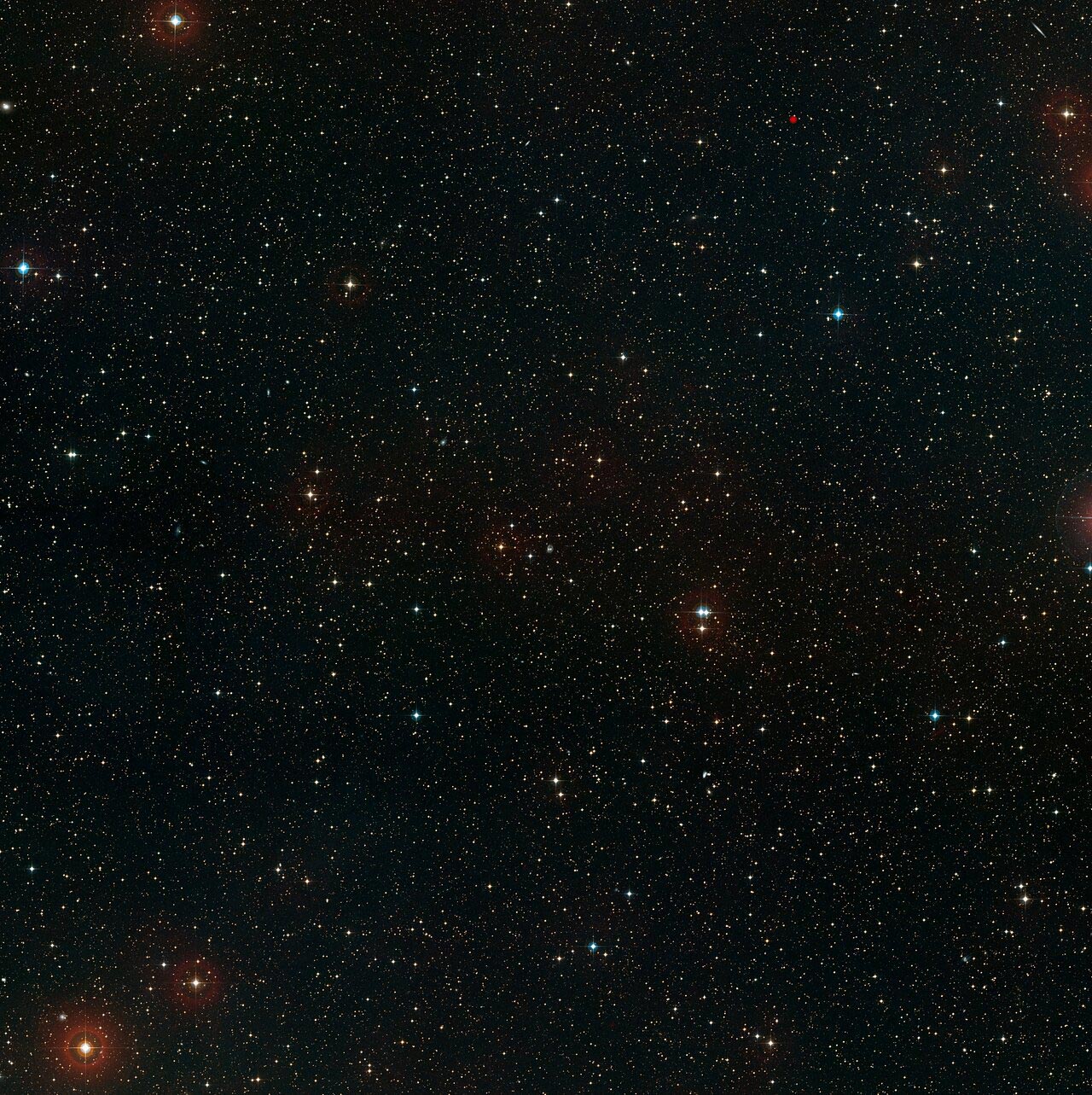
    This image shows a ground-based wide-field view of the region around Arp-Madore 2026-424 from the Digitized Sky Survey 2 Credit: ESA/Digitized Sky Survey 2

    The side-by-side juxtaposition of the two central bulges of stars from the galaxies that we see here is also unusual. Since the bulges that form the “eyes” appear to be the same size, we can be sure that the two galaxies involved in the crash were of equal size. This is different from the more common collisions in which small galaxies are gobbled up by their larger neighbors.

    This galaxy system is cataloged as Arp-Madore 2026-424 (AM 2026-424) in the Arp-Madore “Catalogue of Southern Peculiar Galaxies and Associations”. Astronomer Halton Arp published his compendium of 338 unusual-looking interacting galaxies in 1966. He later partnered with astronomer Barry Madore to extend the search for unique galactic encounters in the southern sky. Several thousand galaxies are listed in this 1987 survey.


    This video gives the viewer a closer look at the Arp-Madore 2026-424 (AM 2026-424) from the NASA/ESA Hubble Space Telescope. This image shows the collision of two galaxies of equal size and was taken on 19 June 2019 in visible light by the telescope’s Advanced Camera for Surveys.

    Hubble observed this unique system as part of a “snapshot” program that takes advantage of occasional gaps in the telescope’s observing schedule to squeeze in additional pictures. Astronomers plan to use this innovative Hubble program to take a close look at many other unusual interacting galaxies. The goal is to compile a robust sample of nearby interacting galaxies, which could offer insights into how galaxies grew over time through galactic mergers. By analyzing these detailed Hubble observations, astronomers will be able to decide which systems are prime targets for follow-up observations by the upcoming NASA/ESA/CSA James Webb Space Telescope, scheduled to launch in 2021.

    Read Astronomers Peer Into Abyss of Space and See Menacing Face Staring Back at Them for more details and another video on this galactic collision.

    The Hubble Space Telescope is a project of international cooperation between ESA and NASA.

    Videos: NASA, ESA, J. Dalcanton, B.F. Williams, and M. Durbin (University of Washington)

    Never miss a breakthrough: Join the SciTechDaily newsletter.
    Follow us on Google and Google News.

    Astronomy European Space Agency Hubble Space Telescope Popular
    Share. Facebook Twitter Pinterest LinkedIn Email Reddit

    Related Articles

    Hubble’s Newest Discovery Isn’t a Star, It’s a Window Into the Dark Universe

    Hubble Views Spiral Galaxy NGC 5793

    Hubble Captures the Best Ever Image of the Antennae Galaxies

    Hubble Captures Face-On Image of Messier 61

    Hubble Views an Ongoing Cosmic Collision

    Hubble Views Newborn Stars in Galaxy IC 5052

    New XDF Image, The Deepest-Ever View of the Universe

    Hubble Zooms in on the Center of M4

    Hubble Image of Peculiar Galaxy Pair Arp 116

    Leave A Reply Cancel Reply

    • Facebook
    • Twitter
    • Pinterest
    • YouTube

    Don't Miss a Discovery

    Subscribe for the Latest in Science & Tech!

    Trending News

    Breakthrough Bowel Cancer Trial Leaves Patients Cancer-Free for Nearly 3 Years

    Natural Compound Shows Powerful Potential Against Rheumatoid Arthritis

    100,000-Year-Old Neanderthal Fossils in Poland Reveal Unexpected Genetic Connections

    Simple “Gut Reset” May Prevent Weight Gain After Ozempic or Wegovy

    2.8 Days to Disaster: Scientists Warn Low Earth Orbit Could Suddenly Collapse

    Common Food Compound Shows Surprising Power Against Superbugs

    5 Simple Ways To Remember More and Forget Less

    The Atomic Gap That Could Cost the Semiconductor Industry Billions

    Follow SciTechDaily
    • Facebook
    • Twitter
    • YouTube
    • Pinterest
    • Newsletter
    • RSS
    SciTech News
    • Biology News
    • Chemistry News
    • Earth News
    • Health News
    • Physics News
    • Science News
    • Space News
    • Technology News
    Recent Posts
    • ADHD Isn’t Just a Deficit: Study Reveals Powerful Hidden Strengths
    • Scientists Uncover “Astonishing” Hidden Property of Light
    • Scientists Discover Stem Cells That Could Regrow Teeth and Bone
    • Scientists Discover Natural Molecule That Stops Alzheimer’s Protein Clumps From Forming
    • Early Cannabis Use May Stall Key Brain Skills in Teens
    Copyright © 1998 - 2026 SciTechDaily. All Rights Reserved.
    • Science News
    • About
    • Contact
    • Editorial Board
    • Privacy Policy
    • Terms of Use

    Type above and press Enter to search. Press Esc to cancel.