
Close Menu
    Facebook X (Twitter) Instagram
    SciTechDaily
    • Biology
    • Chemistry
    • Earth
    • Health
    • Physics
    • Science
    • Space
    • Technology
    Facebook X (Twitter) Pinterest YouTube RSS
    SciTechDaily
    Home»Space»Astronomers Peer Into Abyss of Space and See Menacing Face Staring Back at Them
    Space

    Astronomers Peer Into Abyss of Space and See Menacing Face Staring Back at Them

    By Donna Weaver, Space Telescope Science InstituteOctober 30, 2019No Comments3 Mins Read
    Facebook Twitter Pinterest Telegram LinkedIn WhatsApp Email Reddit
    Share
    Facebook Twitter LinkedIn Pinterest Telegram Email Reddit
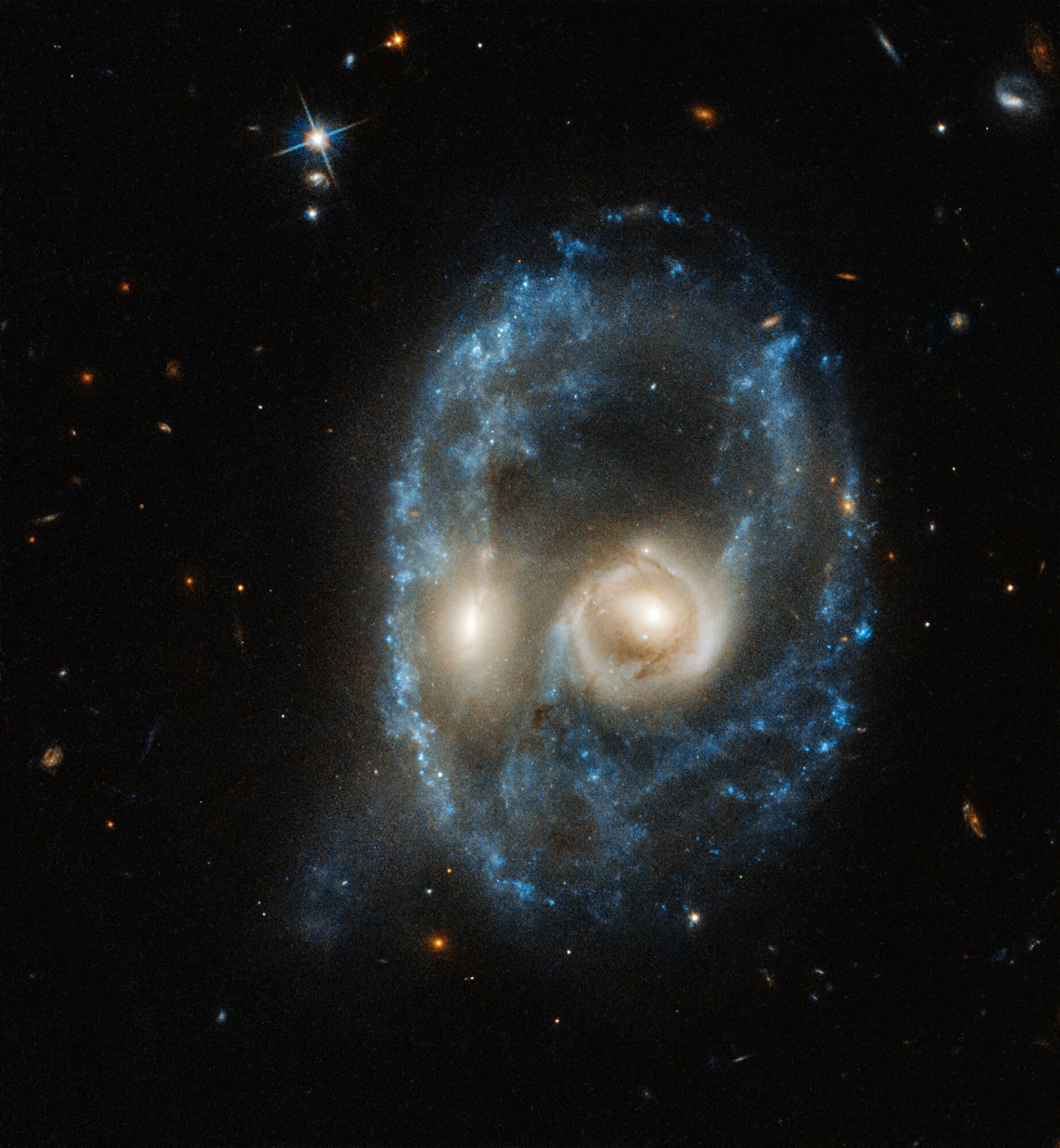
    Hubble Space Telescope Ghostly Face
    This new image from the NASA/ESA Hubble Space Telescope captures two galaxies of equal size in a collision that appears to resemble a ghostly face. This observation was made on June 19, 2019, in visible light by the telescope’s Advanced Camera for Surveys.
    Residing 704 million light-years from Earth, this system is cataloged as Arp-Madore 2026-424 (AM 2026-424) in the Arp-Madore “Catalogue of Southern Peculiar Galaxies and Associations.”
    Credit: NASA, ESA, J. Dalcanton, B.F. Williams, and M. Durbin (University of Washington)

    When astronomers peer deep into space, they don’t expect to find something staring back at them.

    In this new Hubble Space Telescope image, an uncanny pair of glowing eyes glares menacingly in our direction. The piercing “eyes” are the most prominent feature of what resembles the face of an otherworldly creature.

    But this is no ghostly apparition. Hubble is looking at a titanic head-on collision between two galaxies.

    Each “eye” is the bright core of a galaxy, one of which slammed into another. The outline of the face is a ring of young blue stars. Other clumps of new stars form a nose and mouth. The entire system is cataloged as Arp-Madore 2026-424 (AM 2026-424), from the Arp-Madore “Catalogue of Southern Peculiar Galaxies and Associations.”

    Although galaxy collisions are common — especially back in the young universe — most of them are not head-on smashups, like the collision that likely created this Arp-Madore system. The violent encounter gives the system an arresting “ring” structure for only a short amount of time, about 100 million years. The crash pulled and stretched the galaxies’ disks of gas, dust, and stars outward. This action formed the ring of intense star formation that shapes the nose and face.

    Ring galaxies are rare; only a few hundred of them reside in our larger cosmic neighborhood. The galaxies have to collide at just the right orientation to create the ring. The galaxies will merge completely in about 1 to 2 billion years, hiding their messy past.

    The side-by-side juxtaposition of the two central bulges of stars from both galaxies also is unusual. Because the bulges that make the eyes appear to be the same size, it is evident that two galaxies of nearly equal proportions were involved in the crash, rather than more common collisions where small galaxies are gobbled up by their larger neighbors.

    Hubble observed this unique system as part of a “snapshot” program that takes advantage of occasional gaps in the telescope’s observing schedule to squeeze in additional pictures.

    Astronomers plan to use this innovative Hubble program to take a close look at many other unusual interacting galaxies. The goal is to compile a robust sample of nearby interacting galaxies, which could offer insight into how galaxies grew over time through galactic mergers. By analyzing these detailed Hubble observations, astronomers could then choose which systems are prime targets for follow-up with NASA’s James Webb Space Telescope, scheduled to launch in 2021.

    Astronomer Halton Arp published his compendium of 338 unusual-looking interacting galaxies in 1966. He later partnered with astronomer Barry Madore to extend the search for unique galactic encounters in the southern sky. Several thousand galaxies are listed in that survey, published in 1987.

    The Hubble image of AM 2026-424 was taken June 19, 2019, in visible light by the Advanced Camera for Surveys. The system resides 704 million light-years from Earth.

    For more details and videos of this galaxy collision, read Ghostly Cosmic Face Captured by Hubble.

    Never miss a breakthrough: Join the SciTechDaily newsletter.
    Follow us on Google and Google News.

    Astronomy NASA NASA Goddard Space Flight Center Space Telescope Science Institute
    Share. Facebook Twitter Pinterest LinkedIn Email Reddit

    Related Articles

    NASA’s Roman Space Telescope Could Finally Find the Milky Way’s Missing Neutron Stars

    Webb Telescope Uncovers Star Birth Struggles in a Magnetic Maze at the Milky Way’s Core

    The Andromeda Mystery: Hubble Discovers Strange Galactic Behavior

    3.7 Billion Miles Away: Hubble Uncovers a Hidden Trio That Could Rewrite Kuiper Belt History

    Webb Space Telescope Uncovers Star Birth Secrets at Galaxy’s Edge

    Historic Discovery: Twin Titans Clash As NASA Unveils Closest Supermassive Black Hole Duo

    The Great Escape: NASA’s Hubble and MAVEN Help Solve Mystery of Mars’ Vanishing Water

    Astronomers Puzzled After Hubble View of Torrential Outflows From Infant Stars Blows Hole in Current Theories

    Hubble Spots Giant Space “Pumpkin” [Video]

    Leave A Reply Cancel Reply

    • Facebook
    • Twitter
    • Pinterest
    • YouTube

    Don't Miss a Discovery

    Subscribe for the Latest in Science & Tech!

    Trending News

    Stanford Scientists Discover a Remarkable Way To Rescue Dying Corals in Just Seven Weeks

    0 to 15 MPH in a Single Swipe: New Research Reveals How Ancient Giant Sea Monsters Ambushed Their Prey

    Late-Night Snacking Could Be Putting Your Liver at Risk

    40 Years of Superconductor Science Just Got Turned Upside Down by a Stunning Discovery

    A 50-Year-Old Mystery: Scientists Discover What May Have Killed Brazil’s Frogs

    Scientists Discover Exercise Changes the Body in Ways We Never Fully Understood

    Scientists Restore Memory in Mice With Alzheimer’s by Boosting a Single Brain Protein

    Scientists Create “Super Ice” That’s 10 Times Stronger and Rivals Concrete in Strength

    Follow SciTechDaily
    • Facebook
    • Twitter
    • YouTube
    • Pinterest
    • Newsletter
    • RSS
    SciTech News
    • Biology News
    • Chemistry News
    • Earth News
    • Health News
    • Physics News
    • Science News
    • Space News
    • Technology News
    Recent Posts
    • Scientists Discover Ancient Human DNA Hidden in Cave Walls for Thousands of Years
    • Scientists Discover a Hidden Oxygen Source Deep Inside Earth That Could Rewrite Our Planet’s History
    • What if Dark Energy Was Once Negative? Scientists Uncover a Surprising New Possibility
    • Scientists Turn Major Crude Oil Problem Into an Unexpected Energy Breakthrough
    • Ancient Skeletons Reveal a Secret Hidden in Medieval Sicily for 1,000 Years
    Copyright © 1998 - 2026 SciTechDaily. All Rights Reserved.
    • Science News
    • About
    • Contact
    • Editorial Board
    • Privacy Policy
    • Terms of Use

    Type above and press Enter to search. Press Esc to cancel.