
Close Menu
    Facebook X (Twitter) Instagram
    SciTechDaily
    • Biology
    • Chemistry
    • Earth
    • Health
    • Physics
    • Science
    • Space
    • Technology
    Facebook X (Twitter) Pinterest YouTube RSS
    SciTechDaily
    Home»Earth»Giant Croc-Like Carnivores Terrorized Triassic Dinosaurs 210 Million Years Ago
    Earth

    Giant Croc-Like Carnivores Terrorized Triassic Dinosaurs 210 Million Years Ago

    By University of the WitwatersrandSeptember 24, 2019No Comments3 Mins Read
    Facebook Twitter Pinterest Telegram LinkedIn WhatsApp Email Reddit
    Share
    Facebook Twitter LinkedIn Pinterest Telegram Email Reddit
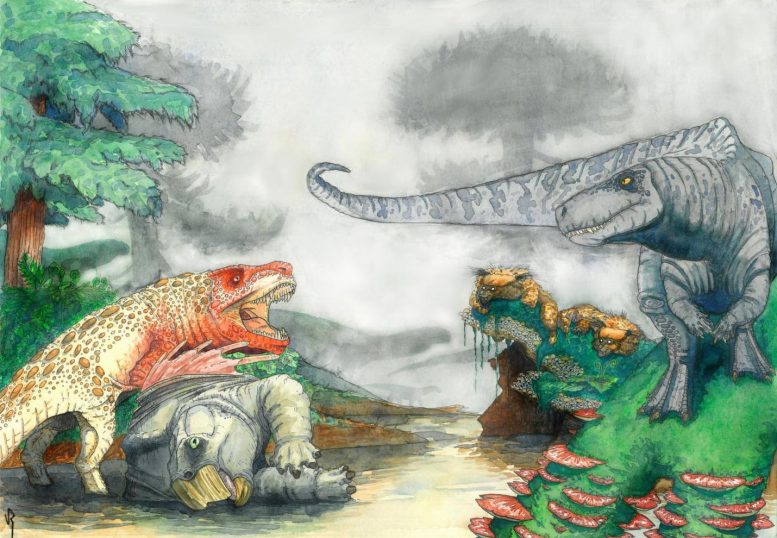
    Two Rauisuchians Fighting
    Artist’s reconstruction of two rauisuchians fighting over a desiccated corpse of a mammal-relative in the Triassic of southern Africa. In the background, dinosaurs and mammal-like reptiles form other parts of the ecosystem. Credit: Viktor Radermacher

    Rauisuchians fed on vegetarian dinosaurs according to Wits student Rick Tolchard.

    Gigantic, predatory croc-like animals that lived during the Triassic period in southern Africa preyed on early dinosaurs and mammal relatives 210 million years ago. These predators, known as “rauisuchians” preyed on early herbivore dinosaurs and their mammal relatives living at the time, according to Wits Masters student Rick Tolchard.

    “These ancient fossils provide us with evidence of how at least two predator species hunted these vegetarian dinosaurs 210 million years ago. It is amazing to follow the clues left behind in fossilized teeth, jaws, limbs, and other fossils to help us tell the ancient story of life in southern Africa,” says Tolchard.

    The fossils studied by Tolchard include teeth, pieces of jaws, hind limbs, and body armor, all of which can be described as parts of rauisuchians.  
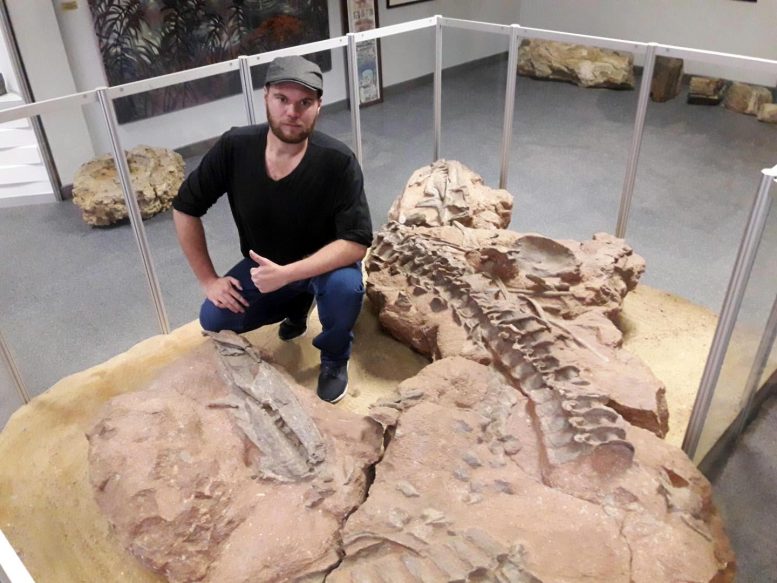
    Rick Tolchard
    Rick Tolchard studying rauisuchians in the Geological Survey in Namibia. Credit: Helke Mocke

    Rauisuchians are closely related to crocodiles as we know them today. They had a diversity of body shapes and sizes during the Triassic period. The specimens described in this research include some of the largest carnivorous members of this group, that were possibly up to 10 meters (33 feet) long, with huge skulls full of serrated, curved teeth.

    The study, published online in the Journal of African Earth Sciences last week, shows that the rauisuchians were some of the latest-surviving members of their group, and that when they were alive, they were thriving close to the Antarctic Circle – the theoretical limit for their physiology.
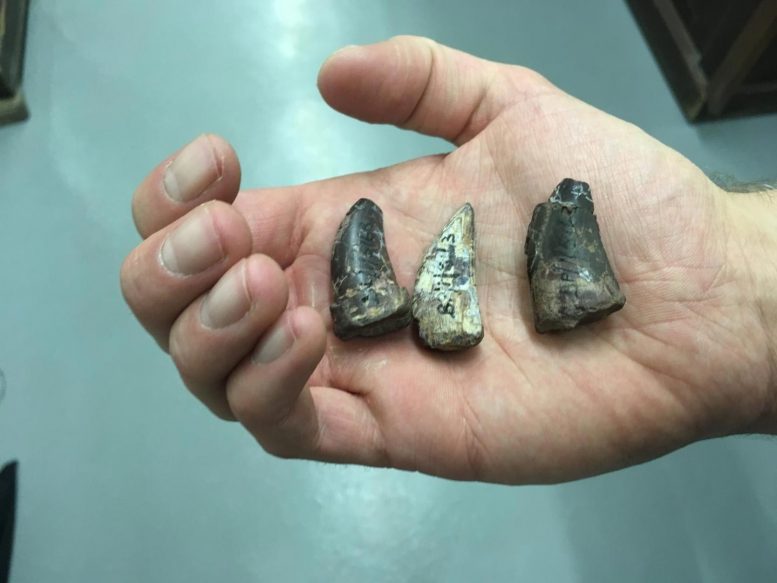
    Rauisuchian Teeth
    Example of rauisuchian teeth in the Wits collections. Credit: Wits University

    “In the Triassic period, rauisuchians were widespread and their fossils are known from all continents except Antarctica,” adds Tolchard. “They went extinct about 200 million years ago, paving the way for dinosaurs to become the dominant large land animals.”

    “Rick’s study demonstrates the value of re-examining old specimens, and now we finally know what was preying on all those herbivorous dinosaurs!” says Professor Jonah Choiniere, Rick’s advisor and Professor of Comparative Palaeobiology at the Wits Evolutionary Studies Institute.

    Tolchard studied fossils from collections based at the University of the Witwatersrand, the Iziko South African Museum, and the National Museum in Bloemfontein. He was joined in the research by an international team, including researchers from the USA, Argentina, and the UK.

    Reference: “‘Rauisuchian’ material from the lower Elliot Formation of South Africa and Lesotho: Implications for Late Triassic biogeography and biostratigraphy” by Frederick Tolchard, Sterling J. Nesbitt, Julia B. Desojo, Pia Vigliettie, Richard J. Butler and Jonah N.Choiniere, 27 August 2019, Journal of African Earth Sciences.
    DOI: 10.1016/j.jafrearsci.2019.103610

    Never miss a breakthrough: Join the SciTechDaily newsletter.
    Follow us on Google and Google News.

    Dinosaurs Fossils Triassic University of The Witwatersrand
    Share. Facebook Twitter Pinterest LinkedIn Email Reddit

    Related Articles

    252-Million-Year-Old Fossils Reveal Secrets of Triassic Life

    Ancient Predator Unearthed in Nevada Rewrites Triassic Coastal Life Story

    Story of Dinosaur Evolution and Ecology Rewritten After Unambiguous Fossil Evidence Discovered

    Dinosaur Footprints Suggest That Jurassic Beasts Trotted Between Africa and Europe

    Cretaceous Period Sankofa Pyrenaica Fossilized Eggs Are Unusually Shaped

    Microraptor Feathers Were Black With Iridescent Sheen

    Jurassic Period Super-Sized Fleas Had Armored Mouthparts to Attack the Thick Hide of Dinosaurs

    Drexel University Researchers to 3D-Print Dinosaur Bones

    Nest of Juvenile Protoceratops Andrewsi Dinosaurs Discovered

    Leave A Reply Cancel Reply

    • Facebook
    • Twitter
    • Pinterest
    • YouTube

    Don't Miss a Discovery

    Subscribe for the Latest in Science & Tech!

    Trending News

    Your Blood Pressure Reading Could Be Wrong Because of One Simple Mistake

    Astronomers Stunned by Ancient Galaxy With No Spin

    Physicists May Be on the Verge of Discovering “New Physics” at CERN

    Scientists Solve 320-Million-Year Mystery of Reptile Skin Armor

    Scientists Say This Daily Walking Habit May Be the Secret to Keeping Weight Off After Dieting

    New Therapy Rewires the Brain To Restore Joy in Depression Patients

    Giant Squid Detected off Western Australia in Stunning Deep-Sea Discovery

    Popular Sugar-Free Sweetener Linked to Liver Disease, Study Warns

    Follow SciTechDaily
    • Facebook
    • Twitter
    • YouTube
    • Pinterest
    • Newsletter
    • RSS
    SciTech News
    • Biology News
    • Chemistry News
    • Earth News
    • Health News
    • Physics News
    • Science News
    • Space News
    • Technology News
    Recent Posts
    • Scientists Say a 40-Year-Old Childhood Obesity Warning May Be Completely Wrong
    • Marijuana Use May Raise Lung Cancer Risk, Researchers Warn
    • This Common Type of Food May Be Raising Your Risk of Heart Disease
    • Fur Seals’ Hearts Suddenly Spike Hours After Returning to Land
    • Scientists Say Cognitive Decline Isn’t Inevitable — Your Brain Can Improve at Any Age
    Copyright © 1998 - 2026 SciTechDaily. All Rights Reserved.
    • Science News
    • About
    • Contact
    • Editorial Board
    • Privacy Policy
    • Terms of Use

    Type above and press Enter to search. Press Esc to cancel.