
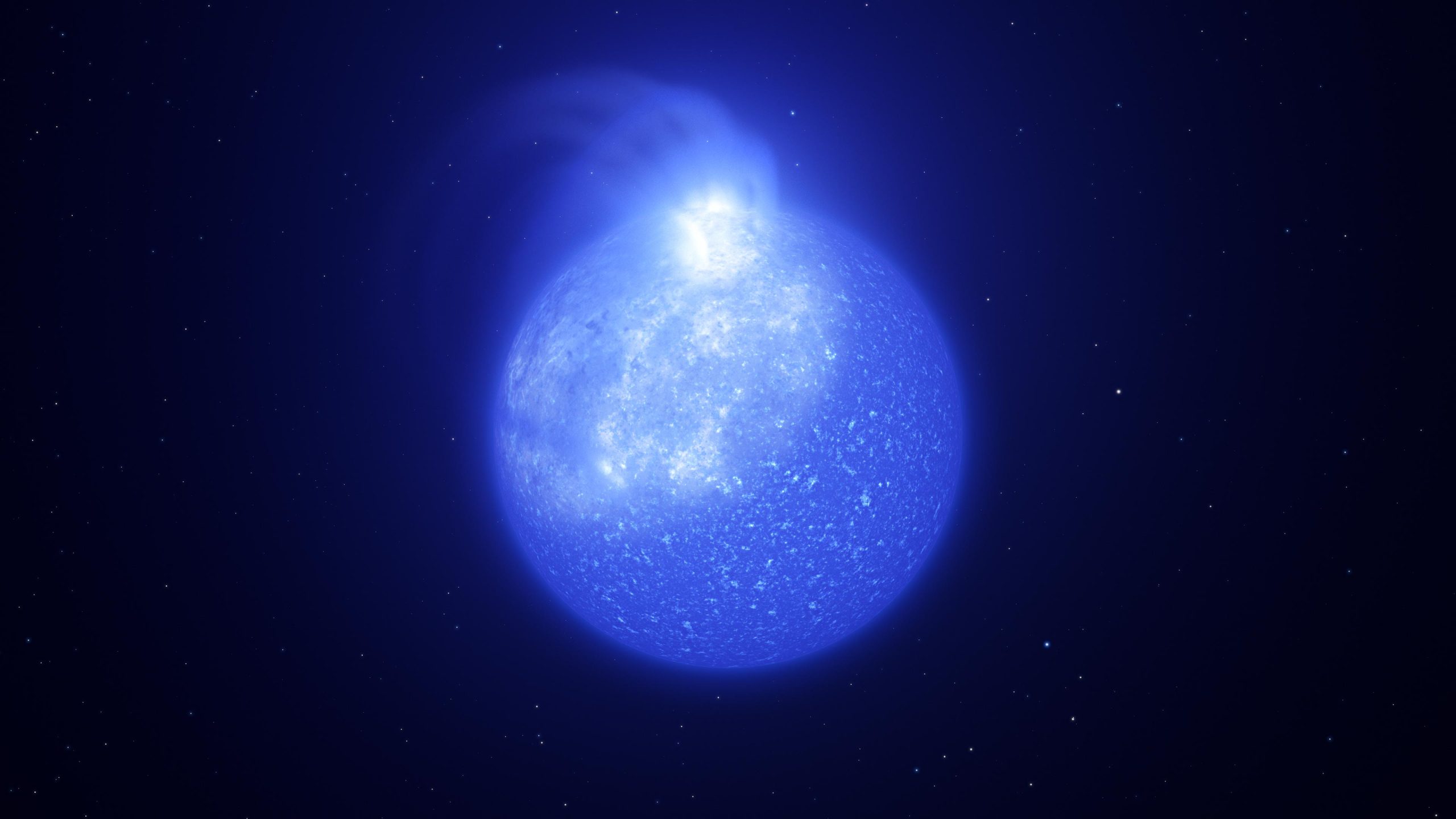
Astronomers using European Southern Observatory (ESO) telescopes have discovered giant spots on the surface of extremely hot stars hidden in stellar clusters. Not only are these stars plagued by magnetic spots, some also experience superflare events, explosions of energy several million times more energetic than similar eruptions on the Sun. The findings, published today in Nature Astronomy, help astronomers better understand these puzzling stars and open doors to resolving other elusive mysteries of stellar astronomy.
Astronomers using ESO telescopes have discovered giant spots on the surface of extremely hot stars hidden in stellar clusters. This video offers a summary of the discovery. Credit: ESO
The team, led by Yazan Momany from the INAF Astronomical Observatory of Padua in Italy, looked at a particular type of star known as extreme horizontal branch stars — objects with about half the mass of the Sun but four to five times hotter. “These hot and small stars are special because we know they will bypass one of the final phases in the life of a typical star and will die prematurely,” says Momany, who was previously a staff astronomer at ESO’s Paranal Observatory in Chile. “In our Galaxy, these peculiar hot objects are generally associated with the presence of a close companion star.”
Surprisingly, however, the vast majority of these extreme horizontal branch stars, when observed in tightly packed stellar groups called globular clusters, do not appear to have companions. The team’s long-term monitoring of these stars, made with ESO telescopes, also revealed that there was something more to these mysterious objects. When looking at three different globular clusters, Momany and his colleagues found that many of the extreme horizontal branch stars within them showed regular changes in their brightness over the course of just a few days to several weeks.
“After eliminating all other scenarios, there was only one remaining possibility to explain their observed brightness variations,” concludes Simone Zaggia, a study co-author from the INAF Astronomical Observatory of Padua in Italy and a former ESO Fellow: “these stars must be plagued by spots!”
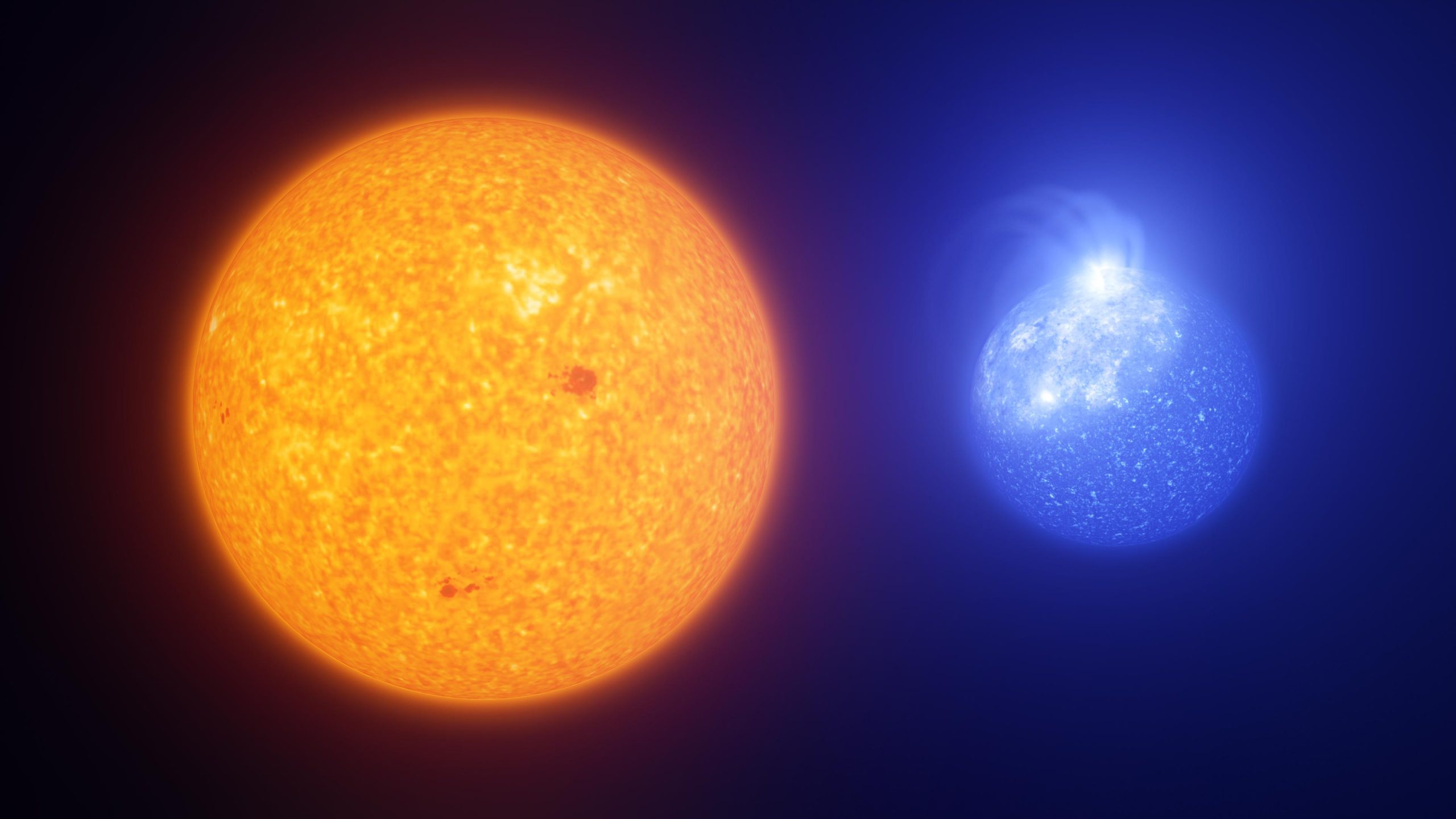
Spots on extreme horizontal branch stars appear to be quite different from the dark sunspots on our own Sun, but both are caused by magnetic fields. The spots on these hot, extreme stars are brighter and hotter than the surrounding stellar surface, unlike on the Sun where we see spots as dark stains on the solar surface that are cooler than their surroundings. The spots on extreme horizontal branch stars are also significantly larger than sunspots, covering up to a quarter of the star’s surface. These spots are incredibly persistent, lasting for decades, while individual sunspots are temporary, lasting only a few days to months. As the hot stars rotate, the spots on the surface come and go, causing the visible changes in brightness.
Astronomers using ESO telescopes have discovered giant spots on the surface of extremely hot stars hidden in stellar clusters, called extreme horizontal branch stars. This animation shows what one of these stars, and its giant whitish spot, might look like. The spot is bright, takes up a quarter of the star’s surface and is caused by magnetic fields. As the star rotates, the spot on its surface comes and goes, causing visible changes in brightness. Note that the movement does not represent the rotation of the star: it mimics the movement of a camera observing the star up close. Credit: ESO/L. Calçada, INAF-Padua/S. Zaggia
Beyond the variations in brightness due to spots, the team also discovered a couple of extreme horizontal branch stars that showed superflares — sudden explosions of energy and another signpost of the presence of a magnetic field. “They are similar to the flares we see on our own Sun, but ten million times more energetic,” says study co-author Henri Boffin, an astronomer at ESO’s headquarters in Germany. “Such behavior was certainly not expected and highlights the importance of magnetic fields in explaining the properties of these stars.”
After six decades of trying to understand extreme horizontal branch stars, astronomers now have a more complete picture of them. Moreover, this finding could help explain the origin of strong magnetic fields in many white dwarfs, objects that represent the final stage in the life of Sun-like stars and show similarities to extreme horizontal branch stars. “The bigger picture though,” says team member, David Jones, a former ESO Fellow now at the Instituto de Astrofísica de Canarias, Spain, “is that changes in brightness of all hot stars — from young Sun-like stars to old extreme horizontal branch stars and long-dead white dwarfs — could all be connected. These objects can thus be understood as collectively suffering from magnetic spots on their surfaces.”
Spots on extreme horizontal branch stars (right) appear to be quite different from the dark sunspots on our own Sun (left), but both are caused by magnetic fields. The spots on these hot, extreme stars are brighter and hotter than the surrounding stellar surface, unlike on the Sun where we see spots as dark stains on the solar surface that are cooler than their surroundings. The spots on extreme horizontal branch stars are also significantly larger than sunspots, covering up to a quarter of the star’s surface. While sunspots vary in size, a typical size is around an Earth-size planet, 3000 smaller than a giant spot on an extreme horizontal branch star. Credit: ESO/L. Calçada, INAF-Padua/S. Zaggia
To arrive at this result, the astronomers used several instruments on ESO’s Very Large Telescope (VLT), including VIMOS, FLAMES and FORS2, as well as OmegaCAM attached to the VLT Survey Telescope at Paranal Observatory. They also employed ULTRACAM on the New Technology Telescope at ESO’s La Silla Observatory, also in Chile. The breakthrough came as the team observed the stars in the near-ultraviolet part of the spectrum, allowing them to reveal the hotter, extreme stars standing out bright amongst the cooler stars in globular clusters.
Reference: “A plague of magnetic spots among the hot stars of globular clusters” by Y. Momany, S. Zaggia, M. Montalto, D. Jones, H. M. J. Boffin, S. Cassisi, C. Moni Bidin, M. Gullieuszik, I. Saviane, L. Monaco, E. Mason, L. Girardi, V. D’Orazi, G. Piotto, A. P. Milone, H. Lala, P. B. Stetson and Y. Beletsky, 1 June 2020, Nature Astronomy.
DOI: 10.1038/s41550-020-1113-4
The team is composed of Y. Momany (INAF Astronomical Observatory of Padua, Italy [INAF Padua]), S. Zaggia (INAF Padua), M. Montalto (Department of Physics and Astronomy, University of Padua, Italy [U. Padua]), D. Jones (Instituto de Astrofísica de Canarias and Department of Astrophysics, University of La Laguna, Tenerife, Spain), H.M.J. Boffin (European Southern Observatory, Garching, Germany, S. Cassisi (INAF Astronomical Observatory of Abruzzo and INFN Pisa, Italy), C. Moni Bidin (Instituto de Astronomia, Universidad Catolica del Norte, Antofagasta, Chile), M. Gullieuszik (INAF Padua), I. Saviane (European Southern Observatory, Santiago, Chile), L. Monaco (Departamento de Ciencias Fisicas, Universidad Andreas Bello, Santiago, Chile), E. Mason (INAF Astronomical Observatory of Trieste, Italy), L. Girardi (INAF Padua), V. D’Orazi (INAF Padua), G. Piotto (U. Padua), A.P. Milone (U. Padua), H. Lala (U. Padua), P.B. Stetson (Herzberg Astronomy and Astrophysics, National Research Council, Victoria, Canada), and Y. Beletsky (Las Campanas Observatory, Carnegie Institution of Washington, La Serena, Chile).
Never miss a breakthrough: Join the SciTechDaily newsletter.
Follow us on Google and Google News.