

New data reveal major geographic disparities and highlight the urgent need for global action on prevention, early detection, and equitable access to treatment.
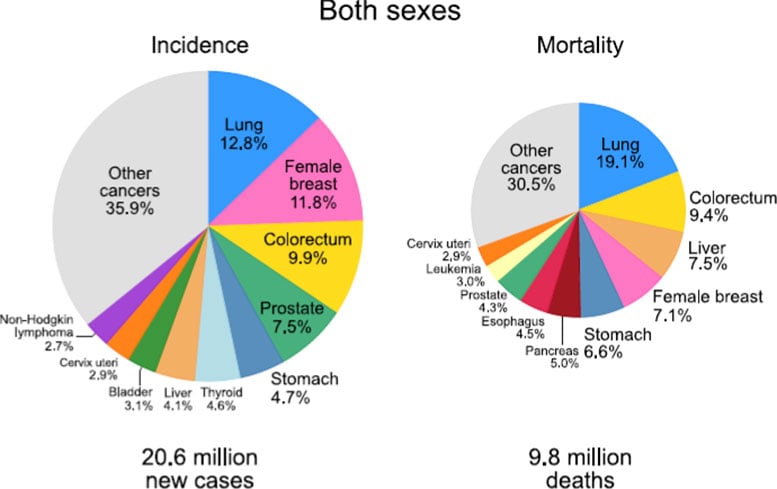
For roughly one in five people worldwide, cancer will become part of their lifetime. Global Cancer Statistics, 2026 estimates that nearly 21 million people were diagnosed with cancer in 2024 and 9.8 million died from the disease.
About 1 in 9 men and 1 in 13 women are expected to die from cancer, while annual cases are projected to reach 34 million by 2050, a 67% increase driven solely by population growth and aging.
The report was produced by researchers at the American Cancer Society (ACS) and the International Agency for Research on Cancer (IARC), the cancer agency of the World Health Organization (WHO). The study was published in CA: A Cancer Journal for Clinicians, the flagship journal of ACS.
“Cancer is one of the greatest public health challenges of the 21st century and a major barrier to increasing life expectancy worldwide. Understanding the magnitude and geographic distributions of the disease is essential to guide effective and equitable prevention and control efforts,” said Dr. Hyuna Sung, senior principal scientist, cancer surveillance at the American Cancer Society and lead author of the report.
“While the scale of the cancer burden and the stark geographic disparities are sobering, they also point to a tremendous opportunity. Nearly half of all cancer deaths are estimated to be avoidable through potentially modifiable risk factors and an additional substantial proportion of cancer deaths can be prevented through early detection and timely treatment.”
Global data reveal stark inequalities
To build a worldwide picture of cancer, the researchers used 2024 estimates from GLOBOCAN, an IARC database covering cancer incidence and mortality for 34 cancer types of cancer across 186 countries. They compared national patterns by region and Human Development Index, then projected the burden through 2050 using demographic trends.
Where people live shapes cancer survival
Cancer incidence varied by approximately four- to fivefold across regions, with the highest rates recorded in Australia and New Zealand and the lowest in parts of Africa and South-Central Asia. Cancer mortality differed by about twofold, reaching its highest levels among men in Eastern Europe and women in Melanesia. Lung cancer remained the leading cancer worldwide for both diagnoses and deaths, largely because of tobacco use, accounting for nearly 2.6 million new cases and 1.9 million deaths in 2024.
Female breast cancer ranked second globally by incidence, with 2.4 million new cases and 694,000 deaths, and it remained the leading cancer among women for both diagnoses and mortality. Notably, women in Western Africa were twice as likely to die from breast cancer as women in Australia and New Zealand despite having only half the incidence rate, underscoring major inequalities in access to diagnosis and treatment.
Colorectal cancer ranked third in new diagnoses and second in cancer deaths, with more than 2 million cases and 918,000 deaths, while liver cancer caused 843,000 new cases and 732,000 deaths, making it the third leading cause of cancer mortality.
Prostate cancer was the second most frequently diagnosed cancer among men and the fourth leading cause of cancer death, with 1.5 million new cases and 420,000 deaths. Mortality was especially high in the Caribbean and Sub-Saharan Africa, where prostate cancer is often the leading cause of cancer death among men. Stomach cancer accounted for about 980,000 new cases and 642,000 deaths, ranking fifth for both incidence and mortality, with the highest rates in Eastern Asia.
Cervical cancer, although largely preventable through HPV vaccination and screening, remained the leading cause of cancer death among women in 26 countries, mainly in sub-Saharan Africa and parts of South and Central America. Pancreatic cancer caused 491,000 deaths, ranking sixth in mortality despite placing only 11th in incidence. Thyroid cancer, meanwhile, accounted for nearly 1 million new cases worldwide, making it the sixth most commonly diagnosed cancer.
Prevention could avert many deaths
“Every region faces different cancer challenges, so every country needs a unique plan to mitigate the growing burden of cancer. However, cancer prevention must be every country’s top priority,” said Dr. Ahmedin Jemal, senior vice president of surveillance & health equity science at the American Cancer Society and co-author of the study. “We must intensify efforts to help people quit tobacco use, avoid cancer-linked infections, abstain from alcohol, maintain a healthy weight, and get more daily exercise.”
Reference: “Global cancer statistics 2024: GLOBOCAN estimates of incidence and mortality worldwide for 34 cancers in 186 countries” by Hyuna Sung, Adalberto M. Filho, Mathieu Laversanne, Jacques Ferlay, Rebecca L. Siegel, Isabelle Soerjomataram, Ahmedin Jemal and Freddie Bray, 8 July 2026, CA: A Cancer Journal for Clinicians.
DOI: 10.3322/caac.70090
Never miss a breakthrough: Join the SciTechDaily newsletter.
Follow us on Google and Google News.