

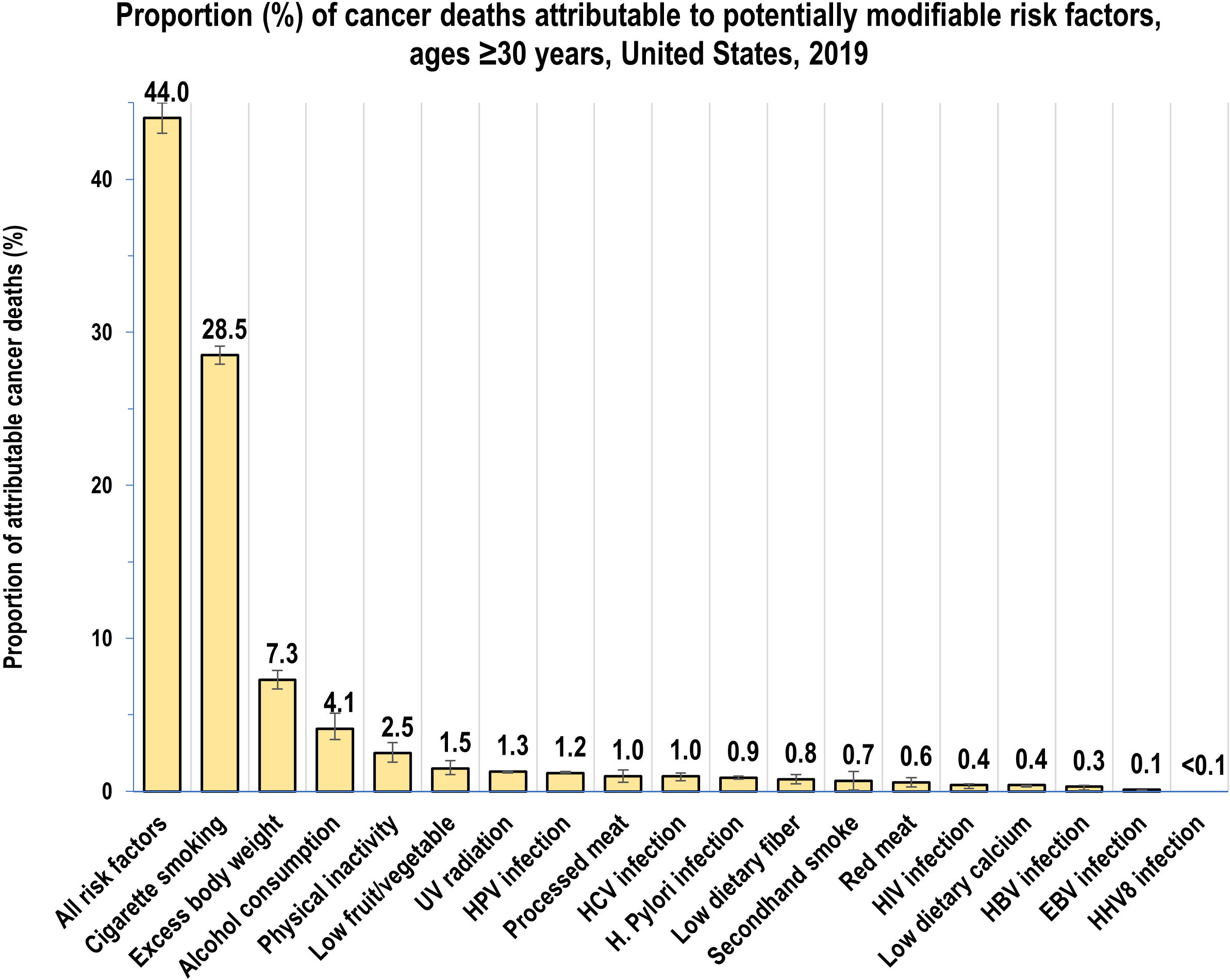
New research finds that modifiable risk factors, especially smoking, are responsible for 40% of cancer cases and 50% of cancer deaths in U.S. adults over 30, emphasizing the need for enhanced tobacco control, obesity management, and preventive healthcare measures.
A recent study by the American Cancer Society (ACS) indicates that 40% of cancer cases and about 50% of cancer deaths among adults aged 30 and older in the United States, amounting to 713,340 cases and 262,120 deaths in 2019, could be linked to preventable risk factors. These include cigarette smoking, excessive body weight, alcohol intake, lack of physical activity, poor diet, and infections. Notably, cigarette smoking is the predominant risk factor, accounting for nearly 20% of all cancer cases and 30% of all cancer deaths. The study was published in the journal CA: A Cancer Journal for Clinicians.
“Despite considerable declines in smoking prevalence during the past few decades, the number of lung cancer deaths attributable to cigarette smoking in the United States is alarming. This finding underscores the importance of implementing comprehensive tobacco control policies in each state to promote smoking cessation, as well as heightened efforts to increase screening for early detection of lung cancer, when treatment could be more effective,” said Dr. Farhad Islami, senior scientific director, cancer disparity research at the American Cancer Society and lead author of the report.
“Interventions to help maintain healthy body weight and diet can also substantially reduce the number of cancer cases and deaths in the country, especially given the increasing incidence of several cancer types associated with excess body weight, particularly in younger individuals.”
Research Methodology and Detailed Results
In this study, researchers used nationally representative data on cancer incidence and mortality and risk factor prevalence to estimate the proportion and number of cancer cases and deaths attributable to potentially modifiable risk factors overall (excluding non-melanoma skin cancers) and for 30 cancer types. These risk factors included cigarette smoking (current and former smoking); secondhand smoke; excess body weight; alcohol consumption; consumption of red and processed meat; low consumption of fruits and vegetables, dietary fiber, and dietary calcium; physical inactivity; ultraviolet (UV) radiation; and infection with Epstein-Barr virus (EBV), Helicobacter pylori, hepatitis B virus (HBV), hepatitis C virus (HCV), human herpes virus-8 (HHV-8; also called Kaposi sarcoma herpesvirus), human immunodeficiency virus (HIV), and human papillomavirus (HPV).
The results showed cigarette smoking had the largest population-attributable fraction (PAF) or proportion of cancer cases attributable to risk factors in the population (344,070 cases; 19.3% of all cases), contributing to 56.0% of all potentially preventable cancers in men (206,550 of 368,600) and 39.9% in women (137,520 of 344,740). Excess body weight had the second largest PAF (7.6%), followed by alcohol consumption (5.4%), UV radiation exposure (4.6%), and physical inactivity (3.1%).
By cancer type, the proportion of cases caused by potentially modifiable risk factors ranged from 100% for cervical cancer and Kaposi sarcoma to 4.9% for ovarian cancer and exceeded 50% for 19 of 30 evaluated cancer types. In addition to cervical cancer and Kaposi sarcoma, more than 80% of all melanomas of the skin (92.2%) and cancers of the anus (94.2%), larynx (89.9%), lung and bronchus (lung; 88.2%), pharynx (87.4%), trachea (85.6%), esophagus (85.4%), and oral cavity (83.7%) were attributable to evaluated risk factors. Lung cancer had the largest number of cases attributable to evaluated risk factors in both men (104,410 cases) and women (97,250), followed by skin melanoma (50,570), colorectal cancer (44,310), and urinary bladder cancer (32,000) in men and by breast (83,840), corpus uteri (35,790), and colorectal (34,130) cancer in women.
“These findings show there is a continued need to increase equitable access to preventive health care and awareness about preventive measures. Effective vaccines are available for hepatitis B virus, that causes liver cancer and HPV, which can cause several cancer types, including cervical, other anogenital, and oropharyngeal cancers,” added Dr. Ahmedin Jemal, senior vice president, surveillance and health equity science at the American Cancer Society and senior author of the study.
“Vaccination at the recommended time can substantially reduce the risk of chronic infection, and consequently, cancers associated with these viruses. HPV vaccination uptake in the United States is suboptimal.”
Reference: “Proportion and number of cancer cases and deaths attributable to potentially modifiable risk factors in the United States, 2019” by Farhad Islami, Emily C. Marlow, Blake Thomson, Marjorie L. McCullough, Harriet Rumgay, Susan M. Gapstur, Alpa V. Patel, Isabelle Soerjomataram and Ahmedin Jemal, 11 July 2024, CA: A Cancer Journal for Clinicians.
DOI: 10.3322/caac.21858
Never miss a breakthrough: Join the SciTechDaily newsletter.
Follow us on Google and Google News.
2 Comments
I am a medical anthropologist breast cancer researcher and co-author of Dressed to Kill: The Link Between Breast Cancer and Bras. For over 30 years, the ACS has been lying about this issue, which is a medical cover-up. Note that tight clothing is not included as a lifestyle factor for cancer. However, medicine knows that tight clothing interferes with the lymphatic system, and that the lymphatic system is responsible for immune function, and that impairing the lymphatics increases cancer incidence. However, they will not connect the dots and say that tight clothing can increase cancer incidence. The fact is, numerous studies around the world show a bra-cancer link. But the ACS will deny these studies exist, and only mention one biased study designed deliberately to “disprove” the link, and that study, done in 2014 at Fred Hutchinson Cancer Research Center, did not include any bra-free control group, and only using women over 55 who were lifetime bra users. That’s like studying lung cancer while ignoring smoking.
The problem is that tight clothing is a biomechanical issue, and cancer research is focused on biochemical issues to create drugs. The medical industry does not want to challenge the fashion industry and alienate women who want bras. Also, there is no money in letting women know that they are giving themselves breast pain, cysts, and cancer by wearing tight bras for long hours daily. And it casts doubt on all the breast cancer research and treatment advice that has ignored bra usage, including tightness and hours worn daily, which is more significant than family history as a risk factor.
Bra-free women have about the same risk of breast cancer as men, while the tighter and longer the bra is worn the higher the risk rises, to over 100 times higher for a 24/7 bra user compared to a bra-free women.
For references, see my article, What Breast Cancer Inc. Doesn’t Want you to Know about Bras. https://www.academia.edu/112861509/What_Breast_Cancer_Inc_Doesnt_Want_You_to_Know_about_Bras
And see my article, Medicine’s Clothing Problem.
https://www.academia.edu/121560525/Medicines_Clothing_Problem
I am a 60+ woman with 38C bra size. I’ve been wearing underwire bras for 40 years. Now I am dealing with several melanoma all along the line of the underwire. There is no doubt that the underwire is directly related to these melanoma. There are no other melanoma on my body.