
WHO researchers have found that alcohol use is a major contributor to cancer risk globally, even at light to moderate levels of consumption.
A new study from the World Health Organization’s (WHO) International Agency for Research on Cancer (IARC), published in the journal Lancet Oncology, has found an association between alcohol and a substantially higher risk of several forms of cancer, including breast, colon, and oral cancers. Increased risk was evident even among light to moderate drinkers (up to two drinks a day), who represented 1 in 7 of all new cancers in 2020 and more than 100,000 cases worldwide.
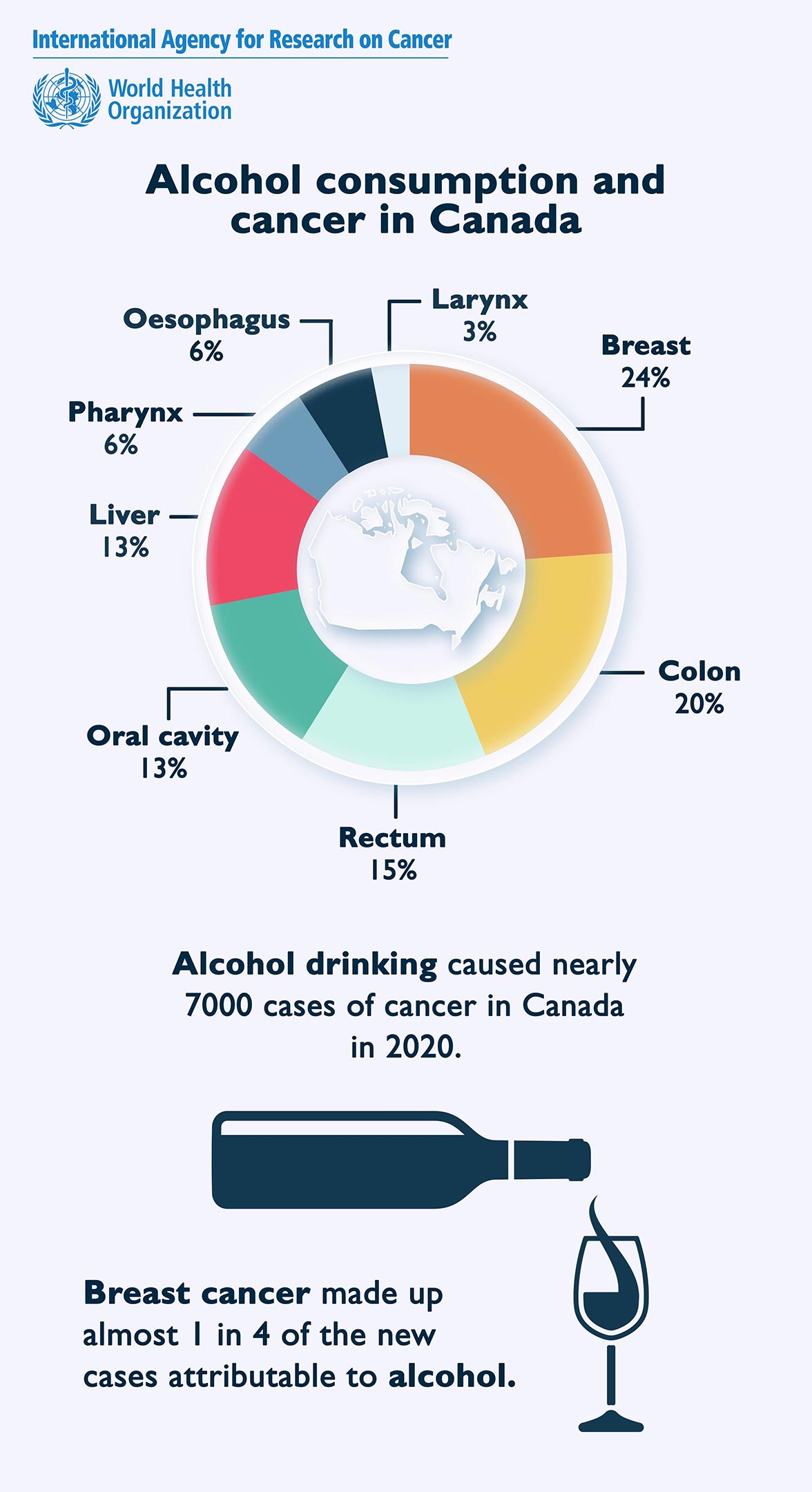
In Canada, alcohol use was linked to 7,000 new cases of cancer in 2020, including 24 percent of breast cancer cases, 20 percent of colon cancers, 15 percent of rectal cancers, and 13 percent of oral and liver cancers.
Risk Evident Even With Light Drinking
“All drinking involves risk,” said study co-author Dr. Jürgen Rehm, Senior Scientist, Institute for Mental Health Policy Research and Campbell Family Mental Health Research Institute at CAMH. “And with alcohol-related cancers, all levels of consumption are associated with some risk. For example, each standard-sized glass of wine per day is associated with a 6 percent higher risk for developing female breast cancer.”
“Alcohol consumption causes a substantial burden of cancer globally,” said Dr. Isabelle Soerjomataram, Deputy Branch Head, Cancer Surveillance Branch at IARC. “Yet the impact on cancers is often unknown or overlooked, highlighting the need for implementation of effective policy and interventions to increase public awareness of the link between alcohol use and cancer risk, and decrease overall alcohol consumption to prevent the burden of alcohol-attributable cancers.”
Dr. Leslie Buckley, CAMH Chief of Addictions, added: “In our clinic we are seeing many people who report increased alcohol use since the onset of the pandemic. Although this may be related to temporary stressors, there is a potential for new habits to become more permanent. The consequences with alcohol use are often subtle harms initially that take time to show themselves, while long-term consequences such as cancer, liver disease, and substance use disorder can be devastating.”
Global Modeling Shows Alcohol’s DNA Damage Mechanism
The modeling study was based on data on alcohol exposure from almost all countries of the world, both surveys and sales figures, which were combined with the latest relative risk estimates for cancer based on level of consumption.
“Alcohol causes cancer in numerous ways,” explained Dr. Kevin Shield, Independent Scientist, Institute for Mental Health Policy Research, and study co-author. “The main mechanism of how alcohol causes cancer is through impairing DNA repair. Additional pathways include chronic alcohol consumption resulting in liver cirrhosis, and alcohol leading to a dysregulation of sex hormones, leading to breast cancer. Alcohol also increases the risk of head and neck cancer for smokers as it increases the absorption of carcinogens from tobacco.”
Policy Gaps and Recommendations to Reduce Harm
Dr. Rehm says research into the link between light to moderate drinking and cancer is relatively new and that public policy does not yet reflect the degree of cancer risk. He added, “As an epidemiologist, I would recommend higher taxes to fully reflect the burden of disease from alcohol. Along with limiting the physical availability and marketing of alcohol, price controls are recognized as high-impact, cost-effective measures to reduce alcohol-related harm.” Governments can also consider requiring manufacturers to include information about health and safety risks associated with alcohol consumption, including cancer risk, on alcoholic beverage labels.
These suggestions and many others can be found in CAMH’s Alcohol Policy Framework. Updated in September 2019, the document proposes evidence-informed measures to effectively address the health and social harms associated with alcohol.
Reference: “Global burden of cancer in 2020 attributable to alcohol consumption: a population-based study” by Harriet Rumgay, BSc; Kevin Shield, PhD; Hadrien Charvat, PhD; Pietro Ferrari, PhD; Bundit Sornpaisarn, PhD; Prof Isidore Obot, PhD; Farhad Islami, PhD; Prof Valery E P P Lemmens, PhD; Prof Jürgen Rehm, PhD and Isabelle Soerjomataram, PhD, 13 July 2021, Lancet Oncology.
DOI: 10.1016/S1470-2045(21)00279-5
CAMH is one of Canada’s leaders in providing addictions services, and has treated approximately 3,600 patients in the last year for alcohol use disorder. For more information and resources regarding alcohol use and dependence, visit the CAMH website.
About The Centre for Addiction and Mental Health (CAMH)
CAMH is Canada’s largest mental health and addiction teaching hospital and a world leading research center in this field. CAMH combines clinical care, research, education, policy development and health promotion to help transform the lives of people affected by mental illness and addiction. CAMH is fully affiliated with the University of Toronto, and is a Pan American Health Organization/World Health Organization Collaborating Centre.
Never miss a breakthrough: Join the SciTechDaily newsletter.
Follow us on Google and Google News.
2 Comments
“I would recommend higher taxes to fully reflect the burden of disease from alcohol.”
How would he propose to ensure that legislators actually spent that tax money on alcohol-related diseases instead of other, ‘sexier’ programs?
This is the most intellectually dishonest garbage.
You cannot say with any certainty that an individual case of cancer was “caused” by any one factor. Saying 7000 cases were “caused” by alcohol is nonsense. Cancer is a multifactorial disease. Factors like alcohol or smoking create an elevated RISK.
The one example they cite is a 12% increase in the chance of developing breast cancer for someone who has two drinks a day. Well, what is the chance of developing breast cancer in a non-drinker? It’s a lifetime risk of 13 percent. A 12% increase from 13% is 14.5%.
Put another way, your annual risk of developing breast cancer changes from 1 in 434 to 1 in 400. In a population of 10,000 women who are moderate drinkers versus 10,000 non-drinkers the drinking population will develop 25 cases of breast cancer versus 23 in the non-drinking. Breast cancer is far and away the most common type, by the way.
This is a small statistical effect that doesn’t justify attempts at legislating morality.