
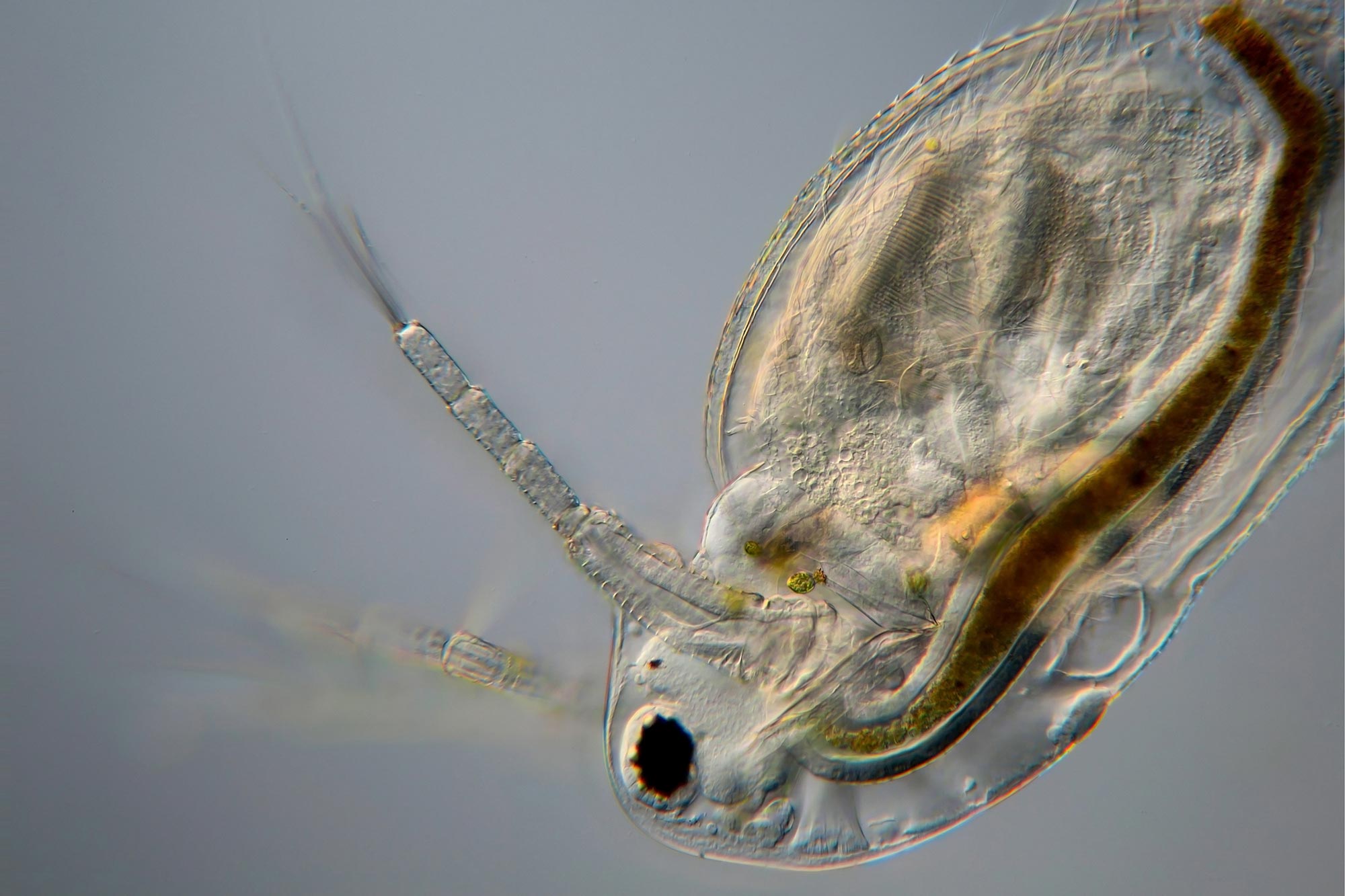
Waterfleas evolved rapidly under predation pressure using existing genetic variation, proving that biodiversity is key to survival in changing environments.
The extraordinary ability of animals to rapidly evolve in response to predators has been demonstrated via genetic sequencing of a waterflea population across nearly two decades.
In a new study, published in Nature Communications, scientists at the Universities of Birmingham in the UK, the Katholieke Universiteit Leuven in Belgium, and the Leibniz Institute for Freshwater Ecology and Inland Fisheries (IGB), Berlin, were able to identify more than 300 genes that vary in the genome of the waterflea.
These genes, which account for about about 3 percent of all sequenced waterflea genes, underpin changes in behavioral and life history traits that improve survival when exposed to predators.
The Power of Genetic Diversity
Strikingly, evolution in response to predation pressure occurs within just a few generations. It is mediated by so-called standing genetic variation — the amount of genetic diversity harbored by a given natural population. The research brings to the forefront of science the importance of standing genetic diversity to support rapid adaptation. It also highlights that reducing the genetic diversity of natural populations has important consequences for their ability to adapt to environmental change.
Lead researcher, Dr. Anurag Chaturvedi, currently at the University of Birmingham’s School of Biosciences and former PhD student at KU Leuven, explained: “We were able to quantify the genetic diversity of one particular Daphnia population over nearly two decades and show clearly how rapid evolution took place in response to environmental pressures. This type of research will be invaluable for understanding the potential impacts of future environmental changes on animal populations.”
The waterflea, or Daphnia, is central to the food webs of lakes and ponds. Its life cycle includes a dormant stage that can last for several decades. By awakening dormant stages through resurrection biology, scientists can quantify genetic changes at several time points in the past and observe evolution as it happens in nature.
Linking Environmental Change to Genomic Evolution
In the study, the team was able to hatch dormant eggs that span two decades and to sequence the genome of 36 resurrected Daphnia from a fish-farming pond. During the two decades, the Daphnia population experienced a transition from no predation from fish to high fish predation and back to lower levels of predation. The team was able to uniquely match changes in predation pressure on Daphnia with changes in the DNA over time. In effect, the research was able to link specific changes in the environment of Daphnia with the evolution occurring in their genomes.
The team found that the required DNA variation to kick-start an evolutionary change that spreads through an entire population did not require more than five ‘founding’ individual Daphnia from the regional set of Daphnia populations.
This surprising result suggests that animal species such as Daphnia have a high capacity for adaptive evolution thanks to the fact that genetic variation is maintained at the landscape level — an important lesson for conservation biology.
Lead researcher, Dr. Anurag Chaturvedi explained: “Our ability to investigate populations that evolve across decades is invaluable for both fundamental and applied science discoveries.”
Reference: “Extensive standing genetic variation from a small number of founders enables rapid adaptation in Daphnia” by Anurag Chaturvedi, Jiarui Zhou, Joost A. M. Raeymaekers, Till Czypionka, Luisa Orsini, Craig E. Jackson, Katina I. Spanier, Joseph R. Shaw, John K. Colbourne and Luc De Meester 14 July 2021, Nature Communications.
DOI: 10.1038/s41467-021-24581-z
Never miss a breakthrough: Join the SciTechDaily newsletter.
Follow us on Google and Google News.
1 Comment
I have often wondered why there are fewer dead animals on the UK’s roads now ( remembering a, I travel more miles, b, there are far more pet animals 9(and hedgehogs) and c, cars travelling much faster speeds) than was the case in my childhood?