
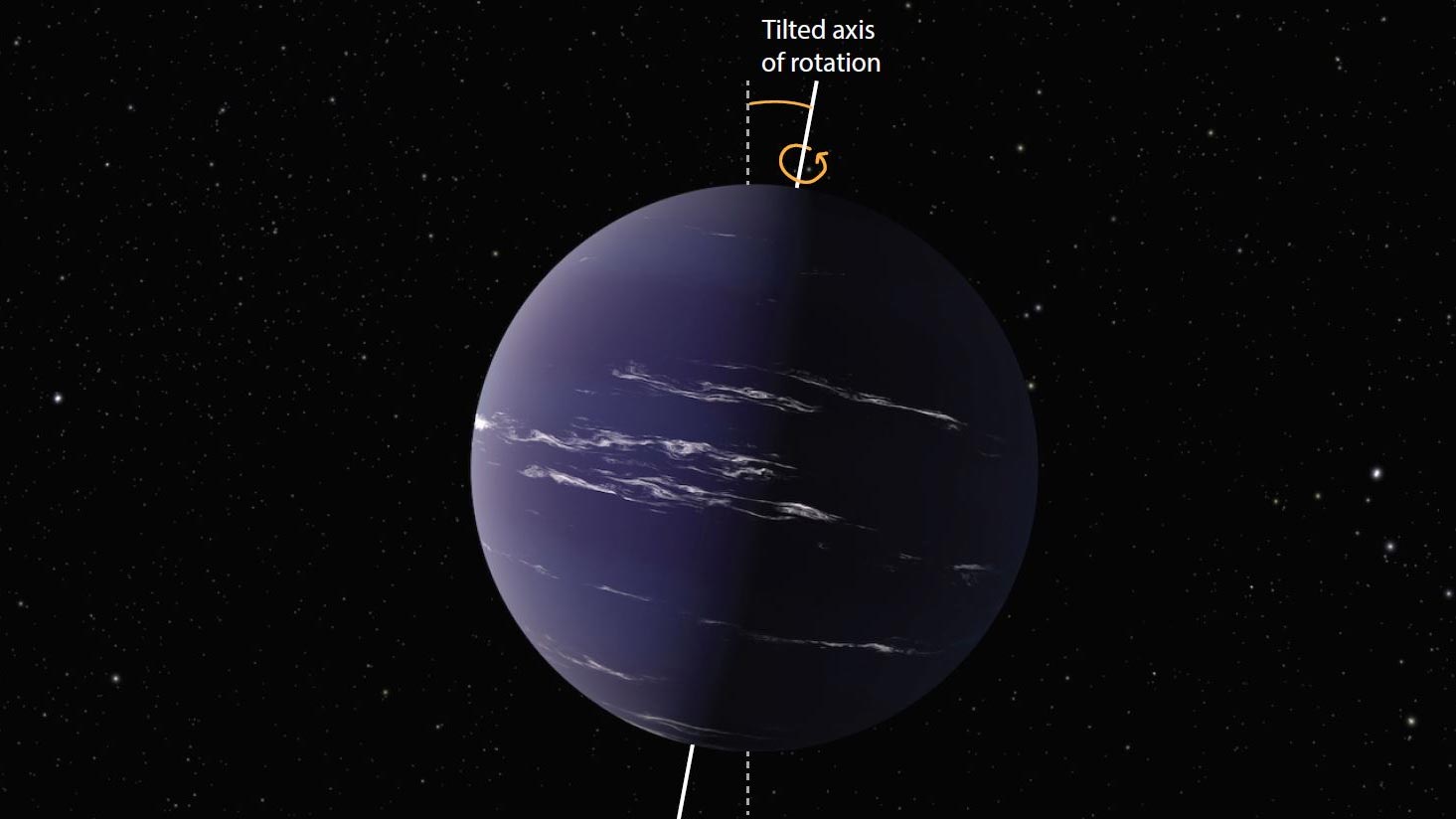
Planets with modest tilts are more likely to support complex life due to enhanced oxygen production in oceans.
Planets which are tilted on their axis, like Earth, are more capable of evolving complex life. This finding will help scientists refine the search for more advanced life on exoplanets. This NASA-funded research is presented at the Goldschmidt Geochemistry Conference.
Since the first discovery of exoplanets (planets orbiting distant stars) in 1992, scientists have been looking for worlds which might support life. It is believed that to sustain even basic life, exoplanets need to be at just the right distance from their stars to allow liquid water to exist; the so-called “Goldilocks zone.” However, for more advanced life, other factors are also important, particularly atmospheric oxygen.
Oxygen plays a critical role in respiration, the chemical process which drives the metabolisms of most complex living things. Some basic life forms produce oxygen in small quantities, but for more complex life forms, such as plants and animals, oxygen is critical. Early Earth had little oxygen even though basic life forms existed.
The scientists produced a sophisticated model of the conditions required for life on Earth to be able to produce oxygen. The model allowed them to input different parameters, to show how changing conditions on a planet might change the amount of oxygen produced by photosynthetic life.
Lead researcher Stephanie Olson (Purdue University) said “The model allows us to change things such as day length, the amount of atmosphere, or the distribution of land to see how marine environments and the oxygen-producing life in the oceans respond.”
How Day Length and Pressure Drive Oxygenation
The researchers found that increasing day length, higher surface pressure, and the emergence of continents all influence ocean circulation patterns and associated nutrient transport in ways that may increase oxygen production. They believe that these relationships may have contributed to Earth’s oxygenation by favoring oxygen transfer to the atmosphere as Earth’s rotation has slowed, its continents have grown, and surface pressure has increased through time.
“The most interesting result came when we modeled ‘orbital obliquity’ — in other words how the planet tilts as it circles around its star,” explained Megan Barnett, a University of Chicago graduate student involved with the study. She continued “Greater tilting increased photosynthetic oxygen production in the ocean in our model, in part by increasing the efficiency with which biological ingredients are recycled. The effect was similar to doubling the amount of nutrients that sustain life.”
Earth’s sphere tilts on its axis at an angle of 23.5 degrees. This gives us our seasons, with parts of the Earth receiving more direct sunlight in summer than in winter. However, not all planets in our Solar System are tilted like the Earth: Uranus is tilted at 98 degrees, whereas Mercury is not tilted at all. “For comparison, the Leaning Tower of Pisa tilts at around 4 degrees, so planetary tilts can be quite substantial,” said Barnett.
Moderate Tilt May Favor the Evolution of Complex Life
Dr. Olson continued “There are several factors to consider in looking for life on another planet. The planet needs to be the right distance from its star to allow liquid water and have the chemical ingredients for the origin of life. But not all oceans will be great hosts for life as we know it, and an even smaller subset will have suitable habitats for life to progress towards animal-grade complexity. Small tilts or extreme seasonality on planets with Uranus-like tilts may limit the proliferation of life, but modest tilt of a planet on its axis may increase the likelihood that it develops oxygenated atmospheres that could serve as beacons of microbial life and fuel the metabolisms of large organisms. The bottom line is that worlds that are modestly tilted on their axes may be more likely to evolve complex life. This helps us narrow the search for complex, perhaps even intelligent life in the Universe.”
Timothy Lyons, Distinguished Professor of Biogeochemistry in the Department of Earth and Planetary Sciences at the University of California, Riverside commented:
“The first biological production of oxygen on Earth and its first appreciable accumulation in the atmosphere and oceans are milestones in the history of life on Earth. Studies of Earth teach us that oxygen may be one of our most important biosignatures in the search for life on distant exoplanets. By building from the lessons learned from Earth via numerical simulations, Olson and colleagues have explored a critical range of planetary possibilities wider than those observed over Earth history. Importantly, this work reveals how key factors, including a planet’s seasonality, could increase or decrease the possibility of finding oxygen derived from life outside our solar system. These results are certain to help guide our searches for that life.”
Never miss a breakthrough: Join the SciTechDaily newsletter.
Follow us on Google and Google News.
4 Comments
What about the effect the moon has with tides for the formation of complex life as well?
Yes, what about it!? The article was on best productivity assuming an aged planet (continents, oxygenating photosynthesis).
If live evolved in early Earth global ocean, they wouldn’t have noticed it.
If it wasn’t for the moon it would have been more difficult for life to move beyond the ocean as the tidal effect enabled the development of amphibian life to be able to move on to the land
good luck with that