
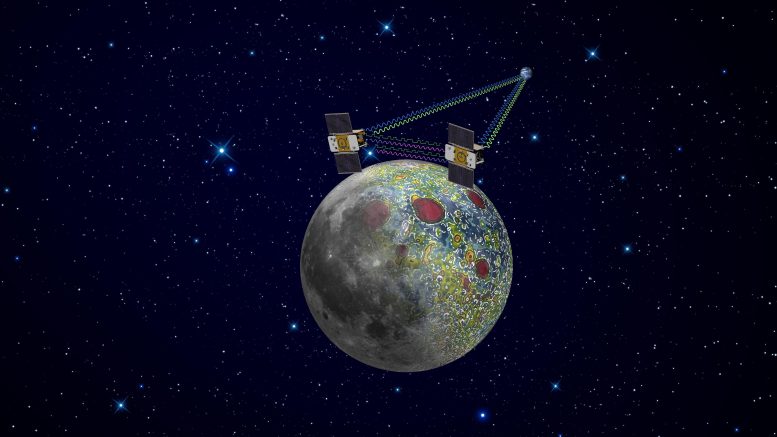
By combining GRAIL gravity data with computer models of large asteroid impacts and known details about the geologic evolution of impact craters, scientists were able uncover the origin of Moon’s uneven surface gravity.
NASA’s Gravity Recovery and Interior Laboratory (GRAIL) mission has uncovered the origin of massive invisible regions that make the moon’s gravity uneven, a phenomenon that affects the operations of lunar-orbiting spacecraft.
Because of GRAIL’s findings, spacecraft on missions to other celestial bodies can navigate with greater precision in the future.
GRAIL’s twin spacecraft studied the internal structure and composition of the moon in unprecedented detail for nine months. They pinpointed the locations of large, dense regions called mass concentrations, or mascons, which are characterized by strong gravitational pull. Mascons lurk beneath the lunar surface and cannot be seen by normal optical cameras.
GRAIL scientists found the mascons by combining the gravity data from GRAIL with sophisticated computer models of large asteroid impacts and known detail about the geologic evolution of the impact craters. The findings are published in the May 30 edition of the journal Science.
“GRAIL data confirm that lunar mascons were generated when large asteroids or comets impacted the ancient moon, when its interior was much hotter than it is now,” said Jay Melosh, a GRAIL co-investigator at Purdue University in West Lafayette, Indiana, and lead author of the paper. “We believe the data from GRAIL show how the moon’s light crust and dense mantle combined with the shock of a large impact to create the distinctive pattern of density anomalies that we recognize as mascons.”
The origin of lunar mascons has been a mystery in planetary science since their discovery in 1968 by a team at NASA’s Jet Propulsion Laboratory in Pasadena, California. Researchers generally agree mascons resulted from ancient impacts billions of years ago. It was not clear until now how much of the unseen excess mass resulted from lava filling the crater or iron-rich mantle upwelling to the crust.
On a map of the moon’s gravity field, a mascon appears in a target pattern. The bulls-eye has a gravity surplus. It is surrounded by a ring with a gravity deficit. A ring with a gravity surplus surrounds the bulls-eye and the inner ring. This pattern arises as a natural consequence of crater excavation, collapse and cooling following an impact. The increase in density and gravitational pull at a mascon’s bulls-eye is caused by lunar material melted from the heat of a long-ago asteroid impact.
“Knowing about mascons means we finally are beginning to understand the geologic consequences of large impacts,” Melosh said. “Our planet suffered similar impacts in its distant past, and understanding mascons may teach us more about the ancient Earth, perhaps about how plate tectonics got started and what created the first ore deposits.”
This new understanding of lunar mascons also is expected to influence knowledge of planetary geology well beyond that of Earth and our nearest celestial neighbor.
“Mascons also have been identified in association with impact basins on Mars and Mercury,” said GRAIL principal investigator Maria Zuber of the Massachusetts Institute of Technology in Cambridge. “Understanding them on the moon tells us how the largest impacts modified early planetary crusts.”
Reference: “The Origin of Lunar Mascon Basins” by H. J. Melosh, Andrew M. Freed, Brandon C. Johnson, David M. Blair, Jeffrey C. Andrews-Hanna, Gregory A. Neumann, Roger J. Phillips, David E. Smith, Sean C. Solomon, Mark A. Wieczorek and Maria T. Zuber, 30 May 2013, Science.
DOI: 10.1126/science.1235768
Launched as GRAIL A and GRAIL B in September 2011, the probes, renamed Ebb and Flow, operated in a nearly circular orbit near the poles of the moon at an altitude of about 34 miles (55 kilometers) until their mission ended in December 2012. The distance between the twin probes changed slightly as they flew over areas of greater and lesser gravity caused by visible features, such as mountains and craters, and by masses hidden beneath the lunar surface.
JPL, a division of the California Institute of Technology (Caltech) in Pasadena, California managed GRAIL for NASA’s Science Mission Directorate in Washington. The mission was part of the Discovery Program managed at NASA’s Marshall Space Flight Center in Huntsville, Alabama. NASA’s Goddard Space Flight Center, in Greenbelt, Maryland, manages the Lunar Reconnaissance Orbiter. Operations of the spacecraft’s laser altimeter, which provided supporting data used in this investigation, is led by the Massachusetts Institute of Technology in Cambridge. Lockheed Martin Space Systems in Denver built GRAIL.
Never miss a breakthrough: Join the SciTechDaily newsletter.
Follow us on Google and Google News.
2 Comments
Moon’s uneven gravity could have possibly come because Moon is gravitationally locked by Earth and also Sun. By this its spin is made zero by Earth’s pull (which makes the Moon to show only one surface to Earth) and its period around earth being 29.531 days is closely related to Sun’s spin of about 26 days. The long acting gravity would have halted the inner core rotation considerably and the mass could be lopsided in distribution in getting different gravity and different surfaces though slightly only. Why? Even on Earth the gravity is different at poles than equator because the whole shape is slightly pear shaped like apple being flat at the poles. Thank Ypu.
Good try, Madanagopal.V.C, But, Wrong again I’m afraid! And you obviously didn’t read or interpret the article correctly if you don’t mind me saying so.
The unevenness has nothing to do with our Moon being, ‘Gravitationally Locked’ as the phenomena are spread right across the entire body…
Imagine a world in its early stages and although for the most part, molten, has developed a very thin crust. On impact, any foreign object colliding with such body would smash through the, ‘Eggshell’ and plunge below the surface creating what I can only define here as a ‘Splash Mark’ (the visible rings that pepper our moon or any other such body in our entire universe). If you now imagine that each of the foreign bodies could have been endowed with their own fe then each would be endowed with it’s own magnetic field which would in turn leave its own imprint under the mantle.
If you have any problem with my explanation, please do not hesitate in replying and I will endeavour to clarify any point you may raise.
Bye for now, Peter.