
Technique Tunes Into Graphene Nanoribbons’ Electronic Potential
Ever since graphene – a thin carbon sheet just one-atom thick – was discovered more than 15 years ago, the wonder material became a workhorse in materials science research. From this body of work, other researchers learned that slicing graphene along the edge of its honeycomb lattice creates one-dimensional zigzag graphene strips or nanoribbons with exotic magnetic properties.
Many researchers have sought to harness nanoribbons’ unusual magnetic behavior into carbon-based, spintronics devices that enable high-speed, low-power data storage and information processing technologies by encoding data through electron spin instead of charge. But because zigzag nanoribbons are highly reactive, researchers have grappled with how to observe and channel their exotic properties into a real-world device.
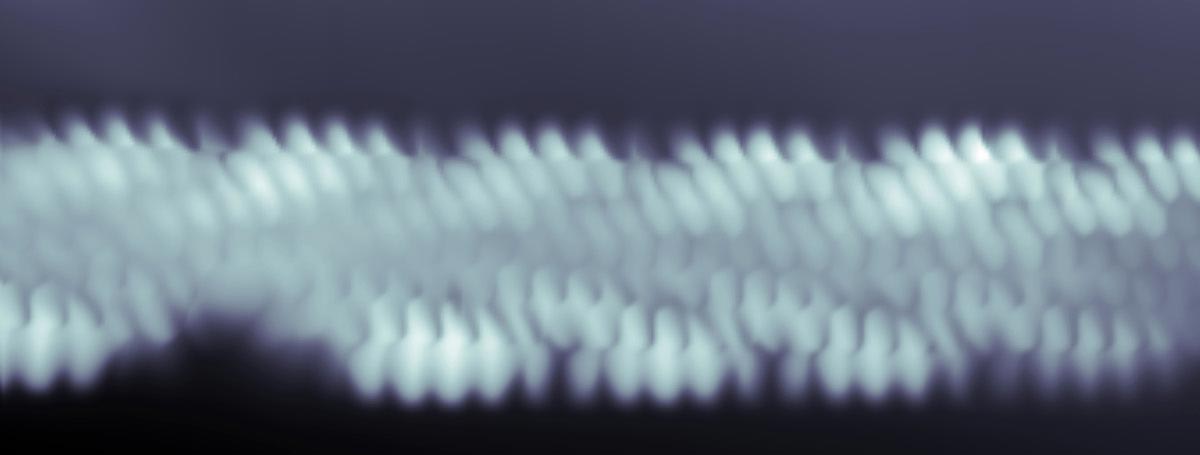
Now, as reported in the journal Nature, researchers at Lawrence Berkeley National Laboratory (Berkeley Lab) and UC Berkeley have developed a method to stabilize the edges of graphene nanoribbons and directly measure their unique magnetic properties.
Nitrogen Substitution Enables Tunable Edge Structure
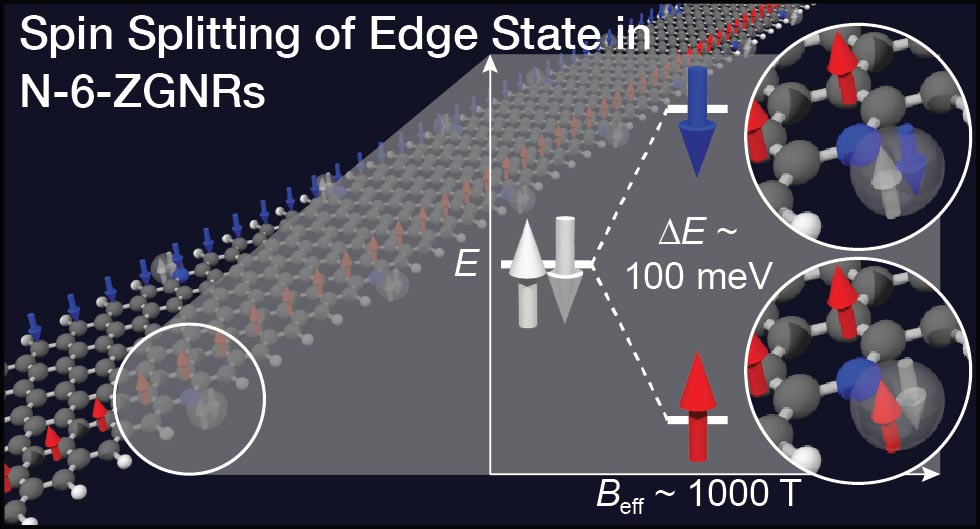
The team co-led by Felix Fischer and Steven Louie, both faculty scientists in Berkeley Lab’s Materials Sciences Division, found that by substituting some of the carbon atoms along the ribbon’s zigzag edges with nitrogen atoms, they could discretely tune the local electronic structure without disrupting the magnetic properties. This subtle structural change further enabled the development of a scanning probe microscopy technique for measuring the material’s local magnetism at the atomic scale.
“Prior attempts to stabilize the zigzag edge inevitably altered the electronic structure of the edge itself,” said Louie, who is also a professor of physics at UC Berkeley. “This dilemma has doomed efforts to access their magnetic structure with experimental techniques, and until now relegated their exploration to computational models,” he added.
Bottom-Up Molecular Construction of Nanoribbons
Guided by theoretical models, Fischer and Louie designed a custom-made molecular building block featuring an arrangement of carbon and nitrogen atoms that can be mapped onto the precise structure of the desired zigzag graphene nanoribbons.
To build the nanoribbons, the small molecular building blocks are first deposited onto a flat metal surface, or substrate. Next, the surface is gently heated, activating two chemical handles at either end of each molecule. This activation step breaks a chemical bond and leaves behind a highly reactive “sticky end.”
Each time two “sticky ends” meet while the activated molecules spread out on the surface, the molecules combine to form new carbon-carbon bonds. Eventually, the process builds 1D daisy chains of molecular building blocks. Finally, a second heating step rearranges the chain’s internal bonds to form a graphene nanoribbon featuring two parallel zigzag edges.
“The unique advantage of this molecular bottom-up technology is that any structural feature of the graphene ribbon, such as the exact position of the nitrogen atoms, can be encoded in the molecular building block,” said Raymond Blackwell, a graduate student in the Fischer group and co-lead author on the paper together with Fangzhou Zhao, a graduate student in the Louie group.
The next challenge was to measure the nanoribbons’ properties.
“We quickly realized that, to not only measure but actually quantify the magnetic field induced by the spin-polarized nanoribbon edge states, we would have to address two additional problems,” said Fischer, who is also a professor of chemistry at UC Berkeley.
Atomic-Scale Magnetic Sensing With Nitrogen Atoms
First, the team needed to figure out how to separate the electronic structure of the ribbon from its substrate. Fischer solved the issue by using a scanning tunneling microscope tip to irreversibly break the link between the graphene nanoribbon and the underlying metal.
The second challenge was to develop a new technique to directly measure a magnetic field at the nanometer scale. Luckily, the researchers found that the nitrogen atoms substituted in the nanoribbons’ structure actually acted as atomic-scale sensors.
Measurements at the positions of the nitrogen atoms revealed the characteristic features of a local magnetic field along the zigzag edge.
Calculations performed by Louie using computing resources at the National Energy Research Scientific Computing Center (NERSC) yielded quantitative predictions of the interactions that arise from the spin-polarized edge states of the ribbons. Microscopy measurements of the precise signatures of magnetic interactions matched those predictions and confirmed their quantum properties.
“Exploring and ultimately developing the experimental tools that allow rational engineering of these exotic magnetic edges opens the door to unprecedented opportunities of carbon-based spintronics,” said Fischer, referring to next-generation nano-electronic devices that rely on intrinsic properties of electrons. Future work will involve exploring phenomena associated with these properties in custom-designed zigzag graphene architectures.
Reference: “Spin splitting of dopant edge state in magnetic zigzag graphene nanoribbons” by Raymond E. Blackwell, Fangzhou Zhao, Erin Brooks, Junmian Zhu, Ilya Piskun, Shenkai Wang, Aidan Delgado, Yea-Lee Lee, Steven G. Louie and Felix R. Fischer, 22 December 2021, Nature.
DOI: 10.1038/s41586-021-04201-y
This research was supported by the DOE Office of Science. NERSC is a DOE Office of Science user facility located at Berkeley Lab.
Never miss a breakthrough: Join the SciTechDaily newsletter.
Follow us on Google and Google News.
3 Comments
Graphine Hydroxide is in the kill shots. It is “Razor-toothed” now all these articles like it’s a great thing. Soon the NWO Elite will announce how they own the Vaxxed and they are connected to the AI Patent (Netherlands).
If they can do these things and the public heard of it?just imagine what they can really do?
Fascinating! Graphene is such an amazing material and so much research is being done on it, no telling what will come from it all but I’m sure it will be amazing!