
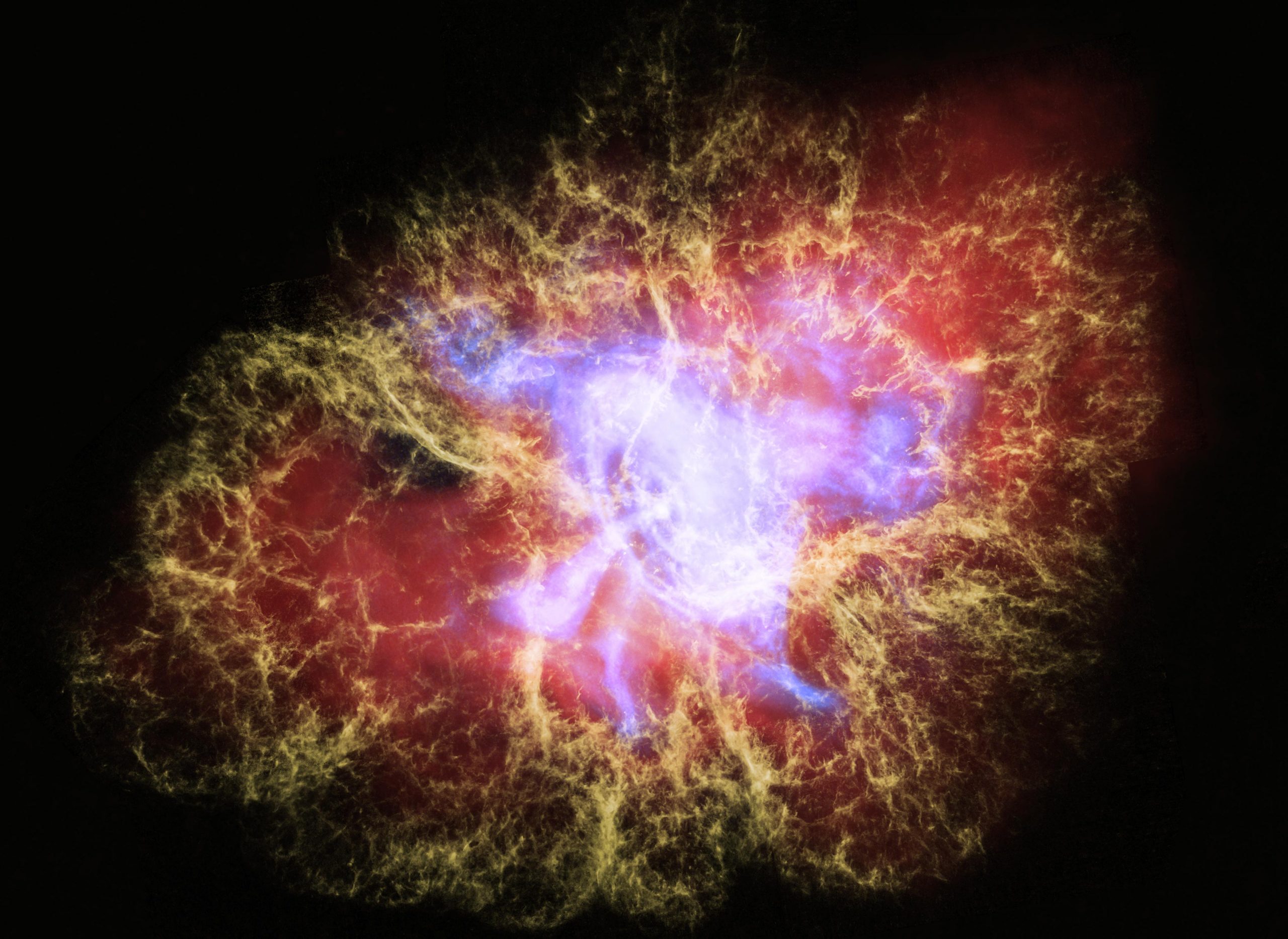
In a recently published study, a team of researchers led by the ARC Centre of Excellence for Gravitational Wave Discovery (OzGrav) at Monash suggests an innovative method to analyze gravitational waves from neutron star mergers, where two stars are distinguished by type (rather than mass), depending on how fast they’re spinning.
Neutron stars are extremely dense stellar objects that form when giant stars explode and die—in the explosion, their cores collapse, and the protons and electrons melt into each other to form a remnant neutron star.
In 2017, the merging of two neutron stars, called GW170817, was first observed by the LIGO and Virgo gravitational-wave detectors. This merger is well-known because scientists were also able to see light produced from it: high-energy gamma rays, visible light, and microwaves. Since then, an average of three scientific studies on GW170817 have been published every day.
In January this year, the LIGO and Virgo collaborations announced a second neutron star merger event called GW190425. Although no light was detected, this event is particularly intriguing because the two merging neutron stars are significantly heavier than GW170817, as well as previously known double neutron stars in the Milky Way.
Scientists use gravitational-wave signals—ripples in the fabric of space and time—to detect pairs of neutron stars and measure their masses. The heavier neutron star of the pair is called the ‘primary’; the lighter one is ‘secondary’.
The recycled-slow labeling scheme of a binary neutron star system
A binary neutron star system usually starts with two ordinary stars, each around ten to twenty times more massive than the Sun. When these massive stars age and run out of ‘fuel’, their lives end in supernova explosions that leave behind compact remnants, or neutron stars. Each remnant neutron star weighs around 1.4 times the mass of the Sun, but has a diameter of only 25 kilometers.
The first-born neutron star usually goes through a ‘recycling’ process: it accumulates matter from its paired star and begins spinning faster. The second-born neutron star doesn’t accumulate matter; its spin speed also slows down rapidly. By the time the two neutron stars merge—millions to billions of years later—it’s predicted that the recycled neutron star may still be spinning rapidly, whereas the other non-recycled neutron star will probably be spinning slowly.
Another way a binary neutron star system might form is through continuously changing interactions in dense stellar clusters. In this scenario, two unrelated neutron stars, on their own or in other separate star systems, meet each other, pair up and eventually merge like a happy couple due to their gravitational waves. However, current modeling of stellar clusters suggests that this scenario is ineffective in merging the neutron stars.
OzGrav postdoctoral researcher and lead author of the study Xingjiang Zhu says: ‘The motivation for proposing the recycled-slow labeling scheme of a binary neutron star system is two-fold. First, it’s a generic feature expected for neutron star mergers. Second, it might be inadequate to label two neutron stars as primary and secondary because they’re most likely to be of similar masses and it’s hard to tell which one is heavier.”
The recent OzGrav study takes a new look at both GW170817 and GW190425 by adopting the recycled-slow scheme. It was found that the recycled neutron star in GW170817 is only mildly or even slowly spinning, whereas that of GW190425 is spinning rapidly, possibly once every 15 milliseconds. It was also found that both merger events are likely to contain two nearly equal-mass neutron stars. Since there is little or no evidence of spin in GW170817, and neutron stars spin down over time, the researchers deduced that the binary probably took billions of years to merge. This agrees well with observations of its host galaxy, called NGC 4993, where little star formation activities are found in the past billions of years.
OzGrav associate investigator and collaborator Gregory Ashton says: “Our proposed astrophysical framework will allow us to answer important questions about the Universe, such as are there different supernova explosion mechanisms in the formation of binary neutron stars? And to what degree do interactions inside dense star clusters contribute to forming neutron star mergers?”
The LIGO/Virgo detectors finished their joint third observing run (O3) earlier this year and are currently conducting scheduled maintenance and upgrades. When the fourth run (O4) starts in 2021, scientists will be readily anticipating more discoveries of neutron star mergers. The prospect will be even brighter when the Japanese underground detector KAGRA and the LIGO-India detector join the global network over the coming years.
‘We are in a golden era of studying binary neutron stars with highly-sensitive gravitational-wave detectors that will deliver dozens of discoveries in the next few years,’ adds Zhu.
Reference: “Characterizing Astrophysical Binary Neutron Stars with Gravitational Waves” by Xing-Jiang Zhu and Gregory Ashton, 7 October 2020, The Astrophysical Journal Letters.
DOI: 10.3847/2041-8213/abb6ea
Never miss a breakthrough: Join the SciTechDaily newsletter.
Follow us on Google and Google News.