
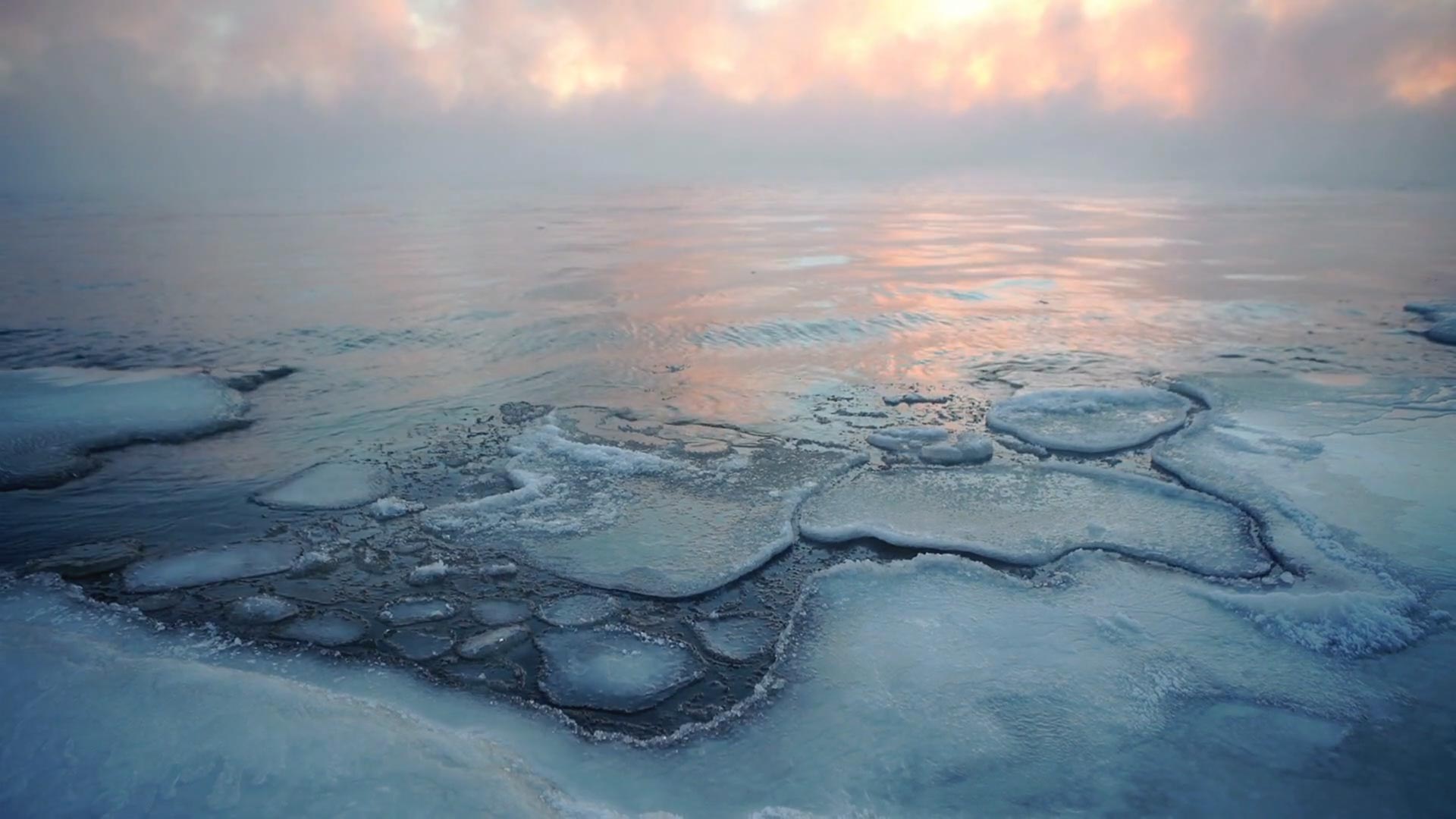
A recent study reveals a surprising finding: a significant amount of meltwater is temporarily retained within the Greenland Ice Sheet during the summer months.
A recent study published in Nature reveals an unexpected discovery: a significant volume of meltwater is temporarily stored within the Greenland Ice Sheet during the summer. For the first time, an international team of researchers has measured this meltwater using precise positioning data. This breakthrough challenges existing models of ice sheet contributions to global sea level rise.
The Greenland Ice Sheet is currently the largest single contributor to global sea-level rise, with the potential to raise the mean sea level by up to seven meters if it fully melts. While scientists have long studied the melt processes of the ice sheet, one crucial question has remained unanswered: how does meltwater storage evolve within the ice sheet throughout the summer melt season? A new approach provides an unprecedented view into the movement and storage of meltwater.
“During the melt season, we found that a significant fraction of meltwater mass is stored temporarily within the ice sheet,” says Jiangjun Ran, associate professor at Southern University of Science and Technology. “This water buffering effect peaks in July and slowly recedes in the following weeks.”
Novel approach to water monitoring
“Understanding how water is stored and released within the ice sheet has always been a challenge,” says Pavel Ditmar, associate professor at Delft University of Technology. The team has utilized data from the Greenland GPS Network (GNET).

The network consists of several tens of stations around Greenland that continuously provide positioning data. The team developed an innovative method that interprets the detected vertical displacements of the bedrock. These displacements are caused, among others, by the mass of melting water, pushing the bedrock down.
Implications for climate models
This discovery will help improve climate models, which often underestimate the complexity of water storage within ice sheets. Especially during warmer years, models that predict water runoff toward the ocean may easily underestimate that process. The study finds that these models could require scaling adjustments of up to 20% for the warmest years.
“These findings are crucial for improving forecasts of the Greenland Ice Sheet’s contribution to future sea-level rise,” says Michiel van den Broeke, professor at Utrecht University. “With climate change making the Arctic warmer than ever, accurate predictions are essential for preparing coastal regions for potential sea-level rise.”
Years in the making
The study has taken years of preparation and required difficult expeditions to some of the most remote areas of the planet.
“The work we’ve done not only improves our understanding of ice sheet dynamics but also opens the door to new measurement techniques and campaigns,” says Shfaqat Abbas Khan, professor at the Technical University of Denmark. The study highlights the importance of international collaboration in addressing one of the planet’s most pressing environmental challenges.
Reference: “Vertical bedrock shifts reveal summer water storage in Greenland ice sheet” by Jiangjun Ran, Pavel Ditmar, Michiel R. van den Broeke, Lin Liu, Roland Klees, Shfaqat Abbas Khan, Twila Moon, Jiancheng Li, Michael Bevis, Min Zhong, Xavier Fettweis, Junguo Liu, Brice Noël, C. K. Shum, Jianli Chen, Liming Jiang and Tonie van Dam, 30 October 2024, Nature.
DOI: 10.1038/s41586-024-08096-3
Never miss a breakthrough: Join the SciTechDaily newsletter.
Follow us on Google and Google News.
8 Comments
“The Greenland Ice Sheet is currently the largest single contributor to global sea-level rise, with the potential to raise the mean sea level by up to seven meters if it fully melts.”
The last time I did a back-of-envelope calculation, it would take about 15,000 years for that to happen, at current rates of melting, if ever. During the Eemian, bedrock was exposed in the interior, but alpine glaciers probably still existed in the mountains. To put that into perspective, human civilizations with cities have only existed about 8,000 years, or about since the time of the Holocene Optimum. If humans don’t annihilate themselves with with a nuclear holocaust, or succumb to something like the Andromeda-COVID Strain, we should be able to cope with a 20-foot sea level rise in 15,000 years.
“we should be able to cope with a 20-foot sea level rise in 15,000 years.”.
Nice thought, but the intelligence of town planners and the Real Estate fraternity comes into play………oh, we’ve got 15 000 years; those sand-dues give a nice view of the sea………….
So if in July at the height of summer, the Greenland ice-sheet stores meltwater, what happens to that meltwater in August, September and November? Do we get massive run off in August and September, or does the stored melt-water simply freeze into the ice-cap a bit later?
Reading between the lines of Mikkelson’s and Iverson’s saga of 1909-1912, the melt-water stopped flowing off the icecap in Autumn, I’d guess in about mid-September from their account. So that gives maybe June, July, August and half of September for all that melt-water to get to the sea. Which would suggest that in August and September, a couple of weary wayfarers wandering their wretched way south along the East coast of Greenland would have a hard time of and would suffer from wet feet, as happened. Which then leads to the notion that in August-September the assorted cracks and crannies in the ice cap have opened up enough to release the melt- water stored during July.
“Which then leads to the notion that in August-September the assorted cracks and crannies in the ice cap have opened up enough to release the melt- water stored during July.”
The slush probably freezes in place. When I was in Greenland in July of 1966, I observed the water-rich slush first hand. I also was able to hear the substantial meltwater stream well above the level of the ice tunnel we were surveying. The guys in the office at Camp Tuto were anxious to get me out of there before August because they said the weather would turn cold and unpredictable and I could be stuck, unable to fly out for weeks, even after the job was done. Satellites are great. However, there is no substitute for boots on the ground to make observations.
” However, there is no substitute for boots on the ground to make observations.”
On that, I agree absolutely.
Mikkelson and Iverson seem to have had a hellish time with the slush and assorted melt through July and I would guess into August, from what Mikkelson writes. He is a bit sparse on dates, although no doubt his diary and Iverson’s etc are lodged somewhere. Unfortunately, I have missed out on Greenand during my travels; and in learning Danish.
This stuff from the University of California and apparently published in “Nature”.
“IMBIE researchers combined 26 separate surveys to compute changes in the mass of Greenland’s ice sheet between 1992 and 2018. Altogether, data from 11 different satellite missions were used, including measurements of the ice sheet’s changing volume, flow and gravity.
The findings, published recently in Nature, show that Greenland has lost 3.8 trillion tons of ice since 1992 – enough to raise global sea levels by 10.6 millimeters (almost half an inch). The rate of ice loss has risen from an average of 33 billion tons per year in the 1990s to 254 billion tons per year in the last decade – a sevenfold increase within three decades.
“There is a rather universal agreement among the independent techniques used in this study and the international group of researchers about the mass loss in Greenland: half from surface melt, half from faster glacier flow,” said IMBIE team member Eric Rignot, chair, Donald Bren Professor and Chancellor’s Professor of Earth system science at UCI. “The more remarkable result from this study is that Greenland is melting along the lines of the highest rate of warming examined by climate models. In other words, we’re in the worst-case scenario.” ”
15 000 years? The problem is that a few cms rise in sea-level, particularly when coupled with a king tide, a depression and a storm, can do a great deal of damage such as happened along the UK’s East Coast and Holland in 1953. That few cms sea-level rise is just the sour cream on top of the normal bottle of abnormal weather we experience from time to time.
“… Greenland has lost 3.8 trillion tons of ice since 1992 …”
Big numbers usually leave an impression on the reader, which is why they are used. They have little intrinsic contribution to the science. It would be more instructive to cite the percentage of ice loss.
You write as though you expect that Nature never changes except when influenced by Man. A single storm can make profound changes along the coast. That’s the way things work. California has a park near the city of Santa Cruz, called Natural Bridges State Park. The entire edifice for which it was named was destroyed during a storm, 1964, if I remember correctly. When a geologist observes an unconformity in a rock sequence, he is looking at the results of a transgressive sea, resulting either from subsidence and/or an increase in sea level. It has happened many time long before humans even evolved.
MGGA – Make Greenland Green Again!
So, Greenland holds enough ice to create a rise in earth’s oceans to rise seven meters, if I read this correctly.
Let’s be clear here, if Greenland melts, all the ice on earth, that touches ocean waters will melt, meaning, the Antarctica will melt as well, making that number closer to 20 meters.
I currently live near a major metro area that sits approximately 700 meters above sea level.
20 meter rise in oceans will displace 80% of human population to migrate inland.
Why do I care if the icecaps melt again?