
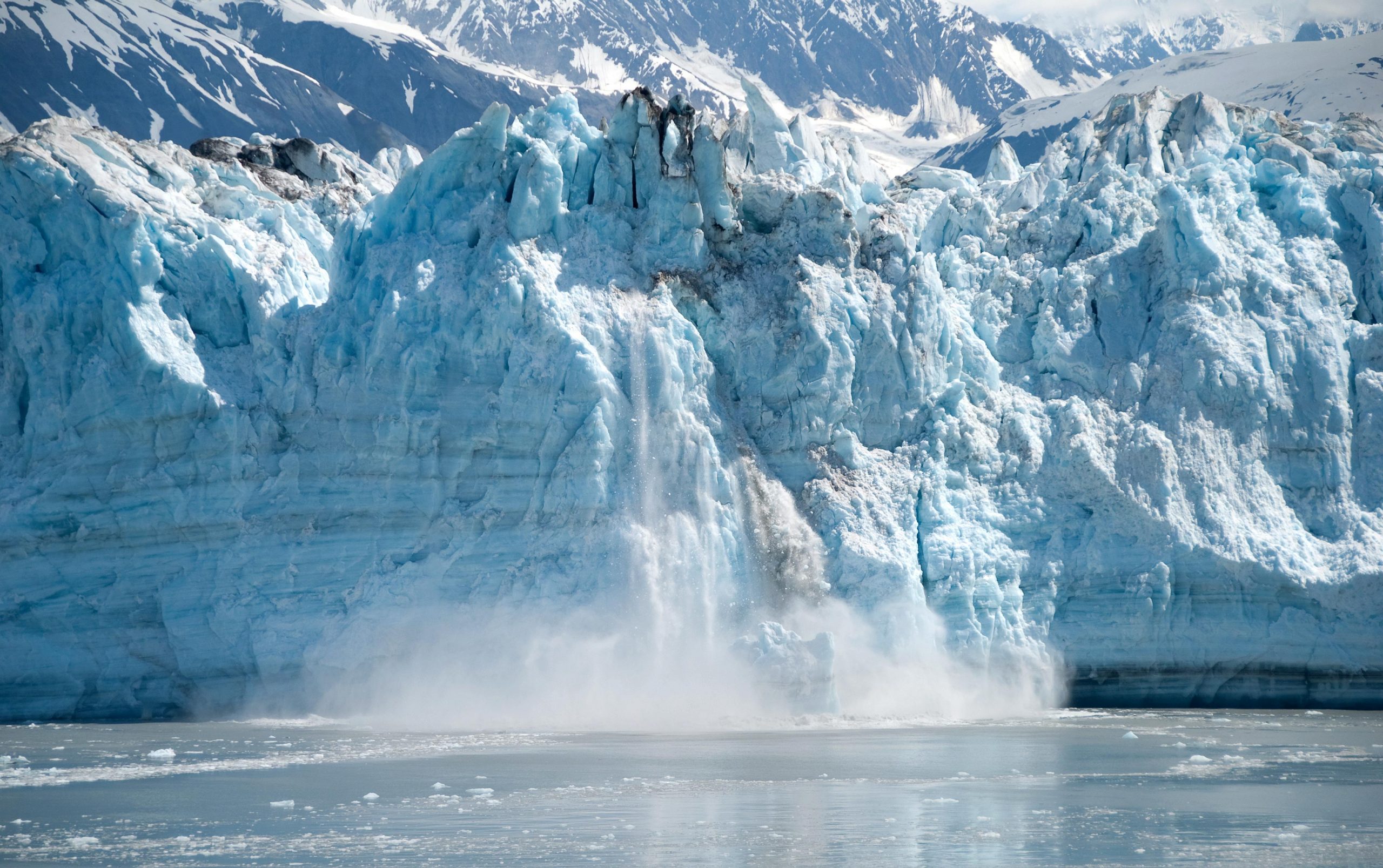
Atmospheric processes are chilling the Atlantic seawater that enters the ice cavern beneath the 79° N Glacier in Northeast Greenland.
Northeast Greenland is home to the 79° N Glacier, the country’s largest floating glacier tongue, which is under serious threat from global warming as warm Atlantic waters erode it from below. However, experts from the Alfred Wegener Institute have recently found that the temperature of the water flowing into the glacier’s cavern decreased between 2018 and 2021, despite the ocean warming steadily in the region over recent decades. This may be linked to temporary shifts in atmospheric circulation patterns.
In a study just released in the journal Science, the researchers discuss how this affects the ocean and what it could mean for the future of Greenland’s glaciers.
Over the past few decades, the Greenland Ice Sheet has lost more and more mass, which has also lessened its stability. This is chiefly due to the warming of the atmosphere and oceans, which accelerates the melting of ice, contributing in turn to an increase in mean sea level. The Northeast Greenland Ice Stream alone, which feeds into the massive Nioghalvfjerdsfjorden Glacier – also known as the 79° N Glacier – could produce a meter of sea-level rise if it melted completely. Beneath the glacier tongue lies a cavern that ocean water flows into.
Surprising Discovery: Cooling Waters
Data gathered by the Alfred Wegener Institute, Helmholtz Centre for Polar and Marine Research (AWI) now indicates that the temperature of the water flowing into the cavern declined between 2018 and 2021.
“We were surprised to discover this abrupt cooling, which is a marked contrast to the long-term regional ocean warming we’ve observed in the influx to the glacier,” says Dr Rebecca McPherson, a researcher at the AWI and the study’s first author. “Since the ocean water in the glacier cavern grew colder, it means less oceanic warmth was transported under the ice in this period – and in turn, the glacier melted more slowly.”

But where did this cold water below the glacier come from if temperatures in the surrounding ocean continued to climb? To find out, the AWI researchers collected data from 2016 to 2021, using an oceanographic mooring to do so. The monitoring platform continually took readings on parameters like the temperature and flow speed of the seawater at the calving front of the 79° N Glacier, which is where water flows into the cavern. Whereas the temperature of the Atlantic water initially rose, topping out at 2.1 degrees Celsius in December 2017, it dropped by 0.65 degrees again from early 2018.
“We were able to track down the source of this temporary cooling from 2018 to 2021 upstream, to Fram Strait and the vast Norwegian Sea,” Rebecca McPherson explains. “In other words, circulation changes in these remote waters can directly affect the melting of the 79° N Glacier.”
As such, the lower water temperatures in Fram Strait were the result of atmospheric blocking. When this blocking occurs, stationary high-pressure systems in the atmosphere force the normally dominant air currents to deviate. That’s also what happened over Fram Strait: several atmospheric blocks over Europe allowed more cold air from the Arctic to flow through Fram Strait into the Norwegian Sea. This slowed water from the Atlantic that was flowing toward the Arctic, so that it cooled more than usual along the way.
The cooled water then flowed through Fram Strait to Greenland’s continental shelf and the 79° N Glacier. The whole process – from the appearance of the atmospheric blocks to the inflow of the cooler Atlantic water in the glacier cavern – took two to three years.
Impact of Atmospheric Blocking
“We assume that atmospheric blocks will remain an important factor for multiyear cooling phases in the Norwegian Sea,” says Rebecca McPherson. “They provide the atmospheric and oceanic conditions that influence temperature variability in Atlantic Ocean water, and in turn the glaciers of Northeast Greenland.” Why? Because the northward-flowing water mass not only continues farther into the Arctic, where it affects the extent and thickness of sea ice; in Fram Strait, roughly half of the water veers to the west, where it determines the oceanic melting of Greenland’s glaciers. “In the summer of 2025, we’ll be returning to the 79° N Glacier on board the research icebreaker Polarstern. We already know that water temperatures in Fram Strait are now rising again slightly and we’re anxious to see if the glacier melting increases as a result.”
To more accurately predict the fate of the 79° N Glacier, it’s important to understand what is driving changes within it, as Rebecca McPherson stresses: “Our study offers new insights into the behavior of Northeast Greenland’s glaciers in a changing climate. This will allow forecasts for rising sea levels to be refined.”
As their colleague Prof Torsten Kanzow from the AWI adds: “Generally speaking, we consider the warm-water inflow into the cavern below the 79° N Glacier to be part of the Atlantic Meridional Overturning Circulation (AMOC). Forecasts indicate that this thermal conveyor belt could weaken in the future. One key challenge will be to establish long-term observation systems capable of capturing the effects of macro-scale ocean circulation extending as far as the fjords of Greenland.”
Reference: “Atmospheric blocking slows ocean-driven melting of Greenland’s largest glacier tongue” by Rebecca Adam McPherson, Claudia Wekerle, Torsten Kanzow, Monica Ionita, Finn Ole Heukamp, Ole Zeising and Angelika Humbert, 19 September 2024, Science.
DOI: 10.1126/science.ado5008
Never miss a breakthrough: Join the SciTechDaily newsletter.
Follow us on Google and Google News.
9 Comments
28:09:2024. Scientists have been predicting that the Earth ice is melting faster. This is cursing the Sea to rise And is cursing coaster Cities to be flooded, from Antarctica ice, Greenland ice etc. If that is the case what we need to do is to Re freece the ice and the water around the ice. There are many ways ice can be melting what you can do is to refrooze the ice and the water around the ice. Scientists should consult the manufacturer of frizzers to see how they can help. To freeze the sea or the Ocean you need Clobber corporation. This can be done. Is the only solution for now. Thanks. To be continued. M. Luke.
Refreeze the ocean. What are we saying. It’s just a theor. How will you execute it. To execute it you will need a massive fridge to run the fridge u will need power. Where will we get that kind of power.
It’s doomsday all the way. Simple will be to shift to higher ground in time.
Refrigerators don’t really ‘cool.’ They move heat from one location to another. So, while a really big refrigerator might cool Greenland, wherever the heat is being dumped, it would turn that area into another Sahara. This idea is in the same category as a ‘perpetual motion machine.’
Why couldn’t we use ROCK SALT on the glaciers at specific time/temperatures to re-freeze the ice?
Rock salt doesn’t freeze ice, it melts ice. That’s why people use rock salt on their driveways, to melt ice, and on roads, to melt ice.
Oh no!!! Global freezing!! The algore says fire up the coal power plants to warm the earth and save humanity.
Oh no!!! Global freezing!! The algore says fire up the coal power plants to warm the earth and save humanity.
I don’t understand but God is in control of it all!!!
Cool made up propaganda story, bro. 👍