

In a groundbreaking study, scientists at Brookhaven National Lab uncovered a new phase of matter dubbed “half ice, half fire” — a bizarre mix of cold, orderly electron spins and hot, chaotic ones.
This discovery flips the script on previously accepted limits in physics and could spark advances in quantum computing, magnetic refrigeration, and more. It stems from a decade-long journey through strange magnetic materials and offers a brand-new way to manipulate matter with ultrasharp precision.
A New State of Matter Emerges
Two physicists at the U.S. Department of Energy’s Brookhaven National Laboratory have discovered a new phase of matter while exploring a model of a magnetic material.
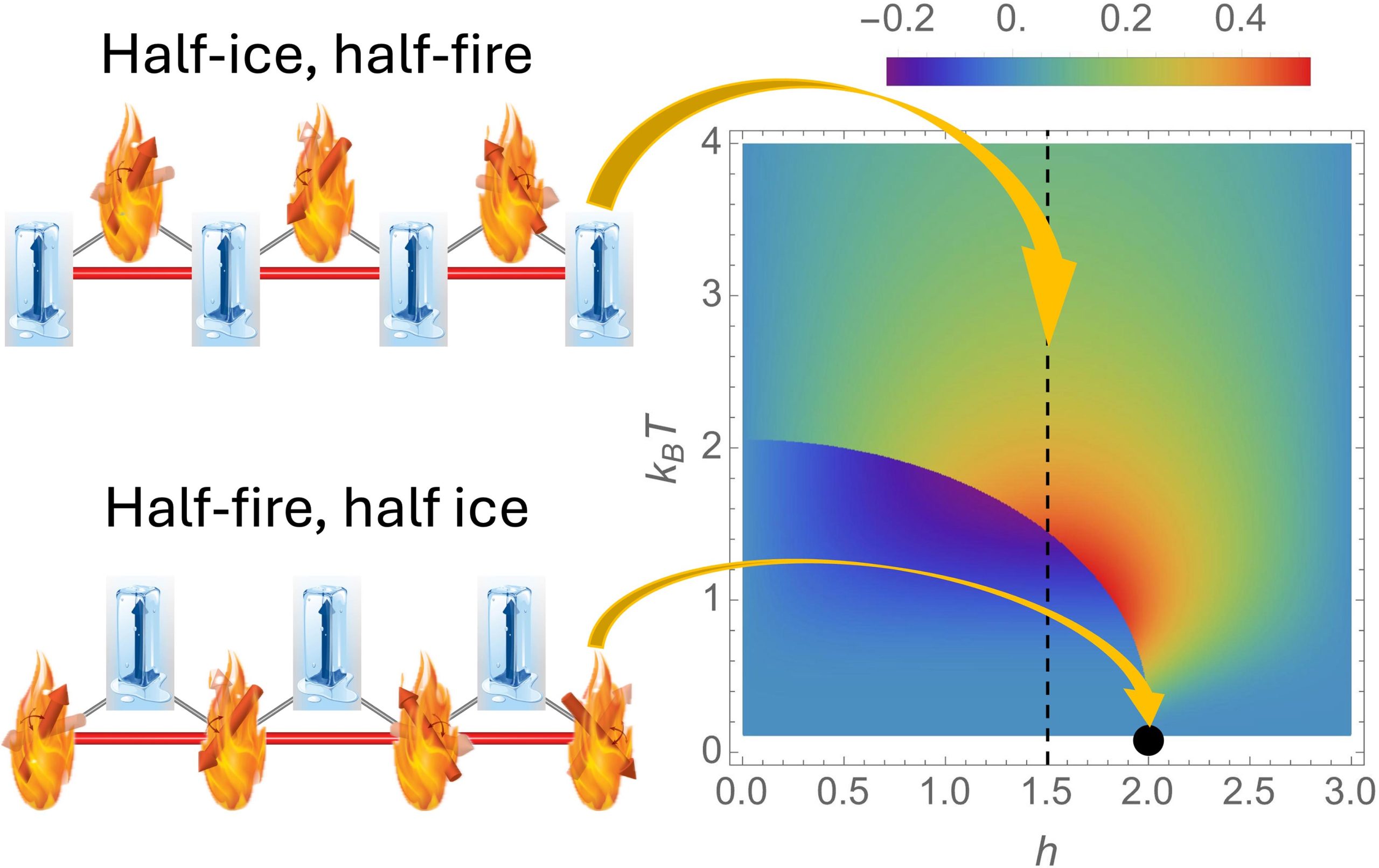
This newly identified phase is a unique arrangement of electron spins, the tiny magnetic moments of electrons that point either “up” or “down.” The phase features a mix of highly ordered (“cold”) and highly disordered (“hot”) spins. Because of this unusual combination, the researchers named it “half ice, half fire.” The discovery emerged from studying a one-dimensional model of a magnetic material known as a ferrimagnet.
Practical Potential for Energy and Information Tech
What makes “half ice, half fire” especially significant is its ability to cause extremely sharp transitions between different states of matter at a practical, finite temperature — something that could have future applications in energy systems and information technology.
The findings, by physicists Weiguo Yin and Alexei Tsvelik, are detailed in the December 31, 2024 issue of Physical Review Letters.
“Finding new states with exotic physical properties — and being able to understand and control the transitions between those states — are central problems in the fields of condensed matter physics and materials science,” said Yin. “Solving those problems could lead to great advances in technologies like quantum computing and spintronics.”
Added Tsvelik, “We suggest that our findings may open a new door to understanding and controlling phases and phase transitions in certain materials.”
A Twin Phase and a Decade of Discovery
The “half-ice, half-fire” phase is the twin state of the “half-fire, half-ice” phase discovered by Yin, Tsvelik, and Christopher Roth, their 2015 undergraduate summer intern who is now a postdoc at the Flatiron Institute. They describe the discovery in a paper published in early 2024.
But the full story goes back to 2012, when Yin and Tsvelik were part of a multi-institutional collaboration, led by Brookhaven physicist John Hill, that was studying Sr3CuIrO6, a magnetic compound of strontium, copper, iridium, and oxygen. This research led to two papers, an experiment-driven study in 2012 and a theory-driven study in 2013, both published in PRL.
Yin and Tsvelik continued to look into the phase behaviors of Sr3CuIrO6 and, in 2016, found the “half-fire, half-ice” phase. In this state, which is induced by a critical external magnetic field, the “hot” spins on the copper sites are fully disordered on the atomic lattice and have smaller magnetic moments, while the “cold” spins on the iridium sites are fully ordered and have larger magnetic moments. The work was published in Physical Review B.
“But despite our extensive research, we still didn’t know how this state could be utilized, especially because it has been well known for one century that the one-dimensional Ising model, an established mathematical model of ferromagnetism that produces the half-fire, half-ice state, does not host a finite-temperature phase transition,” said Tsvelik. “We were missing pieces of the puzzle.”
Cracking the Code: Forbidden Transitions
A hint to the missing pieces was recently identified by Yin. In two publications for systems with and without an external magnetic field, respectively, he demonstrated that the aforementioned forbidden phase transition can be approached by ultranarrow phase crossover at fixed finite temperature.
In this current work, Yin and Tsvelik have discovered that “half fire, half ice” has an opposite, hidden state in which the hot and cold spins switch positions. That is, the hot spins become cold, and the cold spins become hot, which led them to name the phase “half ice, half fire.”
Big Tech Potential: Quantum Bits and Cooling
The model reveals that switching between phases takes place over an ultranarrow temperature range, and Yin and Tsvelik have already suggested possible ways that this could be used in future applications. For example, ultrasharp phase switching with a giant magnetic entropy change — offered by “half fire, half ice” — could be useful for refrigeration technologies. The phenomenon could also be used as the foundation for a new type of quantum information storage technology in which phases act as bits.
“Next, we are going to explore the fire-ice phenomenon in systems with quantum spins and with additional lattice, charge, and orbital degrees of freedom,” said Yin. “The door to new possibilities is now wide open.”
This research was supported by the DOE Office of Science.
Never miss a breakthrough: Join the SciTechDaily newsletter.
Follow us on Google and Google News.
5 Comments
A bizarre mix of cold, orderly electron spins and hot, chaotic ones. This discovery flips the script on previously accepted limits in physics.
VERY GOOD!
Ask the researchers:
1. There are so many spins in the universe, where does the power of spin come from?
2. Does spin generate gravitation, or does gravitation generate spin?
3. Spin or gravitation, which one needs to be measured?
You’re a loony.
4. Spin or gravitation, which one is qualitative indicators? Which one is quantitative indicators?
Каждая фундаментальная частица имеет массу, время (вращение, вокруг оси, оно же температура, и период, и продолжительность и если тело двигается в пространстве, и то скорость,)и Пространство. Как промежутки для взаимодействия частиц. Каждое тело построенное из частиц сложенных определенным образом имеет в пространстве всплески сил, которые вследствие вращения синхронизируются. На этом все и построено. Имею обоснование.
What are the units of the color bar above the T/h graph?