

Research has revealed that non-pathogenic Listeria species, L. innocua and L. welshimeri, are acquiring traits that pose significant health risks.
Listeria monocytogenes, a deadly bacteria commonly found in the food processing industry, poses a significant threat to human health. Not only can it cause severe illness, it is also becoming resistant to food safety measures worldwide.
Startingly, two previously thought to be harmless species of Listeria have recently been found to possess a number of characteristics that may be harmful to humans.
A Whole Genome Sequencing study in South Africa, from a team of researchers with first author Dr. Thendo Mafuna at the University of Johannesburg, shows some of the changing characteristics of Listeria found in the country.
The study shows that Listeria innocua strains are developing resistance to temperature, pH, dehydration, and other stresses; as well as hypervirulence genetically identical to that of Listeria monocytogenes.
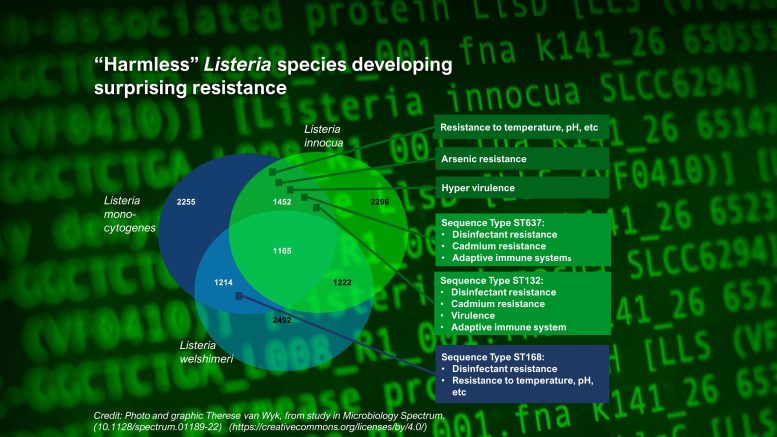
Some strains of L. innocua and L. welshimeri in the study show all three genes for resistance to a widely-used disinfectant, from the quaternary ammonium compound (QAC or QUAT) group of chemicals.
Two strains of L. innocua they analyzed have developed three or more concerning pathogenic characteristics, including CRISPR CAS-type adaptive immune systems.
The two non-pathogenic strains of Listeria were sampled in raw, dried, and processed meats at commercial food processing facilities in the country.
The study confirms other research showing growing resistance in non-pathogenic Listeria species in other parts of the world.
Shared Genes With Pathogenic Species
“The Listeria innocua that we tested has some of the genes that are also found in pathogenic Listeria monocytogenes”, says Dr. Thendo Mafuna. Mafuna is from the Department of Biochemistry at the University of Johannesburg.
These shared genes between L. innocua and L. monocytogenes are also responsible for disease in humans; and stress tolerance such as resistance to the disinfectant Benzalkonium chloride (BC or BAC).

Research from others has shown that though Listeriosis is rarely caused by L. innocua, it does happen more often in people with compromised immune systems, he adds.
Benzalkonium chloride (BAC) is a member of a group of chemicals called Quaternary ammonium compounds, or QUATs. Quats are found in many common disinfectant products. They have been shown to be highly effective at killing bacteria, fungi, and viruses.
All the L. innocua strains they tested also had the complete LIPI-4 hypervirulence gene sequence, which can cause disease in humans, he says. The LIPI-4 sequence they found in L. innocua is identical to that found in pathogenic L. monocytogenes, as recorded by the Pasteur Institute in Paris, France.
From Raw, Dried, and Processed Meats
The samples and isolates analyzed in this study were collected between 2014 and 2019 by the South African Government’s Department of Agriculture, Land Reform, and Rural Development (DALRRD). These were submitted to the Agricultural Research Council (ARC) at Onderstepoort Veterinary Research SA for analysis.
In total, 258 isolates from butcheries, abbatoirs, retail outlets, cold stores, and processing facilities all over the country were studied. Of these, 38 were found to be nonpathogenic L. Innocua; and another three isolates found to be nonpathogenic L. welshimeri.
The isolates came from raw whole, raw processed, dried, and processed cooked, beef, chicken, and pork meats. Dr. Itumeleng Matle at the Bacteriology Division, ARC in Onderstepoort did the microbiological analysis of Listeria isolation and identification.
The Whole Genome Sequencing (WGS) was done by Dr. Rian E. Pierneef at the ARC’s Biotechnology Platform at Onderstepoort.
Mafuna then compared the genome sequences with those recorded by the Pasteur Institute, in Paris, France; and performed the analysis for the study.
On the Lookout
“We need to look at our own facilities in South Africa to really see what is happening. Our analyses of these bacteria can help us predict which sequence types to be on the lookout for,” says Mafuna.
It is the number of harmful characteristics that the L. innocua strains share with L. monocytogenes that is concerning, he adds.
Food processors need to look out for Listeria innocua because it is becoming resistant to disinfectants that are used in industry to get rid of them. It would also be helpful to try different types of disinfectants to surfaces, he says. Switching from one type to another may prevent or delay the bacteria from developing resistance to one type of disinfectant.
“Big industrial food processors may want to investigate how efficient BC or quat disinfectants are in their facilities. This can be done by taking swabs before cleaning and again after cleaning, culturing those, to see how well the disinfectant regimes are working,” says Mafuna.
Reference: “Comparative Genomics of Listeria Species Recovered from Meat and Food Processing Facilities” by T. Mafuna, I. Matle, K. Magwedere, R. E. Pierneef and O. N. Reva, 6 September 2022, Microbiology Spectrum.
DOI: 10.1128/spectrum.01189-22
The study was funded by the South African Department of Agriculture, Land Reform and Rural Development (DALRRD).
Sample collection was provided by the DALRRD Directorate: Veterinary Public Health. Sample testing and DNA isolation was conducted by the Food and Feed Analysis and General Bacteriology Laboratories of the Agricultural Research Council (ARC): Onderstepoort Veterinary Institute (OVI). Whole Genome Sequencing analyses were conducted at the ARC Biotechnology Platform. This research forms part of Dr. Thendo Mafuna’s doctoral studies registered at the University of Pretoria.
Never miss a breakthrough: Join the SciTechDaily newsletter.
Follow us on Google and Google News.
1 Comment
gooooid