
Close Menu
    Facebook X (Twitter) Instagram
    SciTechDaily
    • Biology
    • Chemistry
    • Earth
    • Health
    • Physics
    • Science
    • Space
    • Technology
    Facebook X (Twitter) Pinterest YouTube RSS
    SciTechDaily
    Home»Technology»Harnessing the Dark Side: Optical Singularities Could Be Used for a Wide Range of Applications
    Technology

    Harnessing the Dark Side: Optical Singularities Could Be Used for a Wide Range of Applications

    By Harvard John A. Paulson School of Engineering and Applied SciencesJuly 13, 2021No Comments4 Mins Read
    Facebook Twitter Pinterest Telegram LinkedIn WhatsApp Email Reddit
    Share
    Facebook Twitter LinkedIn Pinterest Telegram Email Reddit
    Heart-Shaped Phase Singularity Sheet
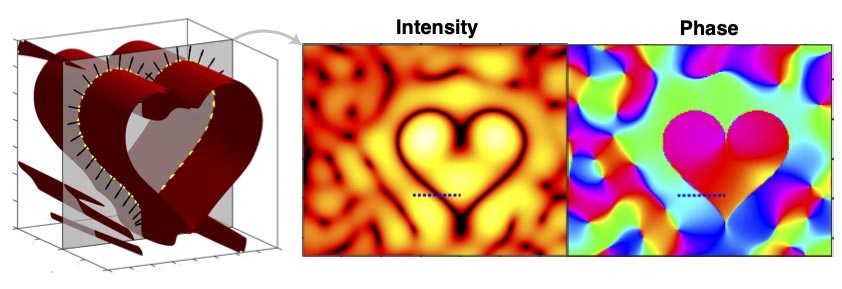
    Cross-section of the designed heart-shaped phase singularity sheet. The extended dark region in the center image is a cross-section of the singularity sheet. The phase is undefined on the singularity sheet. Credit: Daniel Lim/Harvard SEAS

    By precisely engineering darkness with nanoscale metasurfaces, scientists unlock powerful new tools for imaging, communications, and wave control across physics.

    When we think about singularities, we tend to think of massive black holes in faraway galaxies or a distant future with runaway AI, but singularities are all around us. Singularities are simply places where certain parameters are undefined. The North and South Pole, for example, are what’s known as coordinate singularities because they don’t have a defined longitude.

    Optical singularities typically occur when the phase of light with a specific wavelength, or color, is undefined. These regions appear completely dark. Today, some optical singularities, including optical vortices, are being explored for use in optical communications and particle manipulation but scientists are just beginning to understand the potential of these systems. The question remains — can we harness darkness like we harnessed light to build powerful, new technologies?

    Now, researchers from the Harvard John A. Paulson School of Engineering and Applied Sciences (SEAS) have developed a new way to control and shape optical singularities. The technique can be used to engineer singularities of many shapes, far beyond simple curved or straight lines. To demonstrate their technique, the researchers created a singularity sheet in the shape of a heart.
    Polarization Properties
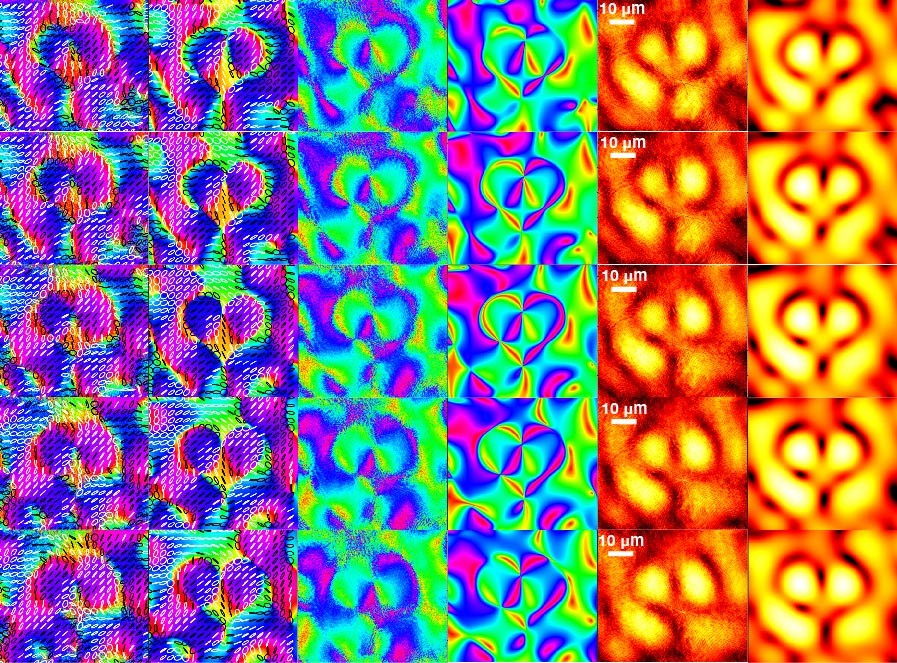
    The singularity engineering procedure was also applied to creating more exotic singularities, such as a polarization singularity sheet. Here, the polarization properties (e.g. polarization azimuth, ellipticity angle, and intensity) of the experimental structured light field is compared to the numerical predictions. Credit: Daniel Lim/Harvard SEAS

    Shaping Darkness with Metasurfaces

    “Conventional holography techniques are good at shaping light, but struggle to shape the darkness,” said Federico Capasso, the Robert L. Wallace Professor of Applied Physics and Vinton Hayes Senior Research Fellow in Electrical Engineering at SEAS and senior author of the paper. “We have demonstrated on-demand singularity engineering, which opens up a vast set of possibilities in wide-ranging fields, from super-resolution microscopy techniques to new atomic and particle traps.”

    The research is published in Nature Communications. 

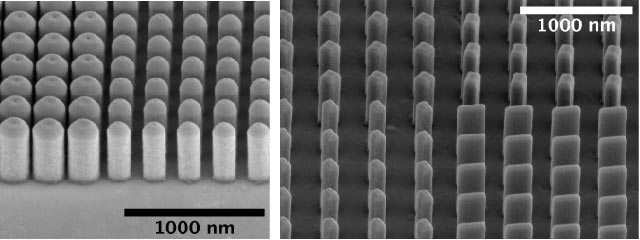
    Capasso and his team used flat metasurfaces with precisely-shaped nanopillars to shape the singularities. 

    “The metasurface tilts the wavefront of light in a very precise manner over a surface so that the interference pattern of the transmitted light produces extended regions of darkness,” said Daniel Lim, a graduate student at SEAS and first author of the paper. “This approach allows us to precisely engineer dark regions with remarkably high contrast.”
    Metasurfaces Nanopillars Nanofins
    Metasurfaces, which are nanostructured surfaces containing shapes like nanopillars (left) and nanofins (right), were employed to realize these singularity structures experimentally. The above image shows scanning electron microscope images of titanium dioxide nanostructures that were used to precisely shape the wavefront of light in producing the singularity sheets. Credit: Daniel Lim/Harvard SEAS

    Darkness Without Limits

    Engineered singularities could be used to trap atoms in dark regions. These singularities could also improve super high-resolution imaging. While light can only be focused to regions about half a wavelength (the diffraction limit) in size, darkness has no diffraction limit, meaning it can be localized to any size. This allows darkness to interact with particles over length scales much smaller than the wavelengths of light. This could be used to provide information on not only the size and the shape of the particles but their orientation as well.

    Engineered singularities could extend beyond waves of light to other types of waves.

    “You can also engineer dead zones in radio waves or silent zones in acoustic waves,” said Lim. “This research points to the possibility of designing complex topologies in wave physics beyond optics, from electron beams to acoustics.”

    Reference: “Engineering phase and polarization singularity sheets” by Soon Wei Daniel Lim, Joon-Suh Park, Maryna L. Meretska, Ahmed H. Dorrah and Federico Capasso, 7 July 2021, Nature Communications.
    DOI: 10.1038/s41467-021-24493-y

    The Harvard Office of Technology Development has protected the intellectual property relating to this project and is exploring commercialization opportunities.

    The research was co-authored by Joon-Suh Park, Maryna L. Meretska, and Ahmed H. Dorrah. It was supported in part by the Air Force Office of Scientific Research under award number FA9550- 19-1-0135 and by the Office of Naval Research (ONR) under award number N00014-20-1-2450.

    Never miss a breakthrough: Join the SciTechDaily newsletter.
    Follow us on Google and Google News.

    Harvard University Imaging Materials Science Nanotechnology Optics Popular
    Share. Facebook Twitter Pinterest LinkedIn Email Reddit

    Related Articles

    Harvard Scientists Control “Points of Darkness” for Remote Sensing and Covert Detection Applications

    Transforming Circles Into Squares: Researchers Reconfigure Material Topology on the Microscale

    Ordinary Microscope Sees in Super-Resolution With Specially Engineered Light-Shrinking Material

    Multifunctional Nanofiber Protects Against Explosions – For Soldiers, Firefighters, Astronauts and More

    Order From Disorder: Harnessing Turbulence in Light to Create a High-Precision Laser

    “Perfect” Solar Energy Absorber Created by Laser Etching Metal With Nanoscale Structures

    Nanomaterials Actively Self-Regulate in Response to Environmental Change

    Spray Paint Battery Can be Painted on Virtually Any Surface

    SLIPS Prevents Ice From Sticking on Metal Surfaces

    Leave A Reply Cancel Reply

    • Facebook
    • Twitter
    • Pinterest
    • YouTube

    Don't Miss a Discovery

    Subscribe for the Latest in Science & Tech!

    Trending News

    One of the Universe’s Largest Stars May Be Getting Ready To Explode

    Scientists Discover Enzyme That Could Supercharge Ozempic-Like Weight Loss Drugs

    Popular Sweetener Linked to DNA Damage – “It’s Something You Should Not Be Eating”

    Ancient “Rock” Microbes May Reveal How Complex Life Began

    Researchers Capture Quantum Interference in One of Nature’s Rarest Atoms

    “A Plague Is Upon Us”: The Mass Death That Changed an Ancient City Forever

    Scientists Discover Game-Changing New Way To Treat High Cholesterol

    This Small Change to Your Exercise Routine Could Be the Secret to Living Longer

    Follow SciTechDaily
    • Facebook
    • Twitter
    • YouTube
    • Pinterest
    • Newsletter
    • RSS
    SciTech News
    • Biology News
    • Chemistry News
    • Earth News
    • Health News
    • Physics News
    • Science News
    • Space News
    • Technology News
    Recent Posts
    • New Study Challenges 40-Year Puzzle About Childhood Body Fat
    • 20-Year Study Finds Daily Multivitamins Don’t Extend Lifespan
    • Landmark Study Links Never Marrying to Significantly Higher Cancer Risk
    • Revolutionary Imaging Technique Unlocks Secrets of Matter at Extreme Speeds
    • Where Does Mass Come From? Scientists Find Evidence of a New Exotic Nuclear State
    Copyright © 1998 - 2026 SciTechDaily. All Rights Reserved.
    • Science News
    • About
    • Contact
    • Editorial Board
    • Privacy Policy
    • Terms of Use

    Type above and press Enter to search. Press Esc to cancel.