

Discovery of Planckian time limit offers new opportunities for quantum technologies.
A collaborative team of researchers in Japan has identified “heavy fermions”—electrons with greatly increased effective mass—that display quantum entanglement controlled by Planckian time, the fundamental unit of time in quantum mechanics. This breakthrough suggests new possibilities for using these effects in solid-state materials to advance the development of next-generation quantum computers.
Heavy fermions emerge when conduction electrons in a material interact strongly with localized magnetic electrons, causing their effective mass to grow dramatically. This behavior produces unusual properties, including unconventional superconductivity, making it a major focus in condensed matter physics. The compound examined in this study, Cerium-Rhodium-Tin (CeRhSn), is part of a family of heavy fermion systems characterized by a quasi-kagome lattice structure, which is notable for its geometrical frustration effects.
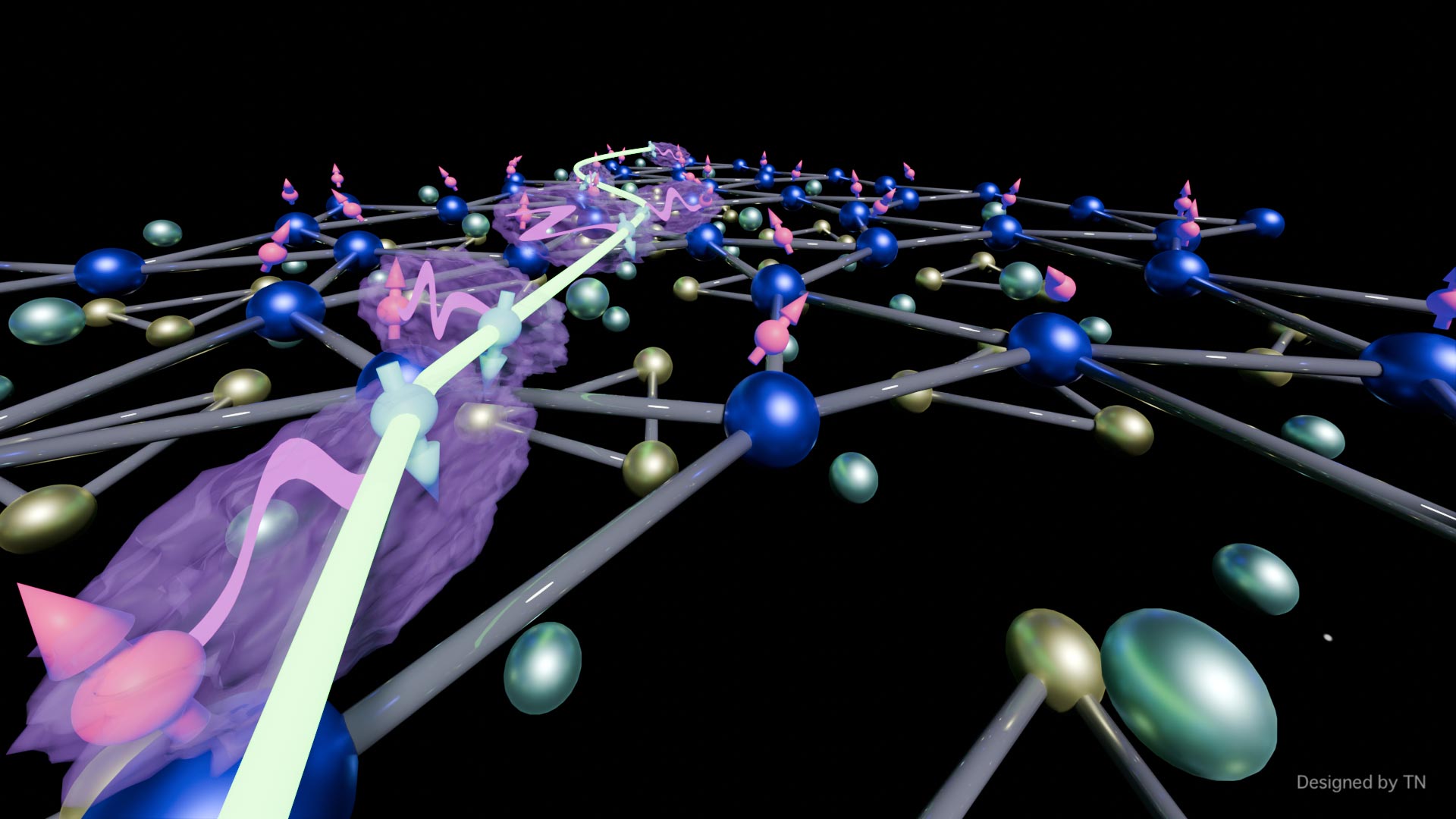
Experimental findings in CeRhSn
The research team examined the electronic properties of CeRhSn, a material recognized for showing non-Fermi liquid behavior at relatively high temperatures.
Detailed measurements of its reflectance spectra confirmed that this unusual behavior persists nearly up to room temperature, with heavy electron lifetimes approaching the Planckian limit. The spectral patterns, which can be represented by a single mathematical function, provide strong evidence that the heavy electrons in CeRhSn are quantum entangled.
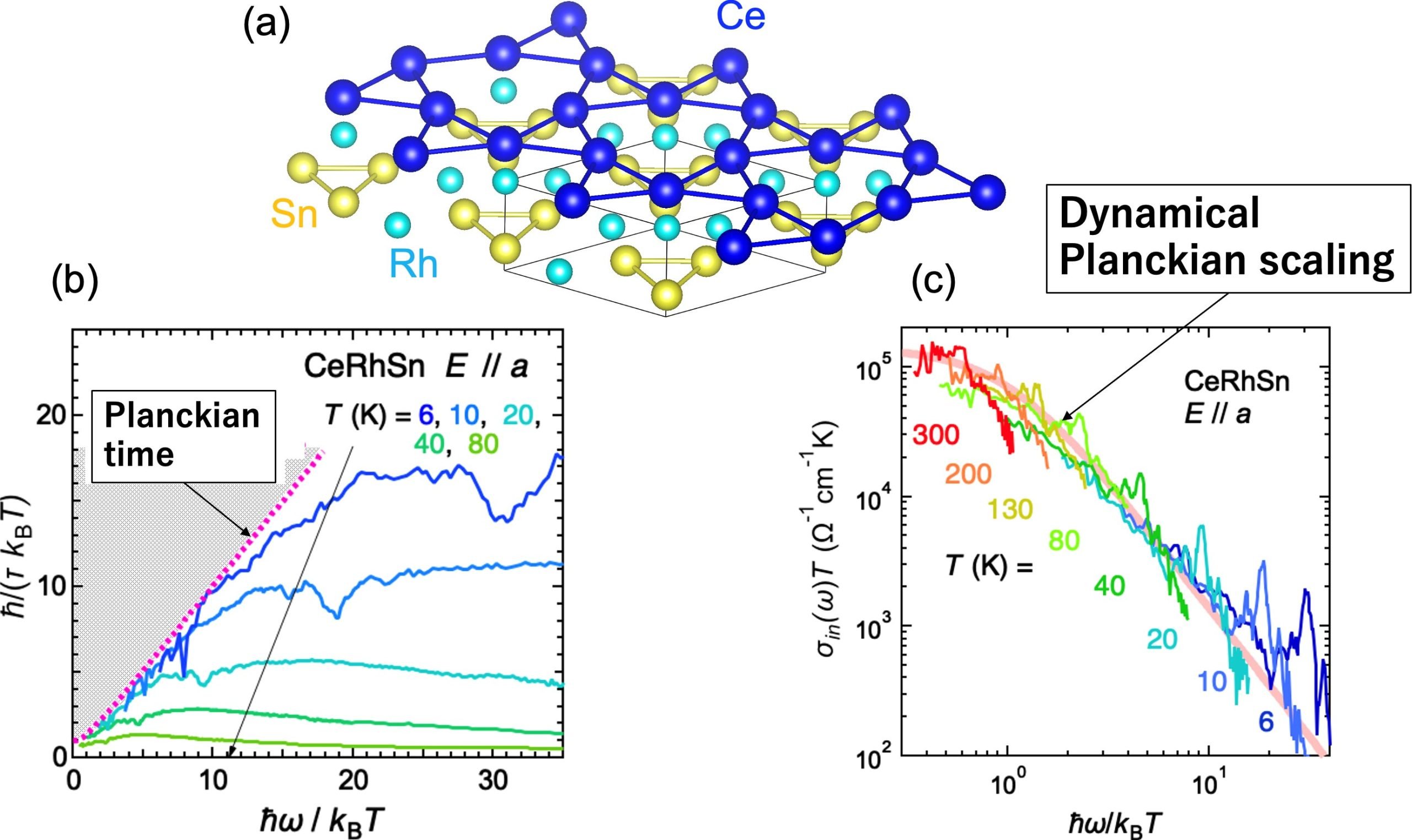
Implications for quantum computing
Dr. Shin-ichi Kimura of The University of Osaka, who led the research, explains, “Our findings demonstrate that heavy fermions in this quantum critical state are indeed entangled, and this entanglement is controlled by the Planckian time. This direct observation is a significant step towards understanding the complex interplay between quantum entanglement and heavy fermion behavior.”
Quantum entanglement is a key resource for quantum computing, and the ability to control and manipulate it in solid-state materials like CeRhSn offers a potential pathway towards novel quantum computing architectures. The Planckian time limit observed in this study provides crucial information for designing such systems.
Further research into these entangled states could revolutionize quantum information processing and unlock new possibilities in quantum technologies. This discovery not only advances our understanding of strongly correlated electron systems but also paves the way for potential applications in next-generation quantum technologies.
Reference: “Anisotropic non-Fermi liquid and dynamical Planckian scaling of a quasi-kagome Kondo lattice system” by Shin-ichi Kimura, Muhammad Frassetia Lubis, Hiroshi Watanabe, Yasuyuki Shimura and Toshiro Takabatake, 5 August 2025, npj Quantum Materials.
DOI: 10.1038/s41535-025-00797-w
Funding: Japan Society for the Promotion of Science
Never miss a breakthrough: Join the SciTechDaily newsletter.
Follow us on Google and Google News.
6 Comments
Note 2508310347_Source1.Reinterpreting
Source 1.
https://scitechdaily.com/heavy-electrons-hold-the-key-to-a-new-type-of-quantum-computer/
1.
A “heavy” electron holds the key to a new type of quantum computer.
August 29, 2025 at Osaka University
_Japanese scientists have discovered quantum entanglement in “heavy fermions,” revealing the motion of electrons related to Planck time in a unique material. Source: SciTechDaily.com
The discovery of the Planck time limit presents new opportunities for quantum technology.
1-1.
The Japanese joint research team has discovered “heavy fermions” (electrons with significantly increased effective mass) that exhibit quantum entanglement phenomena controlled by Planck time, the basic time unit of quantum mechanics. This discovery presents new possibilities to leverage these effects in solid matter to speed up the development of next-generation quantum computers.
1-2.
_Heavy fermions are created when conduction electrons within a material interact strongly with local magnetic electrons, resulting in a sharp increase in their effective mass.
[>>>
>Because of the entanglement movement faster than the light and Planck time,
> Because it always looks like zz’.xbar, msbase.qpeoms,
> Heavy fermions (electron, wimp, sample 1.2.3.4) No.
<<>>
>My sample1. shows square.[x]2barz”, (*) domain, which is the structural unit of suqer entanglement.
> It is the exchange of z,z’ entanglement of 2xbar, and the length of time that seems to be always in the same place due to instantaneous movement is infinite in Planck’s time. In other words, even though it always looks like z,z’.bar, it actually reciprocated the diameter of the universe 100 billion times instantaneously.
>That’s why samples always seem to be in the same place. Uh-huh. In space, the Susqer entanglement is the same-looking ⏹️. Huh.
>>>This is what it is! This is what it is! This is the speed of suqer entanglement. Hmm.
<<]
*The Planck time is 10 ⁻¹⁰ times the size of a hydrogen atom when light moves in one Planck time. It means that it went by a distance far smaller than a hydrogen atom. It is such a short time that it is a moment to question the existence of an object.
_This direct observation is an important step forward in understanding the complex interaction between quantum entanglement and the behavior of heavy fermions."
3-1.
_Quantum entanglement is a key resource in quantum computing, and its ability to control and manipulate it in solid materials such as CeRhSn presents a potential path towards new quantum computing architectures.
[>>>>
> Chiral symmetry of oms.vixer.ain is also a kind of quantum entanglement.
>Of course, representative quantum entanglement comes from sample2.nqms.2,0 singularity, but these may be due to heavy fermion electrons or quantized polarization originating from wimp.
>But strictly speaking, a similar phenomenon also appears in sample4.mser.sper2.0.
>So what about the pms? Isn’t it a parallel line of entanglement between two 1 function lines?
sample1.
No no lie game quantum d3cided to come tinier hack and steal data after it had advantage in energy feilds and it will never be capable of what the mind metaphysical energy of source is ever ending
“…heavy fermions in this ‘quantum critical state’…”
Or just quantum interference of quasiparticles in a disordered 2D lattice…
So they are talking about a system that’s measuring the varying charge of the electrons, as a variable? I didn’t read the article. But it felt right? Am I still being tested? 🤔
Yes, well, heavy fermions (gen 1,2,3) were seen when hydrogen is spun in a preparation tank pulling engineer’s -V in an attempt to drain off all ‘electrons’ leaving only nuclei (sans ‘electrons’) to spin up in an accelerator (power inducing sections with coils to gain speed) and colliding them near the speed of light to produce an ultra high energy mash up. The blast is white noise – against which a researcher’s math filter effectively eliminates everything but a hoped-for result – which always seems to be found. And always right where the math model predicted. No one seems to have a math model of scrabbled eggs but such a find would be a interesting. All of this is electrons stripped off and nuclei blasted apart.
To say an inner ‘magnetic’ set of electrons interacts with free electrons at high energy to incubate 2nd or 3rd generation fermions is stretching it – to the point of thinking this must be an AI gag played on everyone to see if anyone were listening.
I suggest the researchers change the language of their monograph. Or pass it through a filter. The term ‘heavy electron’ is not only offensive, it has no clear definition. If, in fact, they are interpreting their data on a first-pass, the paper should be removed from publication. The immediate reaction is to pursue a theory of mass measurements of systems of linked particles, not a spurious state of electrons with an apparent v component approaching 100%c.