
Close Menu
    Facebook X (Twitter) Instagram
    SciTechDaily
    • Biology
    • Chemistry
    • Earth
    • Health
    • Physics
    • Science
    • Space
    • Technology
    Facebook X (Twitter) Pinterest YouTube RSS
    SciTechDaily
    Home»Technology»Helicon Plasma Thruster: Plasma Propulsion for Satellites
    Technology

    Helicon Plasma Thruster: Plasma Propulsion for Satellites

    By European Space Agency (ESA)September 5, 2020No Comments2 Mins Read
    Facebook Twitter Pinterest Telegram LinkedIn WhatsApp Email Reddit
    Share
    Facebook Twitter LinkedIn Pinterest Telegram Email Reddit
    Helicon Plasma Thruster
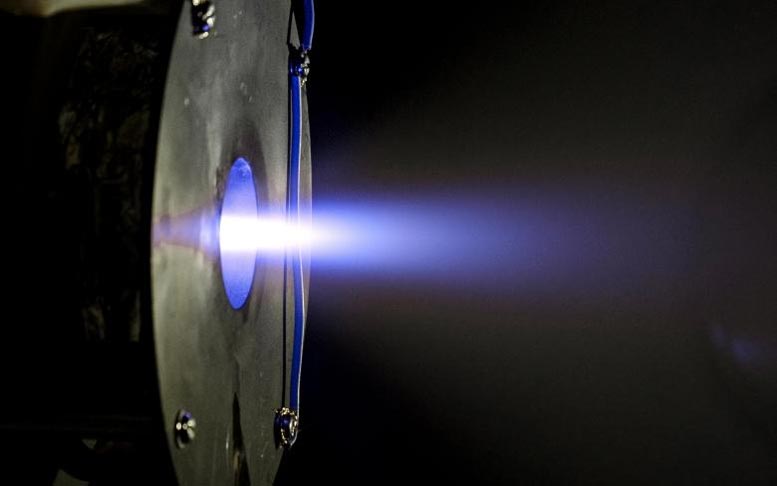
    Europe’s Helicon Plasma Thruster offers plasma propulsion for small satellites. Credit: SENER

    A test firing of Europe’s Helicon Plasma Thruster, developed with ESA by SENER in Spain. This compact, electrodeless and low voltage design is ideal for the propulsion of small satellites, including maintaining the formation of large orbital constellations.

    While traditional chemical propulsion have fundamental upper limits, electric propulsion pumps extra energy into the thrust reaction to reach much higher propellant velocities by accelerating propellant using electrical energy. There are many methods of electric propulsion, many of which require electrodes to apply a current, increasing thruster cost and complexity.

    By contrast, the Helicon Plasma Thruster uses high power radio frequency waves to excite the propellant into a plasma.

    Since the very first test ignition was achieved using argon gas in ESA’s Propulsion Laboratory in the Netherlands, in 2015, the HPT has evolved through repeated test campaigns at the EPL and SENER’s own facility, leading to improved levels of ionization and acceleration efficiency and a compact, lighter design.

    The technology has since been selected for a grant by the European Commission’s Strategic Research Cluster on Electric Propulsion, aimed at the development and verification of the HPT technology for non-geostationary satellite constellations and other small spacecraft. The result has been the new Helicon Plasma Thruster for In-Space Applications, HIPATIA, project.

    Never miss a breakthrough: Join the SciTechDaily newsletter.
    Follow us on Google and Google News.

    European Space Agency
    Share. Facebook Twitter Pinterest LinkedIn Email Reddit

    Related Articles

    Forging the Future With ESA’s Metal 3D Printer in Space

    “Electrospray” Technology: Palm-Sized Propulsion for Future Space Missions

    The Future’s Magnetic Pull: 3D-Printed Electromagnetic Coils

    Lunar Snapshots: Testing NASA’s Incredible Next-Gen Moon Camera

    SOLARIS: ESA’s Bold Venture Into Space-Based Solar Power Plants

    ESA SOLARIS: Wireless Power Beamed Down From Space

    3D Bioprinting Artificial Bone for Emergency Medicine in Space

    Collecting Solar Power Up in Orbit and Beaming It Down to the Ground for Use

    Move Over Plastic: Desktop 3D Printing in Metal and Ceramics

    Leave A Reply Cancel Reply

    • Facebook
    • Twitter
    • Pinterest
    • YouTube

    Don't Miss a Discovery

    Subscribe for the Latest in Science & Tech!

    Trending News

    Your Blood Pressure Reading Could Be Wrong Because of One Simple Mistake

    Astronomers Stunned by Ancient Galaxy With No Spin

    Physicists May Be on the Verge of Discovering “New Physics” at CERN

    Scientists Solve 320-Million-Year Mystery of Reptile Skin Armor

    Scientists Say This Daily Walking Habit May Be the Secret to Keeping Weight Off After Dieting

    New Therapy Rewires the Brain To Restore Joy in Depression Patients

    Giant Squid Detected off Western Australia in Stunning Deep-Sea Discovery

    Popular Sugar-Free Sweetener Linked to Liver Disease, Study Warns

    Follow SciTechDaily
    • Facebook
    • Twitter
    • YouTube
    • Pinterest
    • Newsletter
    • RSS
    SciTech News
    • Biology News
    • Chemistry News
    • Earth News
    • Health News
    • Physics News
    • Science News
    • Space News
    • Technology News
    Recent Posts
    • The Hidden Types of Dementia Most People Have Never Heard Of
    • Scientists Discover Why Alcohol Prevents the Liver From Healing, Even After You Quit
    • Scientists Solve a 60-Year-Old Fat Cell Mystery — and It Changes What We Know About Obesity
    • A Crucial Atlantic Current Is Weakening and Weather Could Change Worldwide
    • Scientists Stunned As Volcano Removes Methane From the Air
    Copyright © 1998 - 2026 SciTechDaily. All Rights Reserved.
    • Science News
    • About
    • Contact
    • Editorial Board
    • Privacy Policy
    • Terms of Use

    Type above and press Enter to search. Press Esc to cancel.