
Close Menu
    Facebook X (Twitter) Instagram
    SciTechDaily
    • Biology
    • Chemistry
    • Earth
    • Health
    • Physics
    • Science
    • Space
    • Technology
    Facebook X (Twitter) Pinterest YouTube RSS
    SciTechDaily
    Home»Technology»Scientists Successfully Complete World-First Firing of Air-Breathing Electric Thruster
    Technology

    Scientists Successfully Complete World-First Firing of Air-Breathing Electric Thruster

    By Philippe Willekens, European Space AgencyMarch 11, 20181 Comment4 Mins Read
    Facebook Twitter Pinterest Telegram LinkedIn WhatsApp Email Reddit
    Share
    Facebook Twitter LinkedIn Pinterest Telegram Email Reddit
    Researchers Build and Fire an Electric Ion Thruster
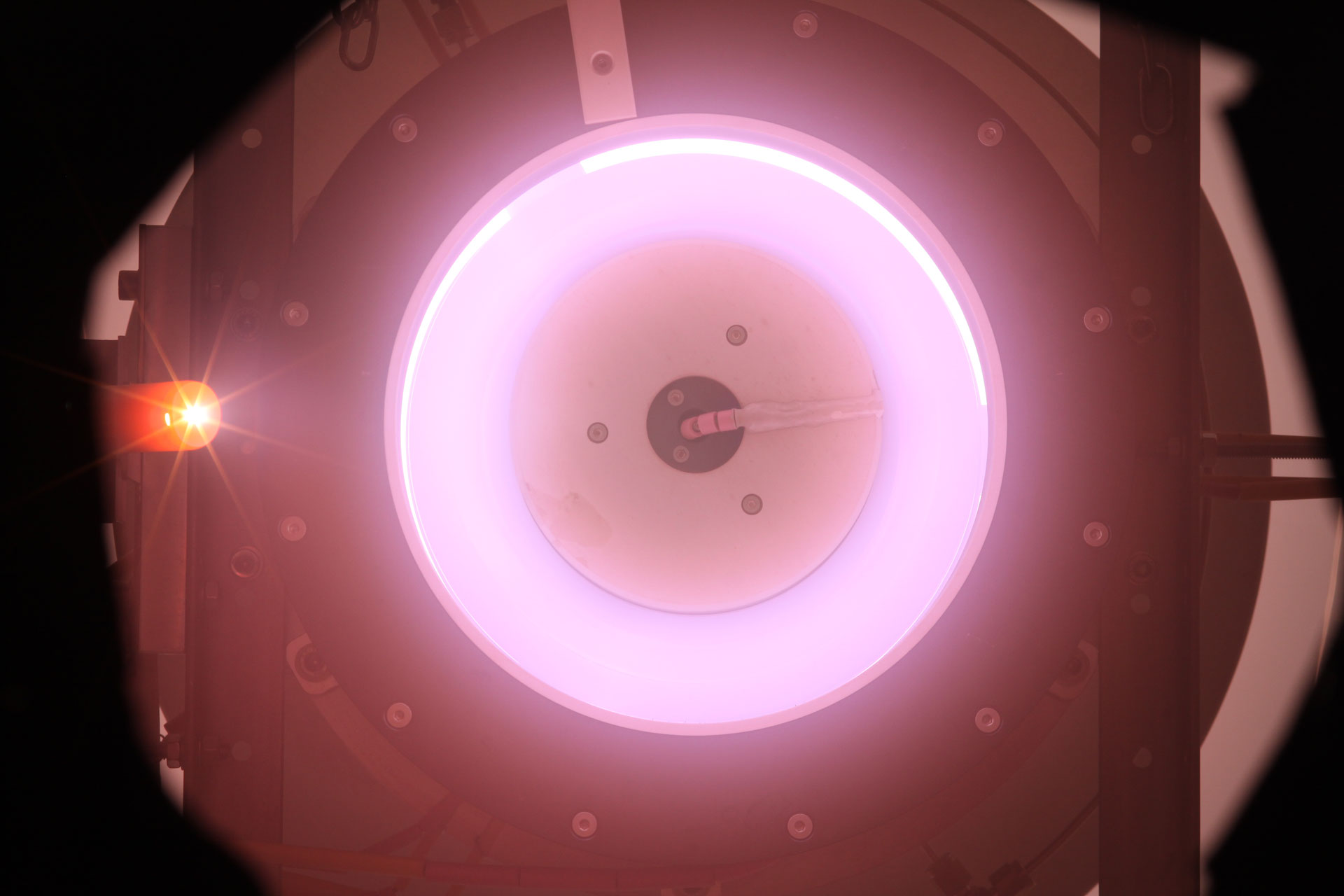
    An ESA-led team has built and fired an electric thruster to ingest scarce air molecules from the top of the atmosphere as propellant, opening the way to satellites flying in very low orbits for years on end. A complete thruster was developed for testing the concept, which was performed in a vacuum chamber by Sitael in Italy, simulating the environment at 200 km altitude. Success was demonstrated by the xenon-based blue color of the engine plume changed to purple.

    In a world-first, an ESA-led team has built and fired an electric thruster to ingest scarce air molecules from the top of the atmosphere for propellant, opening the way to satellites flying in very low orbits for years on end.

    ESA’s GOCE gravity-mapper flew as low as 250 km (155 mi) for more than four years thanks to an electric thruster that continuously compensated for air drag. However, its working life was limited by the 40 kg (88 lb) of xenon it carried as propellant – once that was exhausted, the mission was over.

    Replacing onboard propellant with atmospheric molecules would create a new class of satellites able to operate in very low orbits for long periods.

    Air-breathing electric thrusters could also be used at the outer fringes of atmospheres of other planets, drawing on the carbon dioxide of Mars, for instance.

    “This project began with a novel design to scoop up air molecules as propellant from the top of Earth’s atmosphere at around 200 km (125 mi) altitude with a typical speed of 7.8 km/s, (4.8 mi/s)” explains ESA’s Louis Walpot.
    Air Breathing Electric Propulsion System
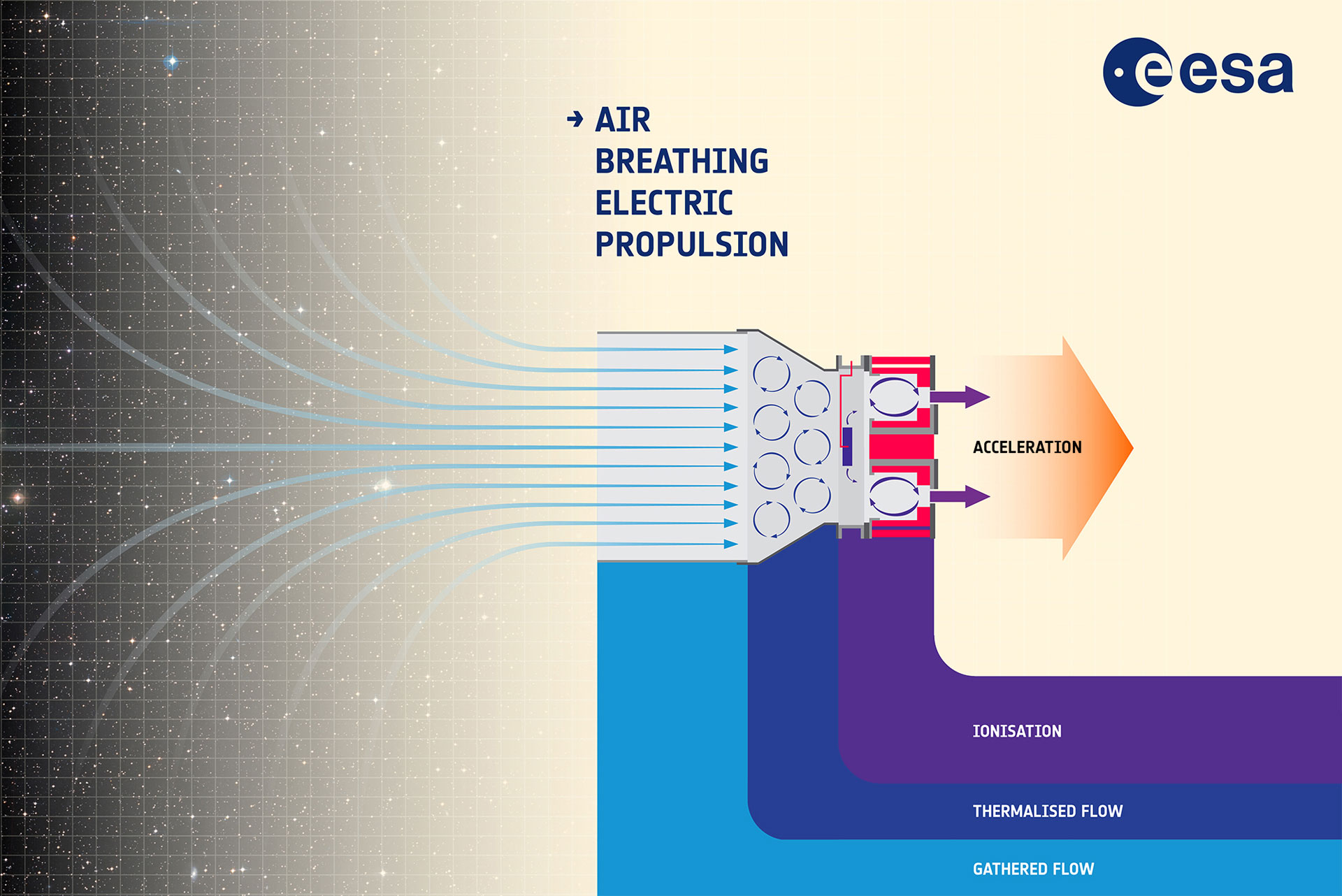
    Molecules of air at the top of the atmosphere are captured by a novel type of intake, then collected and compressed to the point of becoming thermalized ionized plasma, at which point they can be given an electric charge to accelerate them and eject them to provide thrust. Air-breathing electric propulsion could make a new class of long-lived, low-orbiting missions feasible. ESA–A. Di Giacomo

    A complete thruster was developed for testing the concept by Sitael in Italy, which was performed in a vacuum chamber in their test facilities, simulating the environment at 200 km (125 mi) altitude.

    A ‘particle flow generator’ provided the oncoming high-speed molecules for collection by the Ram-Electric Propulsion novel intake and thruster.

    There are no valves or complex parts – everything works on a simple, passive basis. All that is needed is power to the coils and electrodes, creating an extremely robust drag-compensation system.
    Newly Developed Ion Thruster
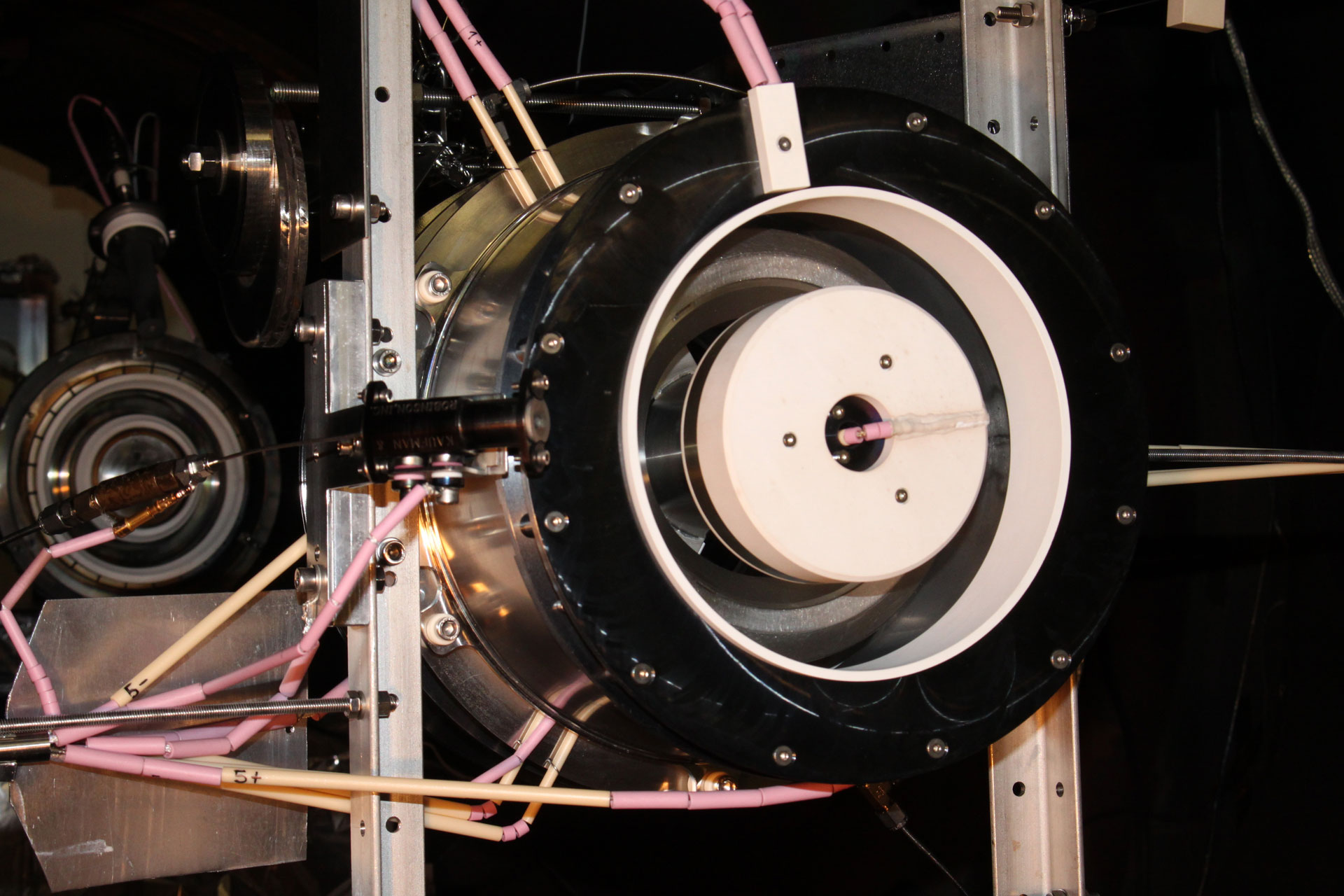
    The air-breathing electric propulsion test set-up inside its vacuum chamber at Sitael in Italy. The Hall Effect Thruster can be seen in the foreground, and behind it the particle flow generator used to generate a simulated flow of orbital-velocity air. ESA

    The challenge was to design a new type of intake to collect the air molecules so that instead of simply bouncing away they are collected and compressed.

    The molecules collected by the intake designed by QuinteScience in Poland are given electric charges so that they can be accelerated and ejected to provide thrust.

    Sitael designed a dual-stage thruster to ensure better charging and acceleration of the incoming air, which is harder to achieve than in traditional electric propulsion designs.

    “The team ran computer simulations on particle behavior to model all the different intake options,” adds Louis, “but it all came down to this practical test to know if the combined intake and thruster would work together or not.”

    “Instead of simply measuring the resulting density at the collector to check the intake design, we decided to attach an electric thruster. In this way, we proved that we could indeed collect and compress the air molecules to a level where thruster ignition could take place, and measure the actual thrust.”

    “At first we checked our thruster could be ignited repeatedly with xenon gathered from the particle beam generator.”

    ESA Researchers Build Electric Ion Thruster
    The air-breathing thruster was initially run with standard xenon propellant, causing a bluish plume, which was then progressively replaced with a mixture of nitrogen and oxygen to represent Earth’s atmosphere. Success was marked by the thruster plume changing to purple. ESA/Sitael

    As a next step, Louis explains, the xenon was partially replaced by a nitrogen–oxygen air mixture: “When the xenon-based blue color of the engine plume changed to purple, we knew we’d succeeded.”

    “The system was finally ignited repeatedly solely with atmospheric propellant to prove the concept’s feasibility.”

    “This result means air-breathing electric propulsion is no longer simply a theory but a tangible, working concept, ready to be developed, to serve one day as the basis of a new class of missions.”

    This project was backed through ESA’s Technology Research Programme for developing promising new ideas for space, with the support of the Agency’s Earth Observation Program.

    Never miss a breakthrough: Join the SciTechDaily newsletter.
    Follow us on Google and Google News.

    European Space Agency Satellites
    Share. Facebook Twitter Pinterest LinkedIn Email Reddit

    Related Articles

    3D Bioprinting Artificial Bone for Emergency Medicine in Space

    Metal Fuels – One of the Most Promising Fuels for the Future?

    Galileo Satellites Help Rescue Sailor in Solo Round-the-World Yacht Race After Raging Waves Pounded His Vessel Apart

    Move Over Plastic: Desktop 3D Printing in Metal and Ceramics

    Artistic Enigma Decoded by Robotic X-ray Scanner

    Space Technology Used for Cleaner and Greener Tennis at the French Open

    ESA AMPER: Mesh Reflector for Shaped Radio Beams

    Helicon Plasma Thruster: Plasma Propulsion for Satellites

    Access a Global View of COVID-19 Impacts Produced by an Unprecedented Collaboration of Space Agencies

    1 Comment

    1. Investigations Toronto Inc. on April 6, 2018 2:21 am

      Easy to follow, easy to read…heck I put to leave a commment!

      Reply
    Leave A Reply Cancel Reply

    • Facebook
    • Twitter
    • Pinterest
    • YouTube

    Don't Miss a Discovery

    Subscribe for the Latest in Science & Tech!

    Trending News

    Don’t Miss: A Brilliant Venus and Glowing Harvest Moon Light Up the Sky

    New Twist on the Einstein Problem Reveals Unexpected Physics

    JWST Captures Stunning Evidence of How Supermassive Black Holes Feed

    Early Exercise May Permanently Change How Much Energy the Body Uses To Move

    New Molecule Wipes Out Aggressive Lymphoma Tumors in Mice in Just 11 Days

    The Human Family Tree May Need a Major Rewrite

    Scientists Find a Surprising Cancer-Fighting Effect in Dark Sweet Cherries

    New AI Detects Hidden Warning Signs of Solar Eruptions Hours Before They Emerge

    Follow SciTechDaily
    • Facebook
    • Twitter
    • YouTube
    • Pinterest
    • Newsletter
    • RSS
    SciTech News
    • Biology News
    • Chemistry News
    • Earth News
    • Health News
    • Physics News
    • Science News
    • Space News
    • Technology News
    Recent Posts
    • Scientists May Have Finally Explained Why Astronauts Get Constipated in Space
    • Pomegranates Could Unlock a New Treatment for Heart Failure
    • Africa’s Giant Herbivores Were Disappearing Millions of Years Before Humans Could Hunt Them
    • This Utah Mountain Is Hiding Enough Ice To Fill 600 Olympic Pools
    • Vagus Nerve Stimulation Could Unlock the Brain’s Hidden Learning Potential
    Copyright © 1998 - 2026 SciTechDaily. All Rights Reserved.
    • Science News
    • About
    • Contact
    • Editorial Board
    • Privacy Policy
    • Terms of Use

    Type above and press Enter to search. Press Esc to cancel.