
Close Menu
    Facebook X (Twitter) Instagram
    SciTechDaily
    • Biology
    • Chemistry
    • Earth
    • Health
    • Physics
    • Science
    • Space
    • Technology
    Facebook X (Twitter) Pinterest YouTube RSS
    SciTechDaily
    Home»Technology»High-Entropy Alloys: Islands Without Structure Inside Metal Alloys for Tougher Materials
    Technology

    High-Entropy Alloys: Islands Without Structure Inside Metal Alloys for Tougher Materials

    By University of California San DiegoJanuary 30, 20211 Comment2 Mins Read
    Facebook Twitter Pinterest Telegram LinkedIn WhatsApp Email Reddit
    Share
    Facebook Twitter LinkedIn Pinterest Telegram Email Reddit
    Hierarchical Deformation Mechanism Paradigm
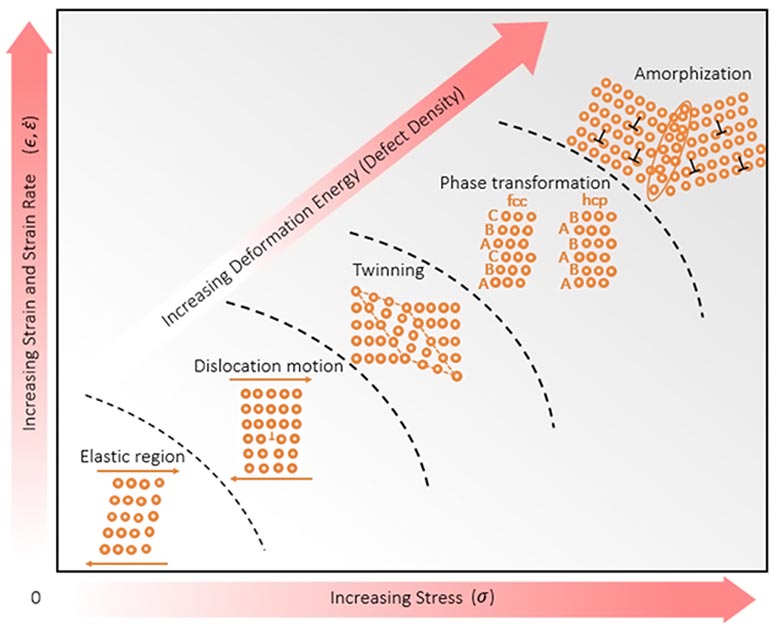
    Proposed hierarchical deformation mechanism paradigm for the equiatomic CrCoNi-based HEAs subjected to increasing degrees of deformation. Elastic deformation, dislocation-mediated plasticity, twinning-induced plasticity, TRIP, and finally solid-state amorphization. Triggering the next mechanism requires the generation of additional defects, i.e., dislocations and/or point defects (vacancies). These multiple mechanisms can interact, leading to a synergy of strengthening processes and a resulting highly complex microstructure. Credit: University of California San Diego

    A new deformation method forms ultra-strong amorphous regions in high-entropy alloys, offering exciting applications in transportation and energy.

    An international team of researchers produced islands of amorphous, non-crystalline material inside a class of new metal alloys known as high-entropy alloys.

    This discovery opens the door to applications in everything from landing gears, to pipelines, to automobiles. The new materials could make these lighter, safer, and more energy-efficient.

    The team, which includes researchers from the University of California San Diego and Berkeley, as well as Carnegie Mellon University and University of Oxford, details their findings in the January 29, 2021 issue of Science Advances.

    Unprecedented Strength Through Atomic Disorder

    “These present a bright potential for increased strength and toughness since metallic glasses (amorphous metals) have a strength that is vastly superior to that of crystalline metals and alloys,” said Marc Meyers, a professor in the Department of Mechanical and Aerospace Engineering at UC San Diego, and the paper’s corresponding author.

    Using transmission electron microscopy, which can identify the arrangement of atoms, the researchers concluded that this amorphization is triggered by extreme deformation at high velocities. It is a new deformation mechanism that can increase the strength and toughness of these high entropy alloys even further.

    The research is based on seminal work by Brian Cantor at the University of Oxford, and Jien-Wei Yeh at National Tsing Hua University in Taiwan. In 2004, both researchers led teams that reported the discovery of high-entropy alloys. This triggered a global search for new materials in the same class, driven by numerous potential applications in the transportation, energy, and defense industries.

    “Significant new developments and discoveries in metal alloys are quite rare,” Meyers said.

    Reference: “Amorphization in extreme deformation of the CrMnFeCoNi high-entropy alloy” by Shiteng Zhao, Zezhou Li, Chaoyi Zhu, Wen Yang, Zhouran Zhang, David E. J. Armstrong, Patrick S. Grant, Robert O. Ritchie and Marc A. Meyers, 29 January 2021, Science Advances.
    DOI: 10.1126/sciadv.abb3108

    Never miss a breakthrough: Join the SciTechDaily newsletter.
    Follow us on Google and Google News.

    Materials Science Nanotechnology UCSD
    Share. Facebook Twitter Pinterest LinkedIn Email Reddit

    Related Articles

    Mimicking the Mind: Quantum Material Exhibits Brain-Like “Non-Local” Behavior

    Biofuel Cell: Wearable Device Turns the Touch of a Finger Into a Source of Power

    New Material Breakthrough for Stable High-Voltage Long-Life Solid-State Batteries

    Nanoengineers Develop ‘Nanosponge Vaccine’ to Fight MRSA Toxins

    Repeating Patterns Dictate Optical Properties of Nanoparticle Arrays

    Spray Paint Battery Can be Painted on Virtually Any Surface

    Nano-Sandwich Design Results in Slimmer Solar Cells With Decreased Costs

    SLIPS Prevents Ice From Sticking on Metal Surfaces

    3D Self-Assembling Polymer Materials Could Lead to New Microchips

    1 Comment

    1. Clyde Spencer on January 31, 2021 8:30 am

      “These high-entropy allows …”

      I presume that what was meant was “alloys,” not “allows.” One needs to spell check the spell checker!

      Reply
    Leave A Reply Cancel Reply

    • Facebook
    • Twitter
    • Pinterest
    • YouTube

    Don't Miss a Discovery

    Subscribe for the Latest in Science & Tech!

    Trending News

    New Study Reveals Why Ozempic Works Better for Some People Than Others

    Climate Change Is Altering a Key Greenhouse Gas in a Way Scientists Didn’t Expect

    New Study Suggests Gravitational Waves May Have Created Dark Matter

    Scientists Discover Why the Brain Gets Stuck in Schizophrenia

    Scientists Engineer “Tumor-Eating” Bacteria That Devour Cancer From Within

    Even “Failed” Diets May Deliver Long-Term Health Gains, Study Finds

    NIH Scientists Discover Powerful New Opioid That Relieves Pain Without Dangerous Side Effects

    Collapsing Plasma May Hold the Key to Cosmic Magnetism

    Follow SciTechDaily
    • Facebook
    • Twitter
    • YouTube
    • Pinterest
    • Newsletter
    • RSS
    SciTech News
    • Biology News
    • Chemistry News
    • Earth News
    • Health News
    • Physics News
    • Science News
    • Space News
    • Technology News
    Recent Posts
    • Household Cats Could Hold the Secret to Fighting Breast Cancer
    • Scientists Say This Natural Hormone Reverses Obesity by Targeting the Brain
    • This 15,000-Year-Old Discovery Changes What We Know About Early Human Creativity
    • 35-Million-Year-Old Mystery: Strange Arachnid Discovered Preserved in Amber
    • Revolutionary Gas Turbine Generates Power Without Air Compression
    Copyright © 1998 - 2026 SciTechDaily. All Rights Reserved.
    • Science News
    • About
    • Contact
    • Editorial Board
    • Privacy Policy
    • Terms of Use

    Type above and press Enter to search. Press Esc to cancel.