
Close Menu
    Facebook X (Twitter) Instagram
    SciTechDaily
    • Biology
    • Chemistry
    • Earth
    • Health
    • Physics
    • Science
    • Space
    • Technology
    Facebook X (Twitter) Pinterest YouTube RSS
    SciTechDaily
    Home»Space»HETDEX Dark Energy Experiment Begins Full Operations
    Space

    HETDEX Dark Energy Experiment Begins Full Operations

    By Penn State UniversityDecember 24, 20201 Comment6 Mins Read
    Facebook Twitter Pinterest Telegram LinkedIn WhatsApp Email Reddit
    Share
    Facebook Twitter LinkedIn Pinterest Telegram Email Reddit
    Hobby-Eberly Telescope at Dusk
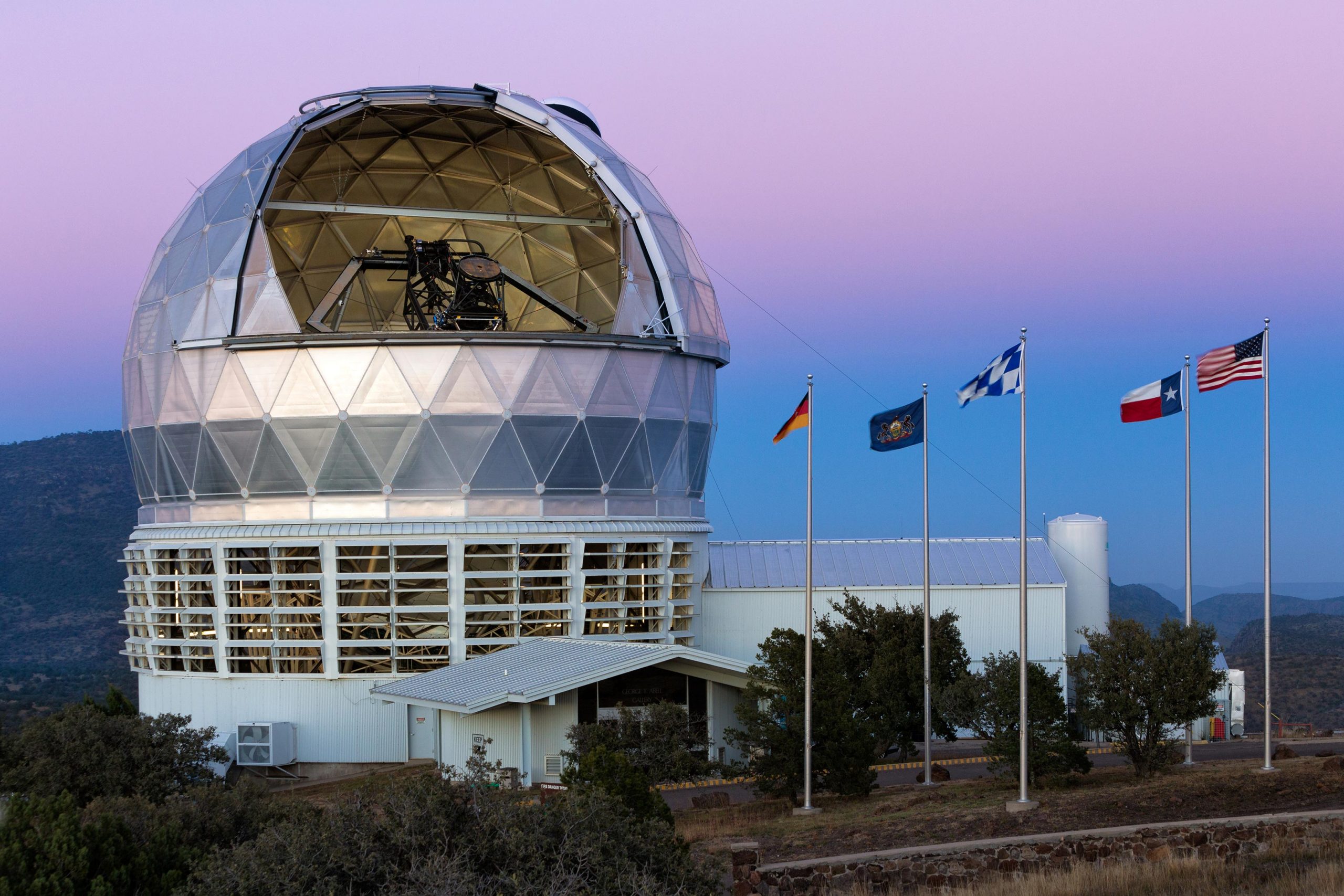
    The Hobby-Eberly Telescope at dusk. The flags of the four partner institutions fly with the U.S. flag outside the open dome. Credit: Ethan Tweedie Photography

    Three years after its initial test observations, the Hobby-Eberly Telescope Dark Energy Experiment (HETDEX) is now training its full suite of instrumentation to reveal the nature and evolution of dark energy, the mysterious entity that is the primary constituent of the universe.

    HETDEX, which is a large international consortium led by the University of Texas at Austin and involves approximately 100 scientists including Penn State researchers, plans to construct one of the largest maps of the cosmos ever made. The three-dimensional map of 2.5 million galaxies will help astronomers to better understand why the expansion of the universe is currently accelerating.

    “Penn State is delighted to be a participant in this fundamental scientific investigation,” said Donald Schneider, a member of the Hobby-Eberly Telescope (HET) Board of Directors and Distinguished Professor and Head of Penn State’s Department of Astronomy and Astrophysics. “The telescope’s innovative design was by two Penn State astronomers, Lawrence Ramsey and Daniel Weedman, and a number of Penn State astronomers are playing important roles in the observations and data analysis in HETDEX.”
    Hobby Eberly Telescope Saddlebags
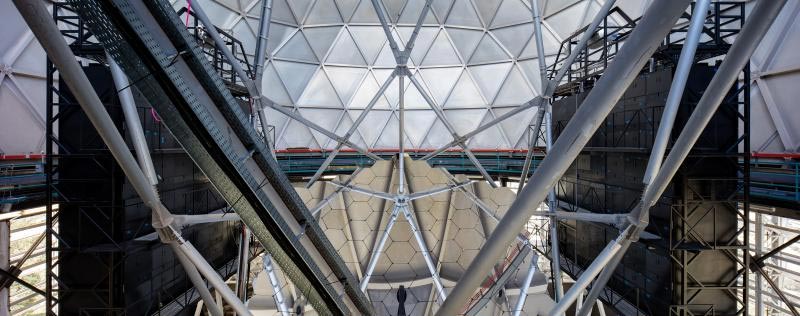
    The two black structures to the left and right of the Hobby-Eberly Telescope’s main mirror are nicknamed ‘saddlebags.’ They hold the dozens of spectrographs that make up the VIRUS instrument designed to undertake HETDEX, the Hobby-Eberly Telescope Dark Energy Experiment. Credit: Ethan Tweedie Photography

    HETDEX is using the 10-meter HET, located at McDonald Observatory in western Texas, to obtain data from two large regions of the sky; one field is in the direction of the Big Dipper, the other is slightly southwest of the constellation of Orion. Each time the telescope is pointed at these regions, which typically last 20 minutes, HETDEX’s instrumentation records approximately 32,000 spectra, capturing the cosmic fingerprint of the light from every object within the 10-meter telescope’s field of view.

    “HETDEX has arrived,” said University of Texas astronomer Karl Gebhardt, who is the survey’s project scientist. “We’re over a third of the way through our program now, and we have this fantastic dataset that we’re going to use to measure the dark energy evolution.”

    HETDEX is a “blind” survey; rather than pointing at specific targets, it records light from all sources over a specific patch of sky. These spectra are recorded via 32,000 optical fibers that feed into more than 100 instruments working together as a single spectrograph. This assembly, the Visible Integral-field Replicable Unit Spectrograph (VIRUS), is a complex system consisting of dozens of copies of an instrument working together for efficiency. VIRUS was designed and built especially for HETDEX.
    Hobby Eberly Telescope Focal Surface
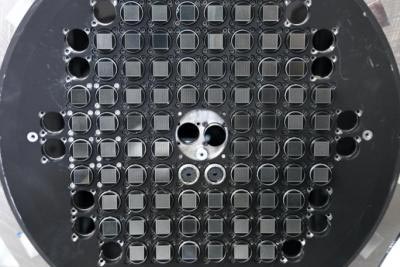
    This image shows the ‘focal surface’ of the Hobby-Eberly Telescope, where the optical fibers of VIRUS are arrayed. The circles each contain a square grid of 448 fibers. When the telescope is pointed and VIRUS takes an observation, each of the 32,000 fibers takes a spectrum simultaneously, recording a vast array of information on the speed, direction, and chemical makeup of every point inside the field of view, which is about the size of the full Moon. Credit: J. Pautzke/E. Mrozinski/G. Hill/HETDEX Collaboration

    Building VIRUS “was quite a task to orchestrate,” said Gary Hill, a University of Texas astronomer and the designer of the instrument. “It’s the largest on many measures,” he said, noting that it has the most optical fibers, as well as having as much detector area as the largest astronomical cameras. VIRUS is also an extremely imposing instrument, claiming much of the volume inside the telescope dome.

    The HETDEX team expects to complete their observations by December 2023. In total, the completed survey will include one billion spectra, “the largest ever spectral survey by far,” Gebhardt said.

    “To investigate the properties of dark matter and its evolution, we must identify a few million galaxies of a specific type in the roughly one billion HETDEX spectra and create a map of their three-dimensional distribution,” explained Donghui Jeong, associate professor of astronomy and astrophysics at Penn State and leader of the HETDEX science group investigating large scale structures in the universe. “By examining the locations of these galaxies, we can compare the observations to models of dark energy and determine the influence of ordinary matter, dark matter, and dark energy at various points in the history of the universe.”
    HETDEX Pinwheel Galaxy
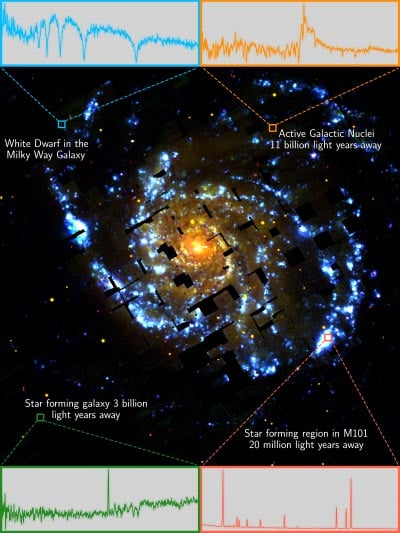
    This false-color image of the Pinwheel Galaxy (Messier 101) shows the power of the VIRUS instrument built for the HETDEX survey. The image is a mosaic made up of the central portion of 21 VIRUS pointings across a region of sky about half the size of the full Moon, with some small gaps in coverage. The colors show the contrast between young stars (blue/white) and older stars (red/orange). The breakout boxes show just four examples of the ‘cosmic fingerprint’ of objects in this view. Clockwise from top left: a white dwarf in our galaxy, an active galaxy 11 billion light-years away, a star-forming region in the Pinwheel Galaxy 20 million light-years away, and a star-forming galaxy 3 billion light-years away. Credit: G. Zeimann/HETDEX Collaboration

    Other Penn State HETDEX participants include Professor of Astronomy and Astrophysics Robin Ciardullo, who is the observations manager for HETDEX, Research Professor Caryl Gronwall, and Associate Professor Derek Fox.

    “The galaxies that will be studied in HETDEX are from the universe’s distant past,” said Gronwall. “The light we detect left these objects approximately ten billion years ago, when the universe was but a few billion years of age.”

    Taft Armandroff, director of The University of Texas at Austin’s McDonald Observatory and Chair of the HET Board of Directors, noted, “HETDEX represents the coming together of many astronomers and institutions to conduct the first major study of how dark energy changes over time.”

    HETDEX is led by The University of Texas at Austin McDonald Observatory and Department of Astronomy with participation from Penn State; Ludwig Maximilians University, Munich; the Max Planck Institute for Extraterrestrial Physics; the Institute for Astrophysics, Gottingen; the Leibniz Institute for Astrophysics, Potsdam; Texas A&M University; The University of Oxford; the Max Planck Institute for Astrophysics; The University of Tokyo; and the Missouri University of Science and Technology.

    In addition to Institutional support, HETDEX is funded by the National Science Foundation (grant AST-0926815), the State of Texas, the US Air Force (AFRL FA9451-04-2-0355), and generous support from private individuals and foundations.

    Never miss a breakthrough: Join the SciTechDaily newsletter.
    Follow us on Google and Google News.

    Astronomy Astrophysics Dark Energy Penn State University
    Share. Facebook Twitter Pinterest LinkedIn Email Reddit

    Related Articles

    Finding “Missing” Matter: New Light on Baryonic Matter and Gravity on Cosmic Scales

    Model Developed for the Distribution of Inner Planetary Systems May Help Unravel Cosmic Mystery

    Spinning Disks, Oddball Stars, and Strange Planets Help Astronomers Test Theories About Planetary System Formation

    New Dark Matter Map Reveals Hidden Bridges Between Galaxies

    Dark Energy Experiment 16 Years in the Making Could Illuminate Origin, Evolution, Fate of Universe

    New Breakthrough Towards Understanding Dark Energy

    New Model Raises Doubt About the Composition of 70% of Our Universe – Dark Energy May Simply Not Exist!

    Giant 2D Atlas of the Universe Created – Helps Dark Energy Spectroscopic Survey

    Shining a New Light on Dark Energy: DES Releases Catalog of 700 Million Objects

    1 Comment

    1. xABBAAA on December 27, 2020 9:46 am

      … no, no, no, …
      … just tell me the outcome…

      Reply
    Leave A Reply Cancel Reply

    • Facebook
    • Twitter
    • Pinterest
    • YouTube

    Don't Miss a Discovery

    Subscribe for the Latest in Science & Tech!

    Trending News

    Breakthrough Bowel Cancer Trial Leaves Patients Cancer-Free for Nearly 3 Years

    Natural Compound Shows Powerful Potential Against Rheumatoid Arthritis

    100,000-Year-Old Neanderthal Fossils in Poland Reveal Unexpected Genetic Connections

    Simple “Gut Reset” May Prevent Weight Gain After Ozempic or Wegovy

    2.8 Days to Disaster: Scientists Warn Low Earth Orbit Could Suddenly Collapse

    Common Food Compound Shows Surprising Power Against Superbugs

    5 Simple Ways To Remember More and Forget Less

    The Atomic Gap That Could Cost the Semiconductor Industry Billions

    Follow SciTechDaily
    • Facebook
    • Twitter
    • YouTube
    • Pinterest
    • Newsletter
    • RSS
    SciTech News
    • Biology News
    • Chemistry News
    • Earth News
    • Health News
    • Physics News
    • Science News
    • Space News
    • Technology News
    Recent Posts
    • Scientists Print Artificial Neurons That Can Talk to the Brain
    • Bowel and Ovarian Cancers Are Dramatically Rising in Young Adults and Scientists Aren’t Sure Why
    • Alzheimer’s May Begin Decades Earlier Than You Think, New Mayo Clinic Study Finds
    • The Hidden Risk of Taking Breaks From Weight-Loss Drugs Like Ozempic
    • Total Solar Eclipse Made Cities Go Eerily Quiet Beneath the Surface
    Copyright © 1998 - 2026 SciTechDaily. All Rights Reserved.
    • Science News
    • About
    • Contact
    • Editorial Board
    • Privacy Policy
    • Terms of Use

    Type above and press Enter to search. Press Esc to cancel.