
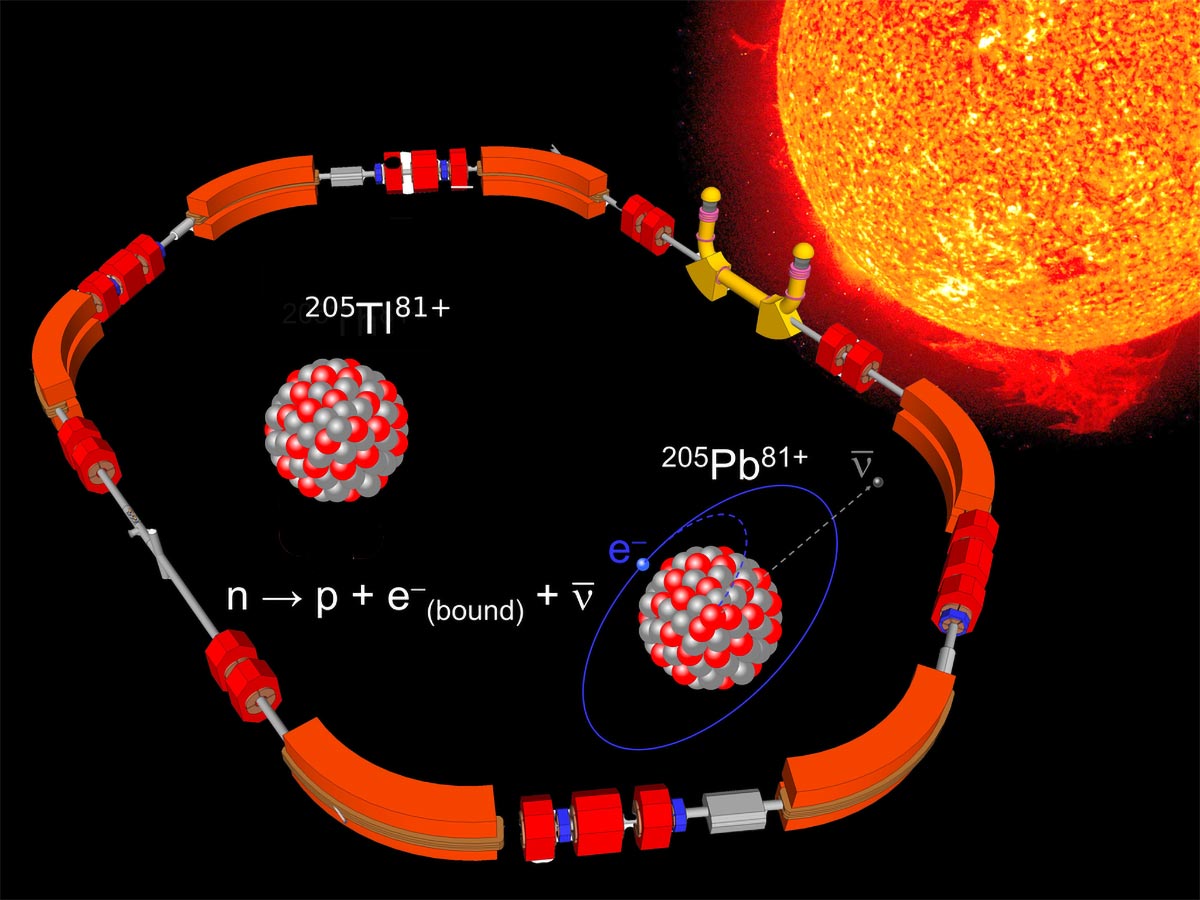
The LOREX experiment utilizes lorandite ore to gauge historical solar neutrino flux, revealing insights about the Sun’s development and climatic effects through advanced decay rate measurements.
The Sun, Earth’s life-sustaining powerhouse, generates immense energy through nuclear fusion while emitting a steady stream of neutrinos — subatomic particles that reveal its inner workings. While modern neutrino detectors shed light on the Sun’s current behavior, key questions remain about its stability over millions of years — a timeframe encompassing human evolution and major climate changes.
Addressing these questions is the mission of the LORandite EXperiment (LOREX), which depends on accurately determining the solar neutrino cross-section for thallium. An international team of scientists has now achieved this crucial measurement using the unique Experimental Storage Ring (ESR) at GSI/FAIR in Darmstadt. Their groundbreaking results, advancing our understanding of the Sun’s long-term stability, have been published in the journal Physical Review Letters.
LOREX and Solar Neutrino Research
LOREX is the longest-running geochemical experiment focused on measuring solar neutrinos. Proposed in the 1980s, its goal is to determine the average solar neutrino flux over an extraordinary four-million-year period, corresponding to the geological age of the lorandite ore.
Solar neutrinos produced by the Sun interact with thallium (Tl) atoms found in the mineral lorandite (TlAsS2), converting them into lead (Pb) atoms. The isotope 205Pb is especially significant due to its long half-life of 17 million years, meaning it remains stable throughout the four-million-year timespan of the lorandite ore.
Since directly measuring the neutrino interaction cross-section with 205Tl is currently not feasible, researchers at GSI/FAIR in Darmstadt, Germany, devised an innovative approach. They focused on a key nuclear physics property known as the nuclear matrix element, which influences both the neutrino interaction rate and the bound-state beta decay of fully ionized 205Tl81+ to 205Pb81+. This clever method allowed them to extract essential data needed for calculating the neutrino cross-section.
Unique Experimental Capabilities at GSI/FAIR
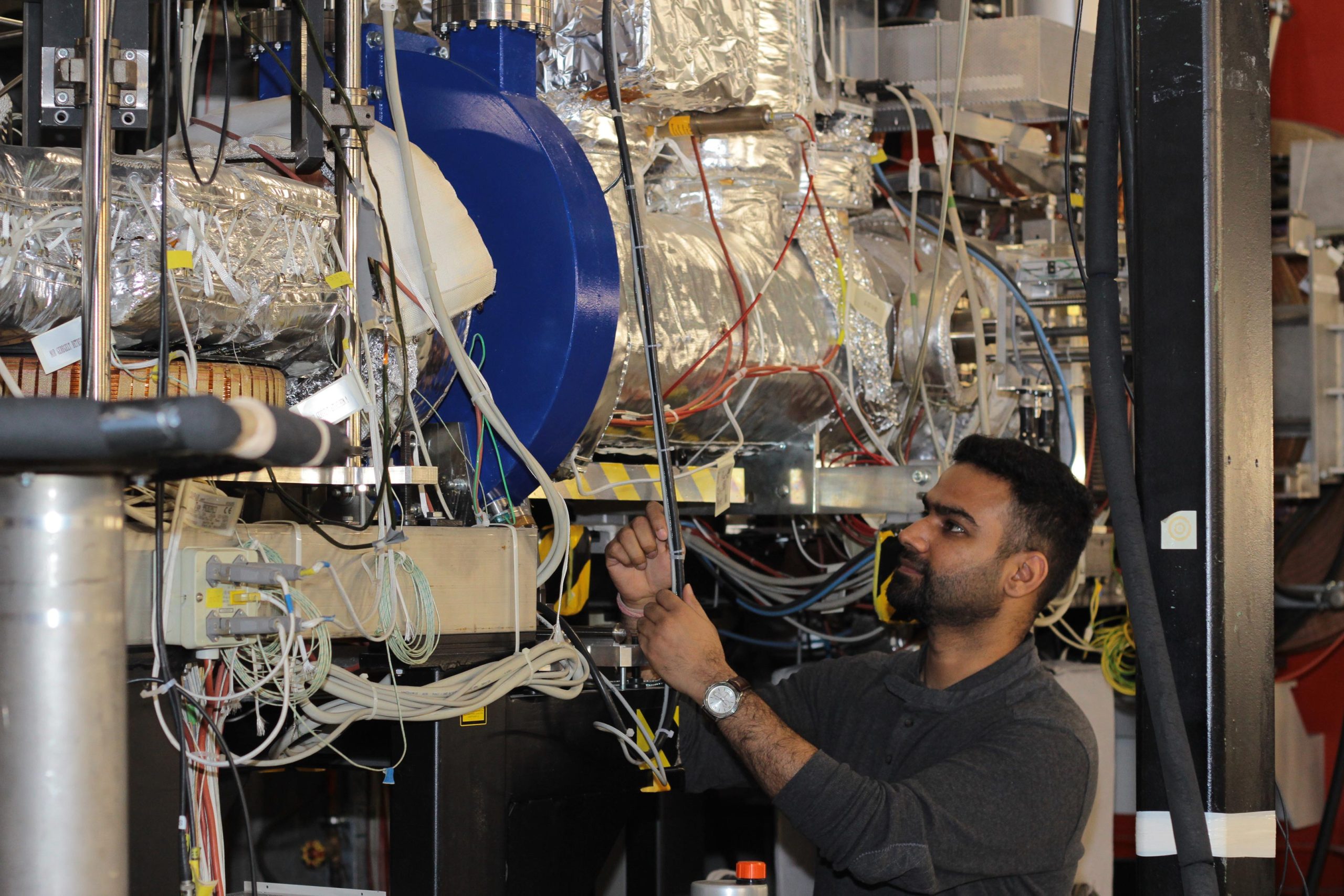
The experimental measurement of the half-life of the bound-state beta decay of fully ionized 205Tl81+ ions was only possible thanks to the unique capabilities of the Experimental Storage Ring (ESR) at GSI/FAIR. The ESR is presently the only facility where such measurements are feasible. The 205Tl81+ ions were produced using nuclear reactions in GSI/FAIR’s Fragment Separator (FRS) and then stored long enough for its decay to be observed and successfully measured in the storage ring. “Decades of continuous advancements in accelerator technology made it possible to generate an intense and pure 205Tl81+ ion beam and measure its decay with high precision,” said Professor Yuri A. Litvinov, spokesperson for the experiment and principal investigator of the European Research Council (ERC) Consolidator Grant ASTRUm.
Insights from Solar Neutrinos and Earth’s Climate
“The team measured the half-life of 205Tl81+ beta decay to be 291 (+33/-27) days, a key measurement which allows to determine the Solar neutrino capture cross-section,” explained Dr. Rui-Jiu Chen, a postdoctoral research associate involved in the project. Once the concentration of 205Pb atoms in the lorandite minerals is determined by the LOREX project, it will be possible to provide insights into the Sun’s evolutionary history and its connection to Earth’s climate over millennia.
Contributions to Nuclear Astrophysics
“This milestone experiment highlights the power of nuclear astrophysics in answering fundamental questions about the universe,” said Professor Gabriel Martínez-Pinedo and Dr. Thomas Neff, who led the theoretical work to convert the measurement into the neutrino cross-section.
Dr. Ragandeep Singh Sidhu, the first author of the publication, emphasized its broader significance: “This experiment highlights how a single, albeit challenging, measurement can play a pivotal role in addressing significant scientific questions related to the evolution of our Sun.”
Reference: “Bound-State Beta Decay of 205Tl81+ Ions and the LOREX Project” by E121 Collaboration and LOREX Collaboration, R. S. Sidhu, G. Leckenby, R. J. Chen, R. Mancino, T. Neff, Yu. A. Litvinov, G. Martínez-Pinedo, G. Amthauer, M. Bai, K. Blaum, B. Boev, F. Bosch, C. Brandau, V. Cvetković, T. Dickel, I. Dillmann, D. Dmytriiev, T. Faestermann, O. Forstner, B. Franczak, H. Geissel, R. Gernhäuser, J. Glorius, C. J. Griffin, A. Gumberidze, E. Haettner, P.-M. Hillenbrand, P. Kienle, W. Korten, Ch. Kozhuharov, N. Kuzminchuk, K. Langanke, S. Litvinov, E. Menz, T. Morgenroth, C. Nociforo, F. Nolden, M. K. Pavićević, N. Petridis, U. Popp, S. Purushothaman, R. Reifarth, M. S. Sanjari, C. Scheidenberger, U. Spillmann, M. Steck, Th. Stöhlker, Y. K. Tanaka, M. Trassinelli, S. Trotsenko, L. Varga, M. Wang, H. Weick, P. J. Woods, T. Yamaguchi, Y. H. Zhang, J. Zhao and K. Zuber, 2 December 2024, Physical Review Letters.
DOI: 10.1103/PhysRevLett.133.232701
The publication is dedicated to the memory of late colleagues Fritz Bosch, Hans Geissel, Paul Kienle, and Fritz Nolden, whose contributions were integral to the success of this project.
Never miss a breakthrough: Join the SciTechDaily newsletter.
Follow us on Google and Google News.
1 Comment
The Sun, Earth’s life-sustaining powerhouse, generates immense energy through nuclear fusion while emitting a steady stream of neutrinos — subatomic particles that reveal its inner workings.
Ask the researchers:
What is the spatiotemporal background of the sun and so-called neutrinos?
If neutrinos is the most abundant particle (or matter) with mass, why do today’s physics need to look around for it? Scientific research guided by correct theories can help people avoid detours, failures, and exaggeration. The physical phenomena observed by researchers in experiments are always appearances, never the natural essence of things. The natural essence of things needs to be extracted and sublimated based on mathematical theories via appearances , rather than being imagined arbitrarily.
For example:
A paper called “Question of Parity Conservation in Weak Interactions”. Which published by Physical Review (PR) in October 1956. In which the question of parity conservation in β decays and in hyperon and meson decays is examined. Possible experiments are suggested which might test parity conservation in these interactions.
However, there are not clear evidence to support the inference and the possible experiments.
Here’s why,
1. If we don’t understand how θ & τ was formed, there will be no clear evidence to infer parity violation of them in weak interaction.
2. There is no clear evidence to suggest that two sets of cobalt-60 can be transformed into symmetry by rotating in opposite directions. Similarly, the motion of two hydrogen atoms – electrons around the nucleus – may not necessarily be symmetrical at the same time, even via reverse rotation.
The mathematics had clearly told us that the topological vortex gravitational field can evolve into a complex space-time structure from the cusp singularity. However, contemporary physics has always regarded understanding as muddle headed and been blindly inferring from unfounded assumptions. Wrong world outlook and scientific outlook may mislead a generation, even several generations.
Topological vortex and its twin anti-vortex exhibit parity conservation (P), charge conjugation (C) and time reversal (T) symmetry. The physical real mirror image of nature can be exist between the topological vortex and its twin anti-vortex, not must be between the high-dimensional space-time matters formed by their interaction.
It is meaningless to discuss the CP of two particles (or things) that are not mirror images of each other. This type of discussion is full of deception and misleading. Its absurd aspect lies in:
1. Firstly, subjectively determine that two particles (or things) are mirror images of each other.
2. Subsequently, experimental detection revealed that the two particles (or things) are asymmetric.
The experiment showed that the previous subjective determination was incorrect. According to common sense, it should be concluded that the two particles (or things) are not mirror images of each other.
However, physical science today does not do so. Their conclusion is:
The two particles (or things) that are mirror images of each other are asymmetric.
This blatant sophistry and misleading behavior is undoubtedly lacks the spirit of science.
— –Extracted from https://scitechdaily.com/microscope-spacecrafts-most-precise-test-of-key-component-of-the-theory-of-general-relativity/#comment-811427.
Their groundbreaking results have been published in the journal Physical Review Letters. CP violation, God particles, Devil particles and Neutrinos are the spirit and hope of today’s physics.