
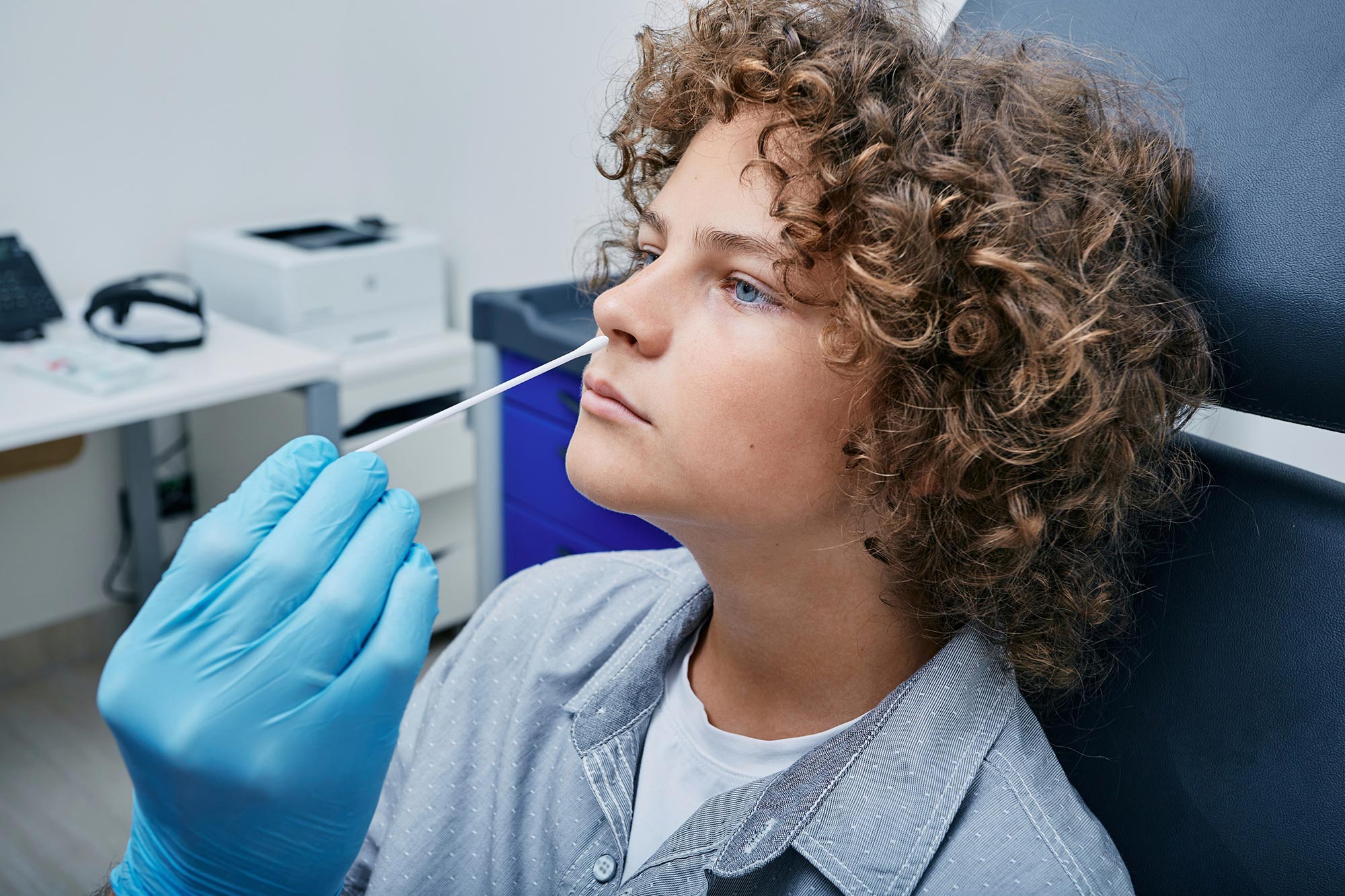
Researchers have unveiled a groundbreaking nasal swab test for diagnosing specific asthma endotypes in children, particularly among vulnerable populations like Puerto Rican and African American youths.
This non-invasive test promises to revolutionize how asthma is diagnosed and treated, paving the way for more precise medication prescriptions and targeted treatments.
Revolutionary Nasal Swab Test for Asthma
Researchers at the University of Pittsburgh have created a nasal swab test designed to identify specific asthma subtypes, known as endotypes, in children. This non-invasive method aims to improve the precision of asthma treatment, allowing doctors to tailor medications more effectively. It also opens the door to research on better therapies for lesser-known asthma types that have been challenging to diagnose accurately.
The study, published today (January 2) in JAMA, analyzed data from three independent U.S. studies focusing on Puerto Rican and African American children. These groups experience higher rates of asthma and face a greater risk of asthma-related deaths compared to their non-Hispanic White peers.

Addressing Asthma in Vulnerable Populations
“Asthma is the most common chronic disease of childhood, and it disproportionately affects Black and Puerto Rican children, so it’s essential that we develop new therapies to better treat these young patients,” said senior author Juan Celedón, M.D., Dr.P.H., professor of pediatrics at Pitt and chief of pulmonary medicine at UPMC Children’s Hospital of Pittsburgh. “Because asthma is a highly variable disease with different endotypes, which are driven by different immune cells and respond differently to treatments, the first step toward better therapies is accurate diagnosis of endotype.”
Traditionally, asthma has been classified into endotypes known as T2-high or T2-low based on the amount of T helper 2 inflammation present. More recently, T2-low has been split into two endotypes: T17-high, which has less T helper 2 inflammation and more T helper 17 inflammation, and low-low, which has low levels of both types of inflammation.
Enhancing Asthma Diagnosis in Children
Precise diagnosis of endotype usually involves genetic analysis of a lung tissue sample taken by a procedure called a bronchoscopy, which is done under general anesthesia. For children, especially those with milder disease, it’s not feasible or ethical to perform this invasive procedure, so clinicians have had to rely on imperfect tools, including immune markers in the blood, lung function, and whether or not they have allergies.
“These tests allow us to presume whether a child has T2-high disease or not,” said Celedón. “But they are not 100% accurate, and they cannot tell us whether a child has T17-high or low-low disease. There is no clinical marker for these two subtypes. This gap motivated us to develop better approaches to improve the accuracy of asthma endotype diagnosis.”
Advancements in Asthma Treatment Research
Celedón and his team, including first authors Molin Yue, M.S., a Pitt graduate student, and Kristina Gaietto, M.D., M.P.H., instructor of pediatrics at Pitt, collected nasal samples from 459 youth across three different studies. Then they analyzed the expression of eight T2 and T17 signature genes.
As expected, analysis of nasal swab samples revealed a patient’s endotype. Across studies, 23% to 29% of participants had T2 high, 35% to 47% had T17-high and 30% to 38% had low-low endotype.
Implications for Future Asthma Management
For treating severe T2-high asthma, there is a powerful new class of drugs called biologics, which target the immune cells that drive disease. However, no available asthma biologics directly target T17-high and low-low endotypes.
“We have better treatments for T2-high disease, in part, because better markers have propelled research on this endotype,” said Celedón. “But now that we have a simple nasal swab test to detect other endotypes, we can start to move the needle on developing biologics for T17-high and low-low disease.”
This rapid test for asthma endotype could also help push forward other areas of asthma research.
“One of the million-dollar questions in asthma is why some kids get worse as they enter puberty, some stay the same and others get better. Before puberty, asthma is more common in boys, but the incidence of asthma goes up in females in adulthood,” said Celedón. “Is this related to endotype? Does endotype change over time or in response to treatments? We don’t know. But now that we can easily measure endotype, we can start to answer these questions.”
National Response and Future Directions
Gustavo Matute-Bello, M.D., acting director of the Division of Lung Diseases at the National Heart, Lung, and Blood Institute, part of the National Institutes of Health (NIH) added, “Having tools to test which biological pathways have a major role in asthma in children, especially those who have a disproportionate burden of disease, may help achieve our goal of improving asthma outcomes. This research has the potential to pave the way for more personalized treatments, particularly in minority communities. More studies are needed.”
Reference: “Transcriptomic Profiles in Nasal Epithelium and Asthma Endotypes in Youth” by Molin Yue, Kristina Gaietto, Yueh Ying Han, Franziska J. Rosser, Zhongli Xu, Christopher Qoyawayma, Edna Acosta-Perez, Glorisa Canino, Erick Forno, Wei Chen and Juan C. Celedón, 2 January 2025, JAMA.
DOI: 10.1001/jama.2024.22684
Other authors on the study were Yueh Ying Han, Ph.D., Franziska J. Rosser, M.D., M.P.H., Zhongli Xu, Christopher Qoyawayma, B.S.E., Erick Forno, M.D., M.P.H., and Wei Chen, Ph.D., all of Pitt and UPMC; and Edna Acosta-Perez, Ph.D., and Glorisa Canino, Ph.D., both of the University of Puerto Rico.
This research was supported by the NIH (HL079966, HL117191, HL150431, HL119952, UL1TR001857, HL129949, K08 HL159333 and HL149693).
This content is solely the responsibility of the authors and does not necessarily represent the official views of the NIH.
Never miss a breakthrough: Join the SciTechDaily newsletter.
Follow us on Google and Google News.