
Close Menu
    Facebook X (Twitter) Instagram
    SciTechDaily
    • Biology
    • Chemistry
    • Earth
    • Health
    • Physics
    • Science
    • Space
    • Technology
    Facebook X (Twitter) Pinterest YouTube RSS
    SciTechDaily
    Home»Science»How Climate Change Led to the Fall of an Ancient Civilization
    Science

    How Climate Change Led to the Fall of an Ancient Civilization

    By Rochester Institute of TechnologySeptember 5, 20201 Comment3 Mins Read
    Facebook Twitter Pinterest Telegram LinkedIn WhatsApp Email Reddit
    Share
    Facebook Twitter LinkedIn Pinterest Telegram Email Reddit
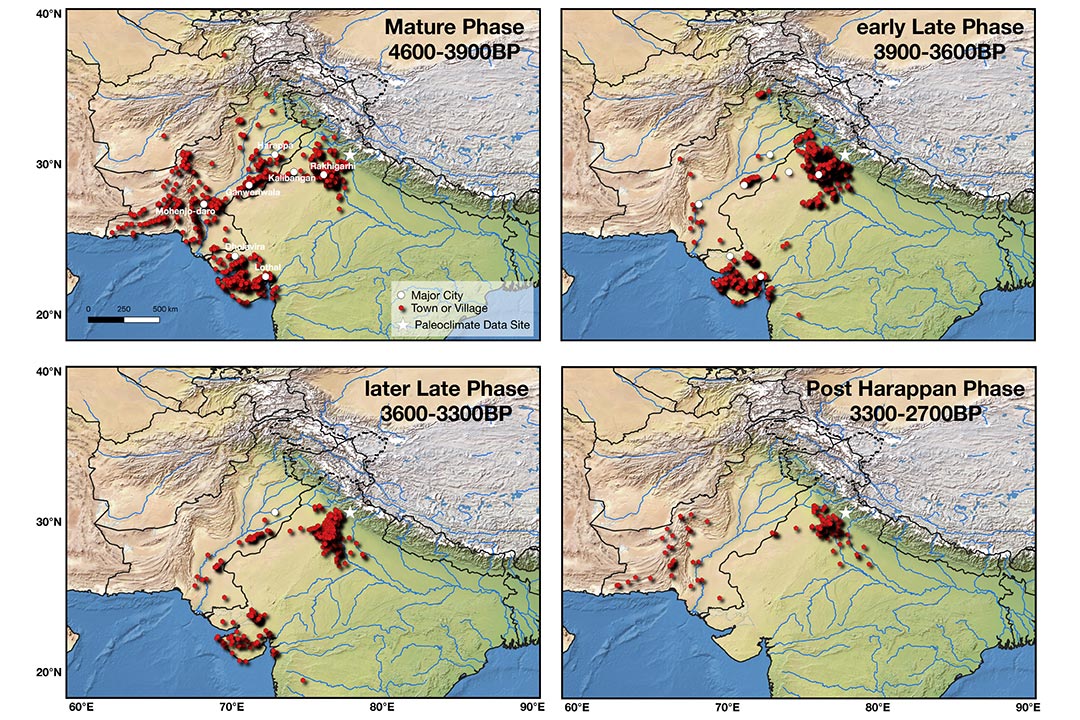
    Settlements of the Indus Valley Civilization
    This figure shows the settlements of the Indus Valley Civilization during different phases of its evolution. RIT Assistant Professor Nishant Malik developed a mathematical method that shows climate change likely caused the rise and fall of the ancient civilization. Credit: RIT

    Chaos paper by RIT Assistant Professor Nishant Malik applies method to Indus Valley Civilization.

    A Rochester Institute of Technology researcher developed a mathematical method that shows climate change likely caused the rise and fall of an ancient civilization. In an article recently featured in the journal Chaos: An Interdisciplinary Journal of Nonlinear Science, Nishant Malik, assistant professor in RIT’s School of Mathematical Sciences, outlined the new technique he developed and showed how shifting monsoon patterns led to the demise of the Indus Valley Civilization, a Bronze Age civilization contemporary to Mesopotamia and ancient Egypt.

    Nishant Malik
    Nishant Malik. Credit: RIT

    Malik developed a method to study paleoclimate time series, sets of data that tell us about past climates using indirect observations. For example, by measuring the presence of a particular isotope in stalagmites from a cave in South Asia, scientists were able to develop a record of monsoon rainfall in the region for the past 5,700 years. But as Malik notes, studying paleoclimate time series poses several problems that make it challenging to analyze them with mathematical tools typically used to understand climate.

    “Usually the data we get when analyzing paleoclimate is a short time series with noise and uncertainty in it,” said Malik. “As far as mathematics and climate is concerned, the tool we use very often in understanding climate and weather is dynamical systems. But dynamical systems theory is harder to apply to paleoclimate data. This new method can find transitions in the most challenging time series, including paleoclimate, which are short, have some amount of uncertainty and have noise in them.”

    There are several theories about why the Indus Valley Civilization declined—including invasion by nomadic Indo-Aryans and earthquakes—but climate change appears to be the most likely scenario. But until Malik applied his hybrid approach— rooted in dynamical systems but also draws on methods from the fields of machine learning and information theory—there was no mathematical proof. His analysis showed there was a major shift in monsoon patterns just before the dawn of this civilization and that the pattern reversed course right before it declined, indicating it was in fact climate change that caused the fall.

    Malik said he hopes the method will allow scientists to develop more automated methods of finding transitions in paleoclimate data and leads to additional important historical discoveries. The full text of the study is published in Chaos: An Interdisciplinary Journal of Nonlinear Science.

    Never miss a breakthrough: Join the SciTechDaily newsletter.
    Follow us on Google and Google News.

    Algorithm Archaeology Climate Change Mathematics Popular Rochester Institute of Technology
    Share. Facebook Twitter Pinterest LinkedIn Email Reddit

    Related Articles

    Archaeologists Discover That Ancient Islamic Tombs Cluster Like Galaxies

    Surprise Discovery of African “Climate Seesaw” Changes View of Human Evolution

    Christmas Cookie Conundrum: The Ever-Elusive Riddle Even Math Experts Have Given Up on Solving

    Humanity’s Oldest Sculptures: Researchers New Theory on “Venus” Figurines May Have Solved Mystery

    Newly Discovered Fossil Shows Evolutionary Changes in an Extinct Human Species

    New Biochemical Research Shows Past Tropical Forest Changes Drove Megafauna and Hominin Extinctions

    Math Riddle From the 1980’s Finally Solved – Could Be Used to Improve Phones and Computers

    Prolonged Drought Contributed to Maya Civilization’s Collapse

    The Algorithmic Approach to the Mathematics of Cramming

    1 Comment

    1. Thomas Guarino on September 1, 2024 8:24 am

      So “climate chang” isn’t caused by man.

      Reply
    Leave A Reply Cancel Reply

    • Facebook
    • Twitter
    • Pinterest
    • YouTube

    Don't Miss a Discovery

    Subscribe for the Latest in Science & Tech!

    Trending News

    Hair Loss May Be an Overlooked Side Effect of Ozempic and Mounjaro

    Scientists Develop a Groundbreaking Chip That Operates at Brain-Like Speed

    Viagra May Block a Hidden Pathway Cancer Cells Need To Spread

    How Brown Tree Snakes Became an Unstoppable Invasive Species

    Earth’s First Complex Organisms May Hold Clues to Life Beyond Our Planet

    A 25,000-Year-Old Ritual Tradition Was Hidden Beneath This Cave Floor

    Plant Compounds in Berries, Tea, and Cocoa May Support Healthy Brain Aging

    Scientists Turn an Old Antibiotic Back Into a Superbug Killer

    Follow SciTechDaily
    • Facebook
    • Twitter
    • YouTube
    • Pinterest
    • Newsletter
    • RSS
    SciTech News
    • Biology News
    • Chemistry News
    • Earth News
    • Health News
    • Physics News
    • Science News
    • Space News
    • Technology News
    Recent Posts
    • Rocks From the Moon’s Far Side Are Rewriting Lunar History
    • NASA’s Curiosity Finds a Vast Sea of Mysterious Polygons on Mars
    • Astronomers May Have Found the First Moon Beyond Our Solar System
    • Underwater Cameras Expose the Secret Lives of Whale Sharks
    • A Massive Study Reveals the Brain Is Far More Flexible Than We Thought
    Copyright © 1998 - 2026 SciTechDaily. All Rights Reserved.
    • Science News
    • About
    • Contact
    • Editorial Board
    • Privacy Policy
    • Terms of Use

    Type above and press Enter to search. Press Esc to cancel.