
Close Menu
    Facebook X (Twitter) Instagram
    SciTechDaily
    • Biology
    • Chemistry
    • Earth
    • Health
    • Physics
    • Science
    • Space
    • Technology
    Facebook X (Twitter) Pinterest YouTube RSS
    SciTechDaily
    Home»Space»How Does Binary Star System AR Scorpii Emit Energy
    Space

    How Does Binary Star System AR Scorpii Emit Energy

    By Jessica Sieff, University of Notre DameSeptember 13, 2017No Comments4 Mins Read
    Facebook Twitter Pinterest Telegram LinkedIn WhatsApp Email Reddit
    Share
    Facebook Twitter LinkedIn Pinterest Telegram Email Reddit
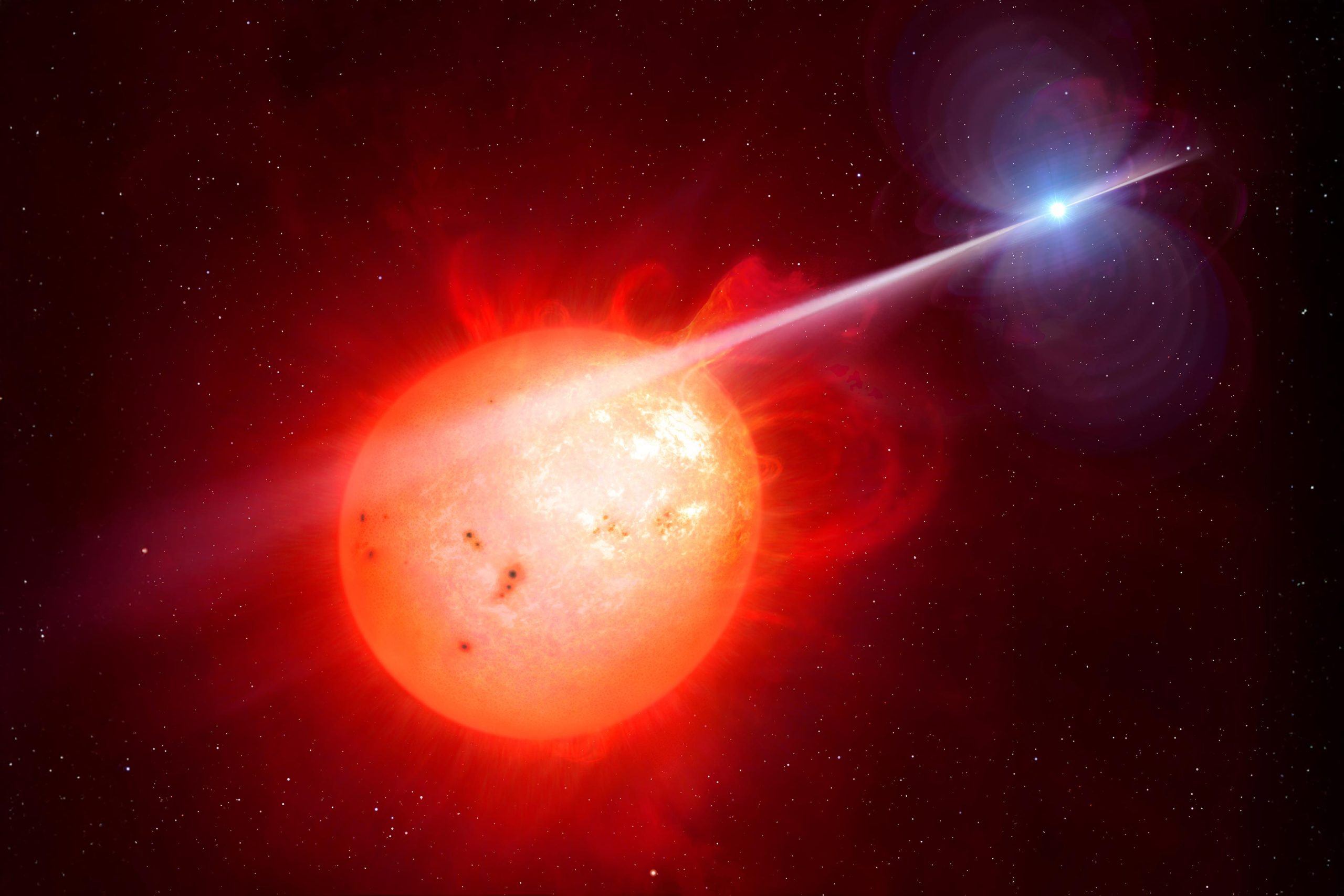
    Exotic Binary Star System AR Scorpii Artist’s Impression
    This artist’s impression shows the strange object AR Scorpii. In this unique double star a rapidly spinning white dwarf star (right) powers electrons up to almost the speed of light. These high energy particles release blasts of radiation that lash the companion red dwarf star (left) and cause the entire system to pulse dramatically every 1.97 minutes with radiation ranging from the ultraviolet to radio. Credit: M. Garlick, University of Warwick, ESO

    New research from Notre Dame lends support to an existing theory of how binary star system AR Scorpii emits energy.

    Astronomers studying the unique binary star system AR Scorpii have discovered the brightness of the system has changed over the past decade. The new evidence lends support to an existing theory of how the unusual star emits energy. AR Scorpii consists of a rapidly spinning, magnetized white dwarf star that mysteriously interacts with its companion star. The system was recently found to more than double in brightness on timescales of minutes and hours, but research recently published in The Astrophysical Journal Letters found variability on a timescale of decades.

    Researchers at the University of Notre Dame analyzed data on the unique system from the Kepler Space Telescope’s K2 mission taken in 2014 before the star was known to be unusual. The data was then compared with archival sky survey images going back to 2004 to look for long-term changes in the light curve of AR Scorpii. The binary’s light curve is unique, in that it exhibits a spike in emission every two minutes as well as a major brightness variation over the approximately 3.5-hour orbital period of the two stars.

    “One model of this system predicts long-term variations in the way the two stars interact. It was not known what the time scale of these changes might be — whether 20 to 200 years. By looking at the K2 and archival data, we were able to show that in addition to hourly changes in the system, there are variations occurring over decades,” said Peter Garnavich, professor and department chair of astrophysics and cosmology physics at Notre Dame.

    A white dwarf is a very dense remnant of a star like the sun. When a solar-like star runs out of energy, gravity compresses its core to about the size of the Earth but with a mass 300,000 times higher. A teaspoon-sized piece of a white dwarf would weigh about 15 tons. The compression of the star can also amplify its magnetic field strength and its spin rate.

    The unique system became famous in 2016 when researchers in England discovered that AR Scorpii, believed to be a mundane solitary star, was actually a rapidly varying binary. The system is remarkable as the white dwarf spins on its axis at an incredibly fast rate, causing flashes in luminosity every two minutes. The amplitude of the flashes varies over the 3.5-hour orbital period, something no other white dwarf binary system is known to do.

    “We found that back 12 years ago, AR Scorpii’s peak brightness came a bit later in its orbit than it does now,” said Colin Littlefield, research associate working with Garnavich. “This does not solve the mystery, but it is another piece to the puzzle that is AR Scorpii.”

    The team at Notre Dame has been observing the system with the Sarah L. Krizmanich Telescope at the University’s Jordan Hall of Science, and they plan to publish those results in an upcoming paper.

    Co-authors of the study include Notre Dame Naughton Fellow Mark Kennedy, Paul Callanan at University College Cork, Benjamin Shappee at Carnegie Observatories and Thomas Holoien at The Ohio State University.

    Research was funded in part by NASA.

    Reference: “Long-term Photometric Variations in the Candidate White-dwarf Pulsar AR Scorpii from K2, CRTS, and ASAS-SN Observations” by Colin Littlefield, Peter Garnavich, Mark Kennedy Paul Callanan Benjamin Shappee and Thomas Holoien, 10 August 2017, The Astrophysical Journal Letters.
    DOI: 10.3847/2041-8213/aa8300

    Never miss a breakthrough: Join the SciTechDaily newsletter.
    Follow us on Google and Google News.

    Astronomy Astrophysics Cosmology Stellar Evolution University of Notre Dame
    Share. Facebook Twitter Pinterest LinkedIn Email Reddit

    Related Articles

    These Massive Stars 10,000x Heavier Than the Sun Ruled Early Universe

    Astronomers Discover Density Waves in Protoplanetary Disk Surrounding Elias 2-27

    ALMA Reveals the First Hot Core Found Outside the Milky Way

    Harvard Astrophysicists Examine the Properties of Pre-Stellar Cores

    Astronomers Reveal How Stars Reach Masses of More Than a Hundred Times Our Sun

    Astronomers Discover VFTS 352 – The Hottest and Most Massive Touching Double Star System to Date

    Survey of Carina Nebula Reveals Details of Star Formation

    Slow-Growing Galaxies Help Reveal How the Very First Stars in Our Universe Formed

    New Model Shows How a Collapsing Star Results in Two Black Holes that Form and Fuse

    Leave A Reply Cancel Reply

    • Facebook
    • Twitter
    • Pinterest
    • YouTube

    Don't Miss a Discovery

    Subscribe for the Latest in Science & Tech!

    Trending News

    One of the Universe’s Largest Stars May Be Getting Ready To Explode

    Scientists Discover Enzyme That Could Supercharge Ozempic-Like Weight Loss Drugs

    Popular Sweetener Linked to DNA Damage – “It’s Something You Should Not Be Eating”

    Ancient “Rock” Microbes May Reveal How Complex Life Began

    Researchers Capture Quantum Interference in One of Nature’s Rarest Atoms

    “A Plague Is Upon Us”: The Mass Death That Changed an Ancient City Forever

    Scientists Discover Game-Changing New Way To Treat High Cholesterol

    This Small Change to Your Exercise Routine Could Be the Secret to Living Longer

    Follow SciTechDaily
    • Facebook
    • Twitter
    • YouTube
    • Pinterest
    • Newsletter
    • RSS
    SciTech News
    • Biology News
    • Chemistry News
    • Earth News
    • Health News
    • Physics News
    • Science News
    • Space News
    • Technology News
    Recent Posts
    • Scientists Prove There Are Just Six Degrees of Separation in a Social Network
    • Bee Bacteria Could Fix a Major Flaw in Plant-Based Milk
    • Scientists Discover a Surprising Way To Make Bread Healthier and More Nutritious
    • Natural Compounds Boost Bone Implant Success While Killing Bacteria and Cancer Cells
    • After 60 Years, Scientists Uncover Unexpected Brain Effects of Popular Diabetes Drug Metformin
    Copyright © 1998 - 2026 SciTechDaily. All Rights Reserved.
    • Science News
    • About
    • Contact
    • Editorial Board
    • Privacy Policy
    • Terms of Use

    Type above and press Enter to search. Press Esc to cancel.