
A special issue of the journal Brain Plasticity explores research on how exercise-induced activation of peripheral systems may improve cognitive function and delay or prevent the onset of neurodegenerative diseases.
A growing body of research shows that exercise can enhance brain function and delay, or even prevent, the onset of neurodegenerative diseases such as Alzheimer’s and Parkinson’s disease. Although the underlying mechanisms still remain unclear, recent research indicates that exercise-induced activation of peripheral systems such as muscle, gut, liver, and adipose tissue may affect neural plasticity. A special issue of the journal Brain Plasticity presents new research and insights on neural plasticity and the role of peripheral factors in cognitive health.
“At least a dozen peripheral factors have been identified that affect neurotrophin levels, adult neurogenesis, inflammation, synaptic plasticity, and memory function,” explained co-Guest Editor and journal Editor-in-Chief Henriette van Praag, PhD, Charles E. Schmidt College of Medicine and Brain Institute, Florida Atlantic University.
Key Proteins in Neuroprotection: CTSB and BDNF
Cathepsin B (CTSB), a myokine, and brain-derived neurotrophic factor (BNDF) have been found to possess robust neuroprotective effects. In a new study presented in the special issue, investigators examined whether increasing aerobic exercise intensity would increase the amount of CTSB and BDNF circulating in the blood. Sixteen young healthy subjects were selected as participants and completed treadmill-based aerobic exercise at maximum capacity and then at 40%, 60%, and 80% of capacity.
After each bout of exercise, blood samples were taken to measure circulating CTSB and BDNF, and CTSB protein, BDNF protein, and mRNA expression were measured in skeletal tissue. Scientists discovered that high-intensity exercise elevates circulating CTSB in young adults immediately after exercise, and that skeletal muscle tissue expresses both message and protein of CTSB and BDNF.
“CTSB and BDNF are promising therapeutic targets that may delay the onset and progression of cognitive impairments,” said lead investigator Jacob M. Haus, PhD, School of Kinesiology, University of Michigan. “Future studies are needed to elucidate the mechanisms regulating their release, processing, and fiber-type specific role in skeletal muscle tissue.”
Exercise’s Role in Cognitive Control and Memory
The special issue of Brain Plasticity also shares new research that CTSB may play a role in cognitive control by modulating processing speed, and that both moderate-intensity and high-intensity interval exercise increase serum BDNF levels and working memory performance in young adult females.
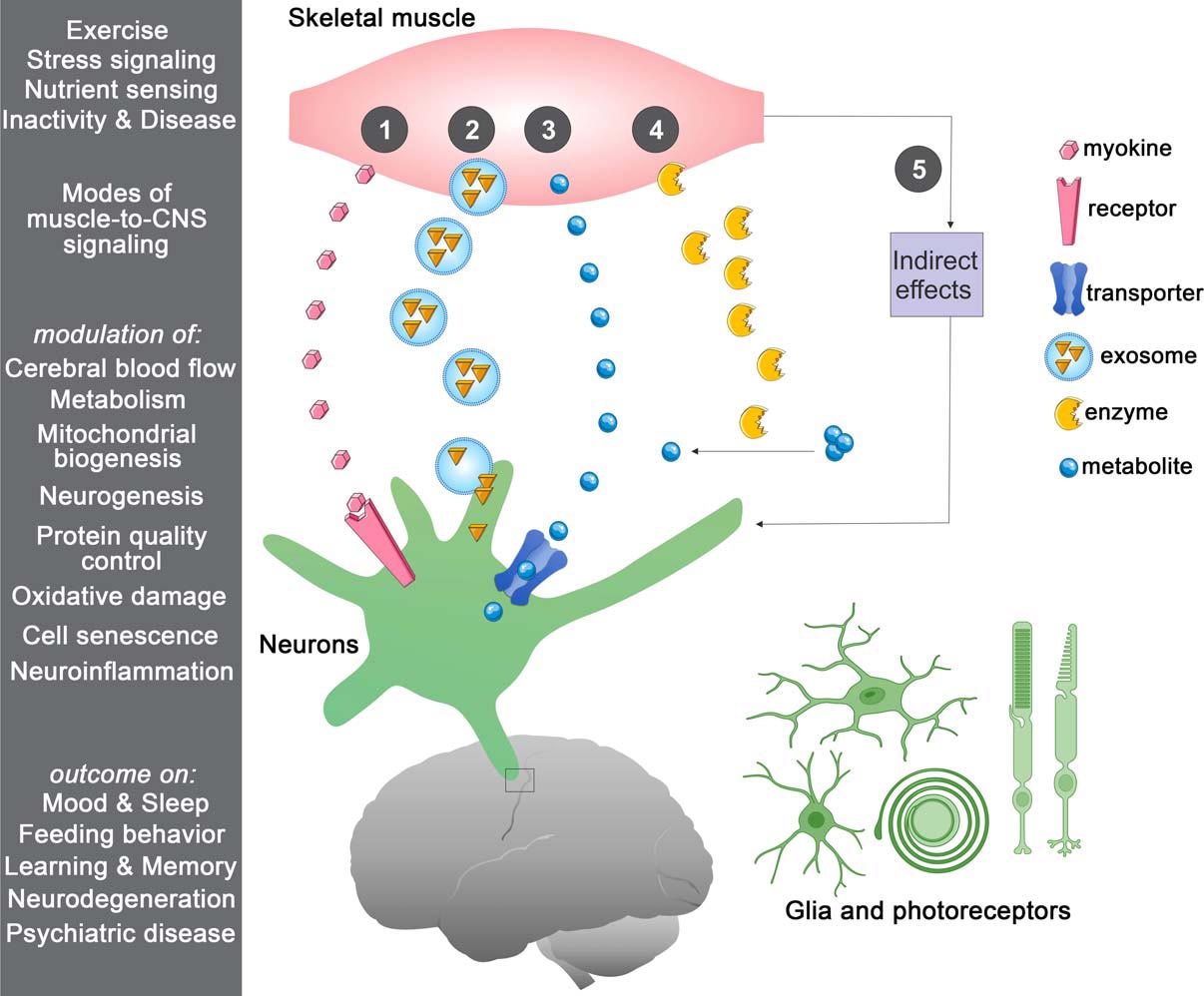
Five review articles cover interorgan crosstalk between muscle, liver, adipose tissue, the gut microbiome, and the brain. While it is well known that exercise protects the central nervous system, it has only recently been found to depend on the endocrine capacity of skeletal muscle. In their review, co-authors Mamta Rai, PhD, and Fabio Demontis, PhD, both of the Department of Developmental Neurobiology, St. Jude Children’s Research Hospital, highlight the impact of myokines, metabolites, and other unconventional factors that mediate effects of muscle-brain and muscle-retina communication on neurogenesis, neurotransmitter synthesis, proteostasis, mood, sleep, cognitive function and feeding behavior following exercise.
They also raise the possibility that detrimental myokines resulting from inactivity and muscle disease states could become a novel focus for therapeutic intervention. “We propose that tailoring muscle-to-central nervous system signaling by modulating myokines and myometabolites may combat age-related neurodegeneration and brain diseases that are influenced by system signals,” they said.
Sex Differences in Exercise Response and Neurodegeneration
Men and women exhibit differences in their biological responses to physical activities and also in their vulnerabilities to the onset, progression, and outcomes of neurodegenerative disease. A review by co-authors Constanza J. Cortes, PhD, University of Alabama at Birmingham, and Zurine De Miguel, PhD, California State University, discusses emerging research on the sex-specific differences in immune system response to exercise as a potential mechanism by which physical activity affects the brain.
“Individual findings suggest that the immune response to exercise might be increased in females, but additional studies are needed,” Dr. Cortes and Dr. De Miguel observed. “Cross-disciplinary research integrating neuroscience, exercise physiology, and geroscience is needed to explain sex differences in cognitive aging and age-related neurodegenerative disease, and to develop novel therapeutic targets.”
Interplay of Brain and Adipose Tissue in Cognitive Health
Research on cross-talk between the brain and adipose tissue, particularly on a hormone that can cross the BBB and has been shown to improve neuronal function in animal models of Alzheimer’s disease; accumulating evidence that neurogenesis can be regulated by the gut microbiome; and research on effects of exercise and diet on hippocampal BDNF signaling, which suggest approaches to the treatment of neurodegenerative conditions are also reviewed.
“The research collected in this issue corroborates the importance of exercise for memory function,” said co-Guest Editor Christiane D. Wrann, PhD, DVM, Massachusetts General Hospital and Harvard Medical School. “We are pleased to share this exciting special issue. In the coming years likely many more systemic molecules relevant to the brain will be discovered and may provide a basis for novel therapeutic approaches to neurodegenerative diseases.”
References:
“High Intensity Acute Aerobic Exercise Elicits Alterations in Circulating and Skeletal Muscle Tissue Expression of Neuroprotective Exerkines” by Corey E. Mazo, Edwin R. Miranda, James Shadiow, Michael Vesia and Jacob M. Haus, 21 October 2022, Brain Plasticity.
DOI: 10.3233/BPL-220137
“Muscle-to-Brain Signaling Via Myokines and Myometabolites” by Mamta Rai and Fabio Demontis, 21 October 2022, Brain Plasticity.
DOI: 10.3233/BPL-210133
“Precision Exercise Medicine: Sex Specific Differences in Immune and CNS Responses to Physical Activity” by Constanza J. Cortes and Zurine De Miguel, 21 October 2022, Brain Plasticity.
DOI: 10.3233/BPL-220139
Never miss a breakthrough: Join the SciTechDaily newsletter.
Follow us on Google and Google News.