
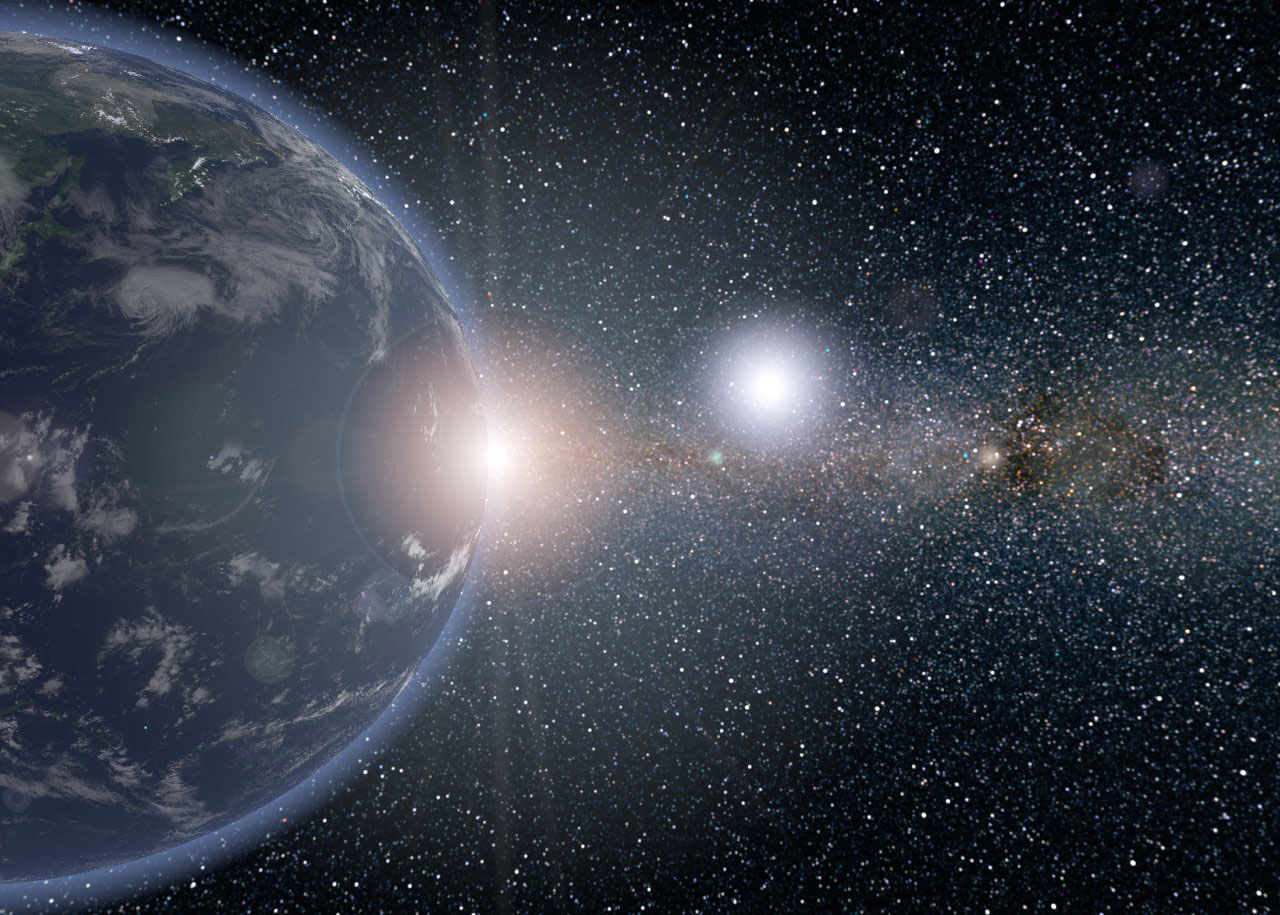
In a new study published today in the Astrophysical Journal, researchers from New York University Abu Dhabi and NASA’s Jet Propulsion Laboratory (JPL) in Pasadena, CA, share new findings about how the presence of “giant” planets (between 10 and 1000 times as large as the Earth) affects potentially habitable neighbors that would be discovered with the next generation of ground-based and space-borne telescopes.
The researchers, led by Research Associate Nikolaos Georgakarakos of the department of physics at NYU Abu Dhabi, report in Giant Planets: Good Neighbors for Habitable Worlds that even after planets have formed with enough water on their surface to potentially support life, “giant” planets can continue to change their orbits and impact their continued habitability in positive or negative ways.
The habitable zone is the region around a star where a planet with an Earth-like atmosphere on a circular orbit can support liquid water on its surface.
Studying 147 extrasolar planetary systems with giant planets (with the parameters of these systems taken from NASA’s exoplanet archive), Georgakarakos and colleagues found that, in most cases, the presence of “giant neighbors” would reduce a terrestrial planet’s chances to remain habitable, even when the terrestrial planet is on a stable orbit. A stable orbit means that the terrestrial planet is not ejected from the system, or pushed to the outskirts. It is important that the complex gravitational interactions between the star, the terrestrial planet, and its ”giant neighbor” result in a stable orbit for the Earth-like planet as the development and evolution of life on a planet require long timescales.
“While in the majority of investigated systems the presence of the gas ‘giants’ shrank the habitable zone, they still left sufficient room for habitable Earth-like planets to be there,” said Georgakarakos. “This is an important insight to inform follow-up investigations. It would not make sense to search for Earth 2.0 in a system where a giant planet stirs the orbit of any neighboring terrestrial planet in the habitable zone so much that its climate collapses.”
Added Siegfried Eggl, associate researcher at JPL: “Perhaps most surprisingly, our findings suggest that, under certain conditions, the presence of a giant planet can actually increase the size of the habitable zone, which is the area where your terrestrial planet receives the right amount of light in order to support liquid water on its surface. This is quite remarkable since the continuous gravitational pull of giant planets on their terrestrial neighbors mostly spells trouble for habitability.”
By providing specific constraints on when precisely giant planets become “bad neighbors,” Georgakarakos, Eggl, and Ian Dobbs-Dixon, NYUAD assistant professor of physics, were able to identify prime targets in the ongoing search for a “second Earth.” “The general idea is the farther away the giant planet is from the habitable zone, the better. For planets that are similar to our Earth that is actually true. What we showed, however, is that this may not necessarily be the case for Earth-like planets with a climate less sensitive to changes in the incoming radiation,” Georgakarakos said.
Reference: “Giant Planets: Good Neighbors for Habitable Worlds?” by Nikolaos Georgakarakos, Siegfried Eggl and Ian Dobbs-Dixon, 4 April 2018, The Astrophysical Journal.
DOI: 10.3847/1538-4357/aaaf72
Never miss a breakthrough: Join the SciTechDaily newsletter.
Follow us on Google and Google News.