
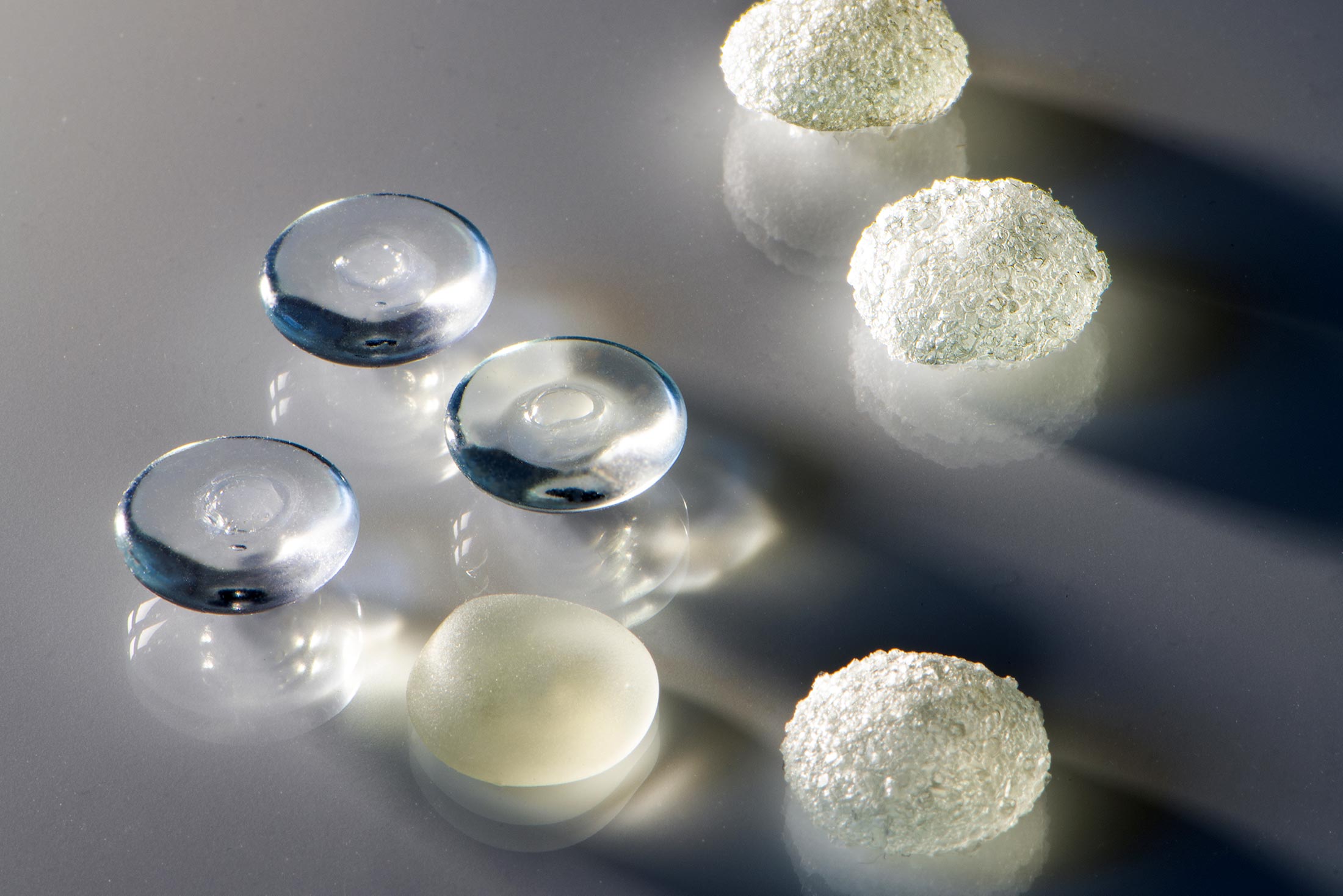
Implant surface topography can influence the development of scarring, inflammation, and other complications, researchers find.
Every year, about 400,000 people receive silicone breast implants in the United States. According to data from the U.S. Food and Drug Administration, a majority of those implants need to be replaced within 10 years due to the buildup of scar tissue and other complications.
A team led by MIT researchers has now systematically analyzed how the varying surface architecture found in these implants influences the development of adverse effects, which in rare cases can include an unusual type of lymphoma.
“The surface topography of an implant can drastically affect how the immune response perceives it, and this has important ramifications for the [implants’] design,” says Omid Veiseh, a former MIT postdoc. “We hope this paper provides a foundation for plastic surgeons to evaluate and better understand how implant choice can affect the patient experience.”
The findings could also help scientists to design more biocompatible implants in the future, the researchers say.
“We are pleased that we were able to bring new materials science approaches to better understand issues of biocompatibility in the area of breast implants. We also hope the studies that we conducted will be broadly useful in understanding how to design safer and more effective implants of any type,” says Robert Langer, the David H. Koch Institute Professor at MIT and the senior author of the study.
Veiseh, who is now an assistant professor at Rice University, and Joshua Doloff, a former MIT postdoc who is now an assistant professor at Johns Hopkins University, are the lead authors of the paper, which appears today in Nature Biomedical Engineering. The research team also includes scientists from Rice University, Johns Hopkins, Establishment Labs, and MD Anderson Cancer Center, among other institutions.
Surface Analysis
Silicone breast implants have been in use since the 1960s, and the earliest versions had smooth surfaces. However, with these implants, patients often experienced a complication called capsular contracture, in which scar tissue forms around the implant and squeezes it, creating pain or discomfort as well as visible deformation of the implant. These implants could also flip after implantation, requiring them to be surgically adjusted or removed.
In the late 1980s, some companies began making implants with rougher surfaces, with the hopes of reducing capsular contracture rates and making them “stick” better to the tissue and stay in place. They did this by creating a surface with peaks extending up to hundreds of microns above the surface.
However, in 2019, the FDA requested a breast implant manufacturer to recall all highly textured breast implants (about 80 microns) marketed in the United States due to risk of breast implant-associated anaplastic large cell lymphoma, a cancer of the immune system.
A new generation of breast implants that dates back a decade, having a unique and patented surface architecture that includes not only a slight degree of surface roughness, with an average of about 4 microns, but also other specific surface characteristics including skewness and the number, distribution, and size of contact points optimized to cellular dimensions, was designed to prevent those complications.
In 2015, Doloff, Veiseh, and researchers from Establishment Labs teamed up to explore how this unique surface, as well as others commonly used, interact with the surrounding tissue and the immune system. They began by testing five commercially available implants with different topographies, including a degree of roughness. These included the highly textured one that had been previously recalled, one that is completely smooth, and three that are somewhere in between. Two of these implants had the aforementioned novel surface architecture, one with a 4-micron roughness and one with a 15-micron roughness, manufactured by Establishment Labs.
In a study of rabbits, the researchers found that tissue exposed to the roughest implant surfaces showed signs of increased activity from macrophages — immune cells that normally clear out foreign cells and debris.
All of the implants stimulated immune cells called T cells, but in different ways. Implants with rougher surfaces stimulated more pro-inflammatory T cell responses, while implants with the unique surface topography, including 4-micron average roughness, stimulated T cells that appear to inhibit tissue inflammation.
The researchers’ findings suggest that rougher implants rub against the surrounding tissue and cause more irritation. This may offer an explanation for why the rougher implants can lead to lymphoma: The hypothesis is that some of the texture sloughs off and gets trapped in nearby tissue, where it provokes chronic inflammation that can eventually lead to cancer.
The researchers also tested miniaturized versions of these implants in mice. They manufactured these implants using the same techniques used to manufacture the human-sized versions, and showed that more highly textured implants provoked more macrophage activity, more scar tissue formation, and higher levels of inflammatory T cells. The researchers also performed single-cell RNA sequencing of immune cells from these tissues to confirm that the cells were expressing pro-inflammatory genes.
“While completely smooth surface implants also had higher levels of macrophage response and fibrosis, it was very clear in mice that individual cells were more stressed and were expressing more of a pro-inflammatory phenotype in response to the highest surface roughness,” Doloff says.
On the other hand, implants with the unique surface architecture, including an optimized degree or “sweet spot” of surface roughness, at about 4 microns on average, and other specific characteristics, appeared to significantly reduce the amount of scarring and inflammation, compared to either the implants with higher roughness or a completely smooth surface.
“We believe that this is due to such surface architecture existing on the scale of individual cells of the body, allowing the cells to perceive them in a different way,” Doloff says.
Rachel Brem, director of breast imaging and intervention and a professor of radiology at George Washington University Medical Center, notes that the study “investigates one of the most timely and increasingly perplexing problems in breast reconstruction — how to identify silicone breast implants with the least immunologic response to minimize the risk of implant-induced lymphoma.”
“The finding of a complex inflammatory and anti-inflammatory response is critically important, as is the finding that the 4-micron textured implant results in a thinner, translucent capsule than that found with smooth implants, and is the optimal formulation of a silicone breast implant to result in the least thick, least overall immunogenic response,” says Brem, who was not involved in the study. “This is a critically important finding which will allow for the development of the optimal implant for patients.”
Toward Safer Implants
After performing their animal studies, the researchers analyzed samples from a large bank of cancer tissue samples at MD Anderson to study how human patients respond to different types of silicone breast implants.
In those samples, the researchers found evidence for the same types of immune responses that they had seen in the animal studies. Among their findings, they observed that tissue samples that had been host to highly textured implants for many years showed signs of a chronic, long-term immune response. They also found that scar tissue was thicker in patients who had more highly textured implants.
“Doing across-the-board comparisons in mice, rabbits, and then in human [tissue samples] really provides a much more robust and substantial body of evidence about how these compare to one another,” Veiseh says.
The authors hope that their datasets will help other researchers optimize the design of silicone breast implants and other types of medical silicone implants for better safety.
“The importance of science-based design that can provide patients with safer breast implants was confirmed in this study,” says Roberto de Mezerville, an author of the paper and head of R&D at Establishment Labs. “By demonstrating for the first time that an optimal surface architecture allows for the least possible inflammation and foreign-body response, this work is a significant contribution to the entire medical device industry.”
For more about the study from Rice University, see Toward Safer Breast Implants: How Implant Surfaces Affect Immune Response.
Reference: “The surface topography of silicone breast implants mediates the foreign body response in mice, rabbits and humans” by Joshua C. Doloff, Omid Veiseh, Roberto de Mezerville, Marcos Sforza, Tracy Ann Perry, Jennifer Haupt, Morgan Jamiel, Courtney Chambers, Amanda Nash, Samira Aghlara-Fotovat, Jessica L. Stelzel, Stuart J. Bauer, Sarah Y. Neshat, John Hancock, Natalia Araujo Romero, Yessica Elizondo Hidalgo, Isaac Mora Leiva, Alexandre Mendonça Munhoz, Ardeshir Bayat, Brian M. Kinney, H. Courtney Hodges, Roberto N. Miranda, Mark W. Clemens and Robert Langer, 21 June 2021, Nature Biomedical Engineering.
DOI: 10.1038/s41551-021-00739-4
Other authors of paper include Marcos Sforza, Tracy Ann Perry, Jennifer Haupt, Morgan Jamiel, Courtney Chambers, Amanda Nash, Samira Aghlara-Fotovat, Jessica Stelzel, Stuart Bauer, Sarah Neshat, John Hancock, Natalia Araujo Romero, Yessica Elizondo Hidalgo, Isaac Mora Leiva, Alexandre Mendonca Munhoz, Ardeshir Bayat, Brian Kinney, H. Courtney Hodges, Roberto Miranda, and Mark Clemens.
The research was funded by Establishment Labs.
Never miss a breakthrough: Join the SciTechDaily newsletter.
Follow us on Google and Google News.