
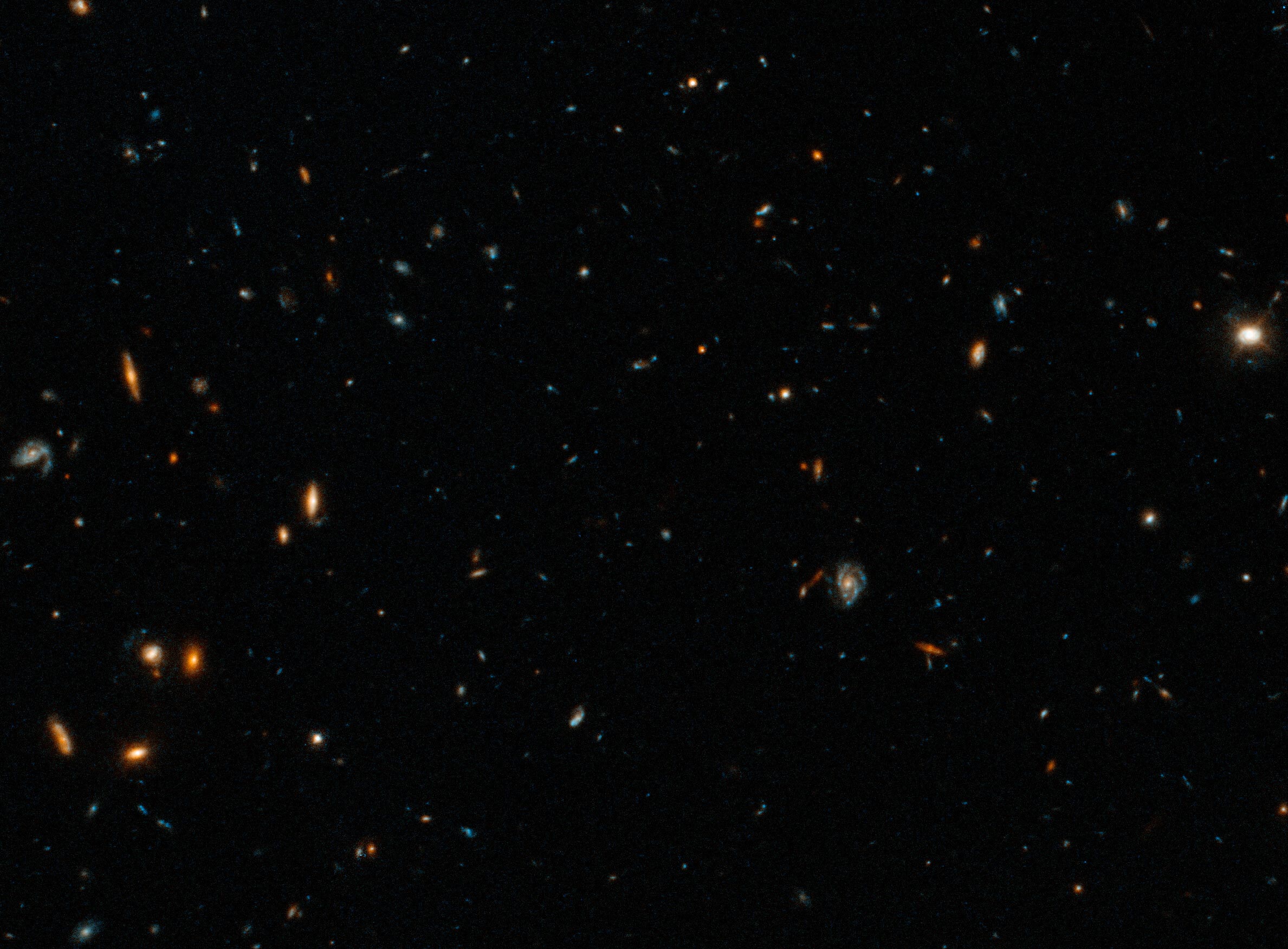
Astronomers using the Hubble Space Telescope have found a rare oddball event in an oddball place.
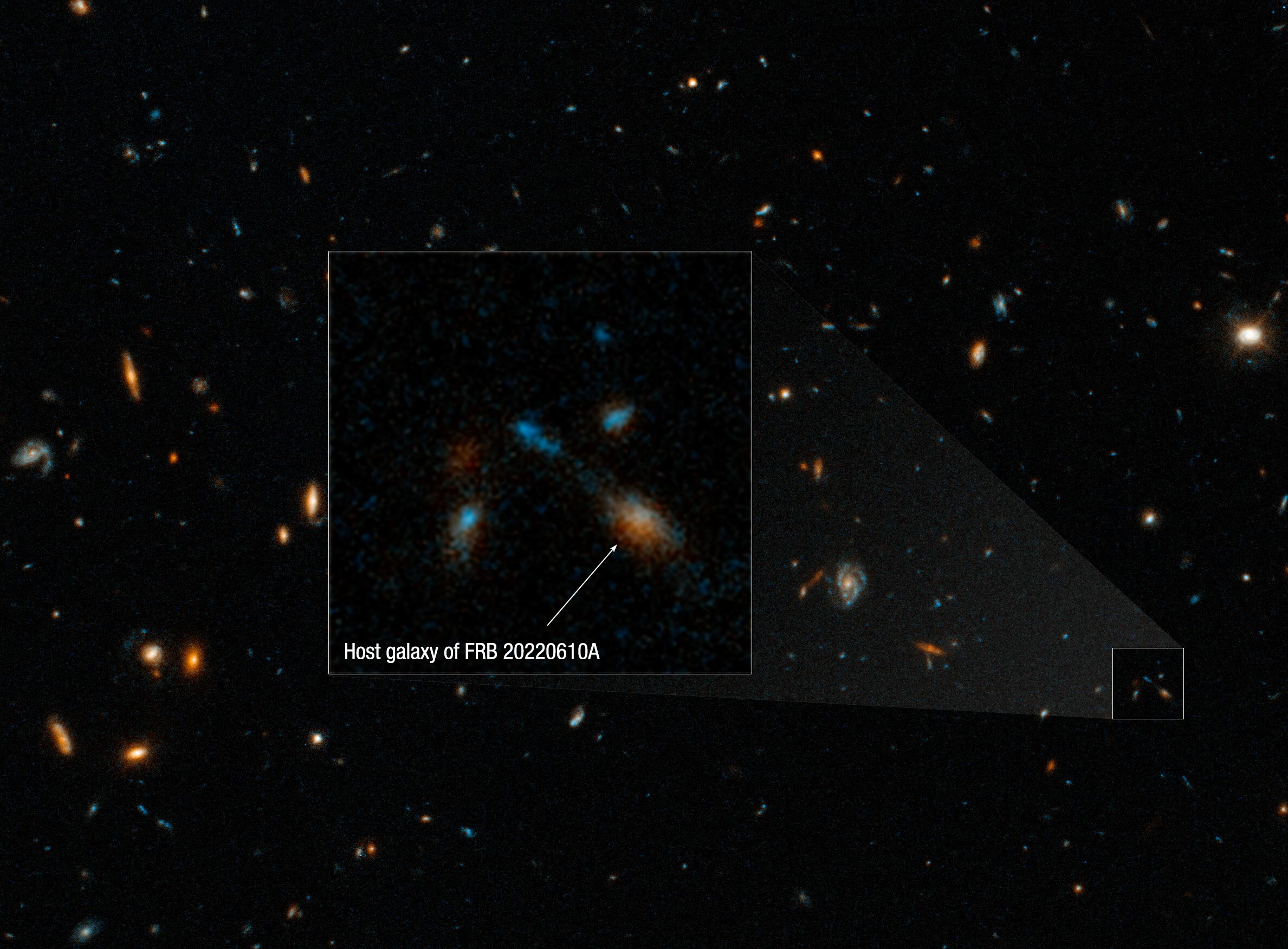
Fast Radio Bursts (FRBs) are brief yet incredibly bright cosmic events, with one recently detected FRB, FRB 20220610A, standing out due to its distance and energy, located in a galaxy cluster from when the Universe was only 5 billion years old. This event challenges existing models of FRBs, as its origin, pinpointed with the help of Hubble’s advanced imaging, hints at complex interactions among up to seven merging galaxies.
A Fast Radio Burst (FRB) is a fleeting blast of energy that can – for a few milliseconds – outshine an entire galaxy. Over the past few years hundreds of FRBs have been detected. They pop off all over the sky like camera flashes at a stadium event, but the sources behind these intense bursts of radiation remain uncertain.
This FRB is particularly weird because it erupted halfway across the Universe, making it the farthest and most powerful one detected to date.
NASA, ESA, STScI, Alexa Gordon (Northwestern University)
And if that’s not strange enough, it just got weirder based on the follow-up Hubble observations after its discovery. The FRB flashed in what seems like an unlikely place, a collection of galaxies that existed when the Universe was only 5 billion years old. Previous FRBs have been found in isolated galaxies.
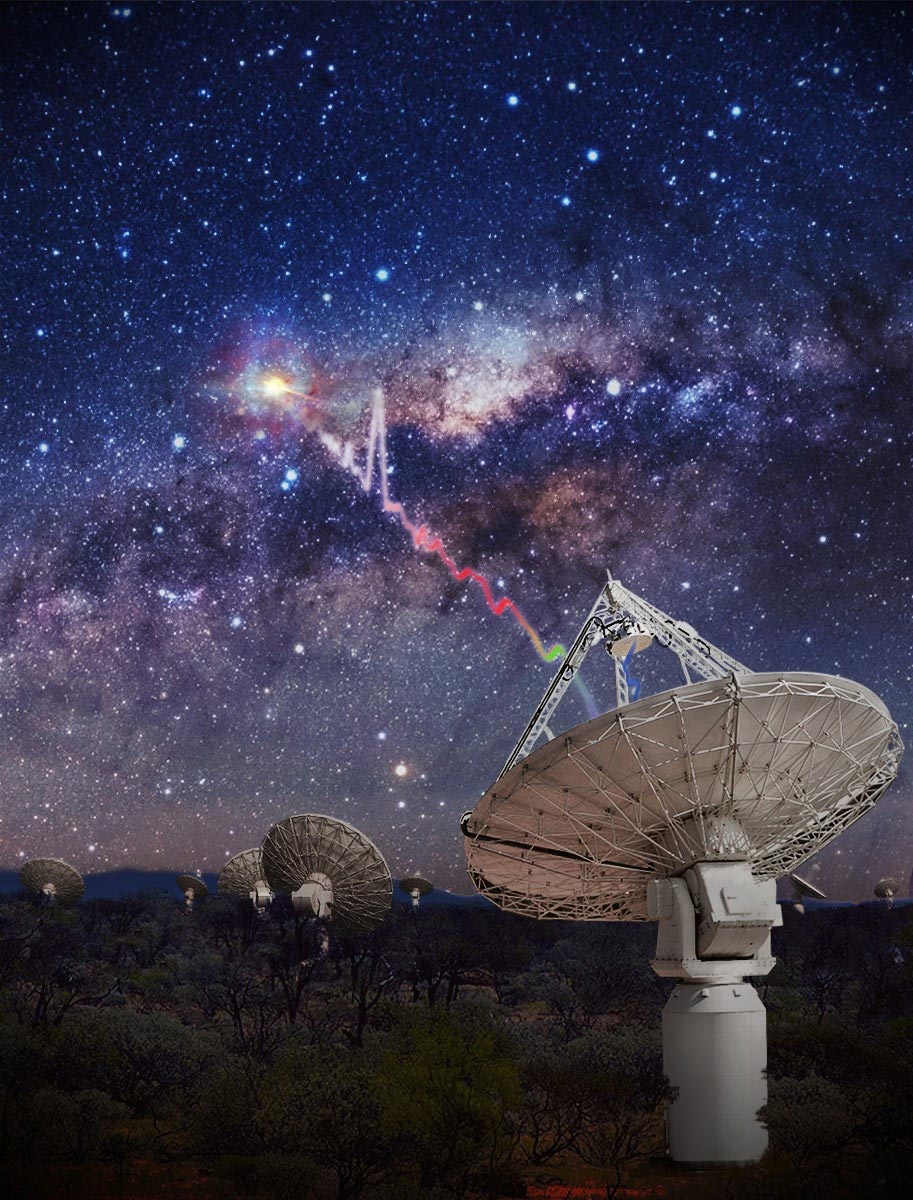
FRB 20220610A was first detected on June 10, 2022, by the Australian Square Kilometre Array Pathfinder (ASKAP) radio telescope in Western Australia, and confirmed to come from a distant origin by the European Southern Observatory’s Very Large Telescope in Chile. It is four times more energetic than closer FRBs. This might challenge models of what is producing FRBs. Or could it be a selection effect where only very bright FRBs can be detected halfway across the Universe?
“It required Hubble’s keen sharpness and sensitivity to pinpoint exactly where the FRB came from,” said lead author Alexa Gordon of Northwestern University in Evanston, Illinois. “Without Hubble’s imaging, it would still remain a mystery as to whether this was originating from one monolithic galaxy or from some type of interacting system. It’s these types of environments – these weird ones – that are driving us toward better understanding the mystery of FRBs.”
Hubble’s crisp images suggest there may be as many as seven galaxies on a possible path to merging, which would also be very significant, say researchers. Such groups of galaxies are rare, and it’s possible this led to the conditions that triggered the FRB.
“We are ultimately trying to answer the questions: What causes them? What are their progenitors and what are their origins? The Hubble observations provide a spectacular view of the surprising types of environments that give rise to these mysterious events,” said co-investigator Wen-fai Fong, also of Northwestern University.
Though astronomers do not have a consensus on the possible mechanism behind this extraordinary phenomenon, it’s generally thought that FRBs must involve some sort of compact object, like a black hole or neutron star. One extreme type of neutron star is called a magnetar – the most intensely magnetic type of neutron star in the Universe. It has a magnetic field that is so strong that, if a magnetar were located halfway between Earth and the Moon, it would erase the magnetic strip on everyone’s credit card in the world. Much worse yet, if an astronaut were to travel within a few hundred kilometers of the magnetar, they would effectively be dissolved, because every atom in their body would be disrupted.
Possible mechanisms involve some kind of jarring starquake, or alternatively, an explosion caused when a magnetar’s twisting magnetic field lines snap and reconnect. A similar phenomenon happens on the Sun, causing solar flares, but a magnetar’s field is a trillion times stronger than the Sun’s magnetosphere. The snapping would generate an FRB’s flash, or might make a shock wave that incinerates surrounding dust and heats gas into a plasma.
There could be several flavors of magnetars. In one case, it could be an exploding object orbiting a black hole surrounded by a disk of material. Another alternative is a pair of orbiting neutron stars whose magnetospheres periodically interact, creating a cavity where eruptions can take place. It’s estimated that magnetars are active for about 10,000 years before settling down, so they would be expected to be found where a firestorm of star birth is taking place. But this doesn’t seem to be the case for all magnetars.
In the near future, FRB experiments will increase their sensitivity, leading to an unprecedented rate in the number of FRBs detected at these distances. Hubble will play a crucial role in characterizing the environments in which these FRBs occur. Astronomers will soon learn just how special the environment of this FRB was.
“We just need to keep finding more of these FRBs, both nearby and far away, and in all these different types of environments,” said Gordon.
The results were presented at the 243rd meeting of the American Astronomical Society in New Orleans, Louisiana.
Never miss a breakthrough: Join the SciTechDaily newsletter.
Follow us on Google and Google News.