
Close Menu
    Facebook X (Twitter) Instagram
    SciTechDaily
    • Biology
    • Chemistry
    • Earth
    • Health
    • Physics
    • Science
    • Space
    • Technology
    Facebook X (Twitter) Pinterest YouTube RSS
    SciTechDaily
    Home»Space»Hubble Image of the Week – Spiral Galaxy NGC 278
    Space

    Hubble Image of the Week – Spiral Galaxy NGC 278

    By SciTechDailyOctober 10, 2016No Comments2 Mins Read
    Facebook Twitter Pinterest Telegram LinkedIn WhatsApp Email Reddit
    Share
    Facebook Twitter LinkedIn Pinterest Telegram Email Reddit
    Hubble Views Spiral Galaxy NGC 278
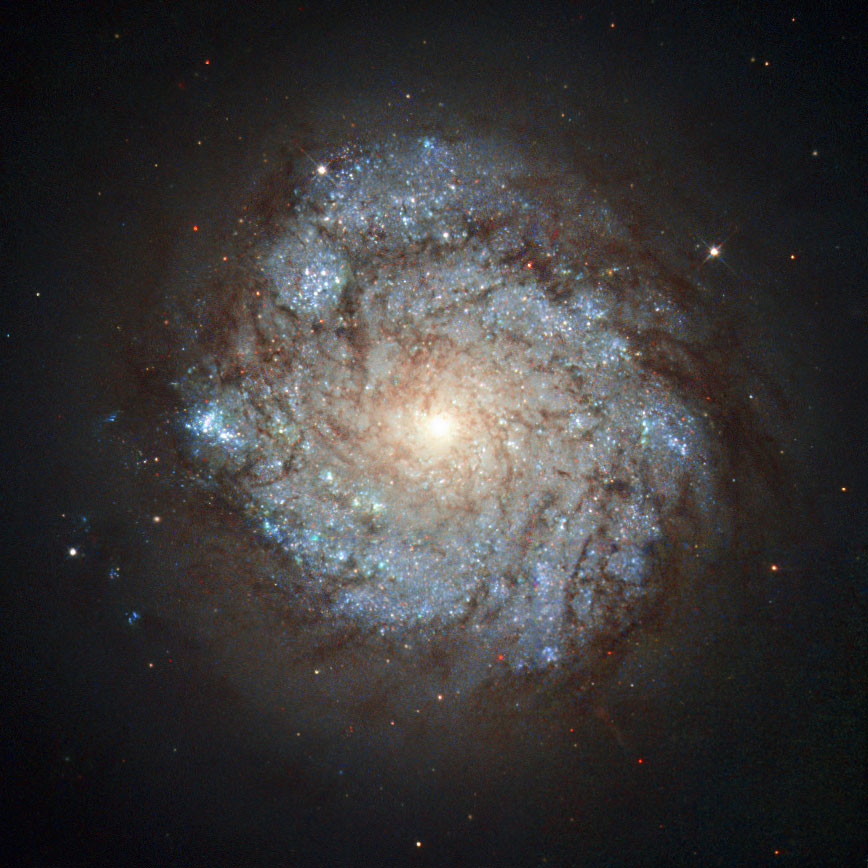
    Spiral galaxy NGC 278 lies some 38 million light-years away in the northern constellation of Cassiopeia (The Seated Queen). Credit: ESA/Hubble & NASA and S. Smartt (Queen’s University Belfast)

    This newly released Hubble Space Telescope image shows spiral galaxy NGC 278. This cosmic beauty lies some 38 million light-years away in the northern constellation of Cassiopeia (The Seated Queen).

    While NGC 278 may look serene, it is anything but. The galaxy is currently undergoing an immense burst of star formation. This flurry of activity is shown by the unmistakable blue-hued knots speckling the galaxy’s spiral arms, each of which marks a clump of hot newborn stars.

    However, NGC 278’s star formation is somewhat unusual; it does not extend to the galaxy’s outer edges, but is only taking place within an inner ring some 6500 light-years across. This two-tiered structure is visible in this image — while the galaxy’s center is bright, its extremities are much darker. This odd configuration is thought to have been caused by a merger with a smaller, gas-rich galaxy — while the turbulent event ignited the center of NGC 278, the dusty remains of the small snack then dispersed into the galaxy’s outer regions. Whatever the cause, such a ring of star formation, called a nuclear ring, is extremely unusual in galaxies without a bar at their center, making NGC 278 a very intriguing sight.

    Never miss a breakthrough: Join the SciTechDaily newsletter.
    Follow us on Google and Google News.

    Astronomy Cosmology Hubble Space Telescope
    Share. Facebook Twitter Pinterest LinkedIn Email Reddit

    Related Articles

    Hubble Image of the Week: Starburst Galaxy Messier 94

    ESO and Hubble Reveal Fast-Moving, Wave-Like Features in the Debris Disk Around AU Microscopii

    New Phoenix Cluster Observations Provide A Fresh Perspective

    Hubble Image of Arp 194 – Cosmic Optical Illusions in Ursa Major

    Hubble Image of the Week – Evolution in Slow Motion

    Hubble Explores the Wings of the Twin Jet Nebula

    Astronomers Discover Supernovae in ‘Wrong Place at Wrong Time’

    Hubble Reveals Diffusion of Stars Through the Core of the Globular Cluster 47 Tucanae

    Study Suggest Spiral Galaxies Are Larger Than Previously Thought

    Leave A Reply Cancel Reply

    • Facebook
    • Twitter
    • Pinterest
    • YouTube

    Don't Miss a Discovery

    Subscribe for the Latest in Science & Tech!

    Trending News

    One of Earth’s Driest Deserts Just Turned White

    A Century-Old Mystery in Cat Kidneys May Finally Have an Answer

    Black Hole Winds Are 100 Times More Powerful Than Astronomers Thought

    “Cancer Melted Away”: Immunotherapy Delivers Striking Results in Bowel Cancer Trial

    Captive Crocodiles Released Into the Wild Did Something Researchers Didn’t Expect

    A Massive 29-Square-Mile Iceberg Hit an Island and Kept Going

    New Mexico’s Largest Reservoir Was Nearly Full. Now It’s at 1.4%

    This Southern-Style Mediterranean Diet Helped People Lose 10 Pounds

    Follow SciTechDaily
    • Facebook
    • Twitter
    • YouTube
    • Pinterest
    • Newsletter
    • RSS
    SciTech News
    • Biology News
    • Chemistry News
    • Earth News
    • Health News
    • Physics News
    • Science News
    • Space News
    • Technology News
    Recent Posts
    • Scientists Say the Universe Isn’t Slowing Down After All
    • A Century-Old Mystery in Venus’s Clouds Just Got Even Stranger
    • The Moon May Be Hiding a 100-Million-Year Record of Exploding Stars
    • 90-Million-Year-Old Fossil Reveals a Small Dinosaur Living Along Japan’s Coast
    • Thawing Permafrost Is Releasing Carbon, but Something Unexpected Happens
    Copyright © 1998 - 2026 SciTechDaily. All Rights Reserved.
    • Science News
    • About
    • Contact
    • Editorial Board
    • Privacy Policy
    • Terms of Use

    Type above and press Enter to search. Press Esc to cancel.