
Close Menu
    Facebook X (Twitter) Instagram
    SciTechDaily
    • Biology
    • Chemistry
    • Earth
    • Health
    • Physics
    • Science
    • Space
    • Technology
    Facebook X (Twitter) Pinterest YouTube RSS
    SciTechDaily
    Home»Space»Hubble Image of the Week – Swimming in Sculptor
    Space

    Hubble Image of the Week – Swimming in Sculptor

    By SciTechDailyMarch 7, 20161 Comment2 Mins Read
    Facebook Twitter Pinterest Telegram LinkedIn WhatsApp Email Reddit
    Share
    Facebook Twitter LinkedIn Pinterest Telegram Email Reddit
    Hubble Space Telescope Reveals Thousands of Colorful Galaxies
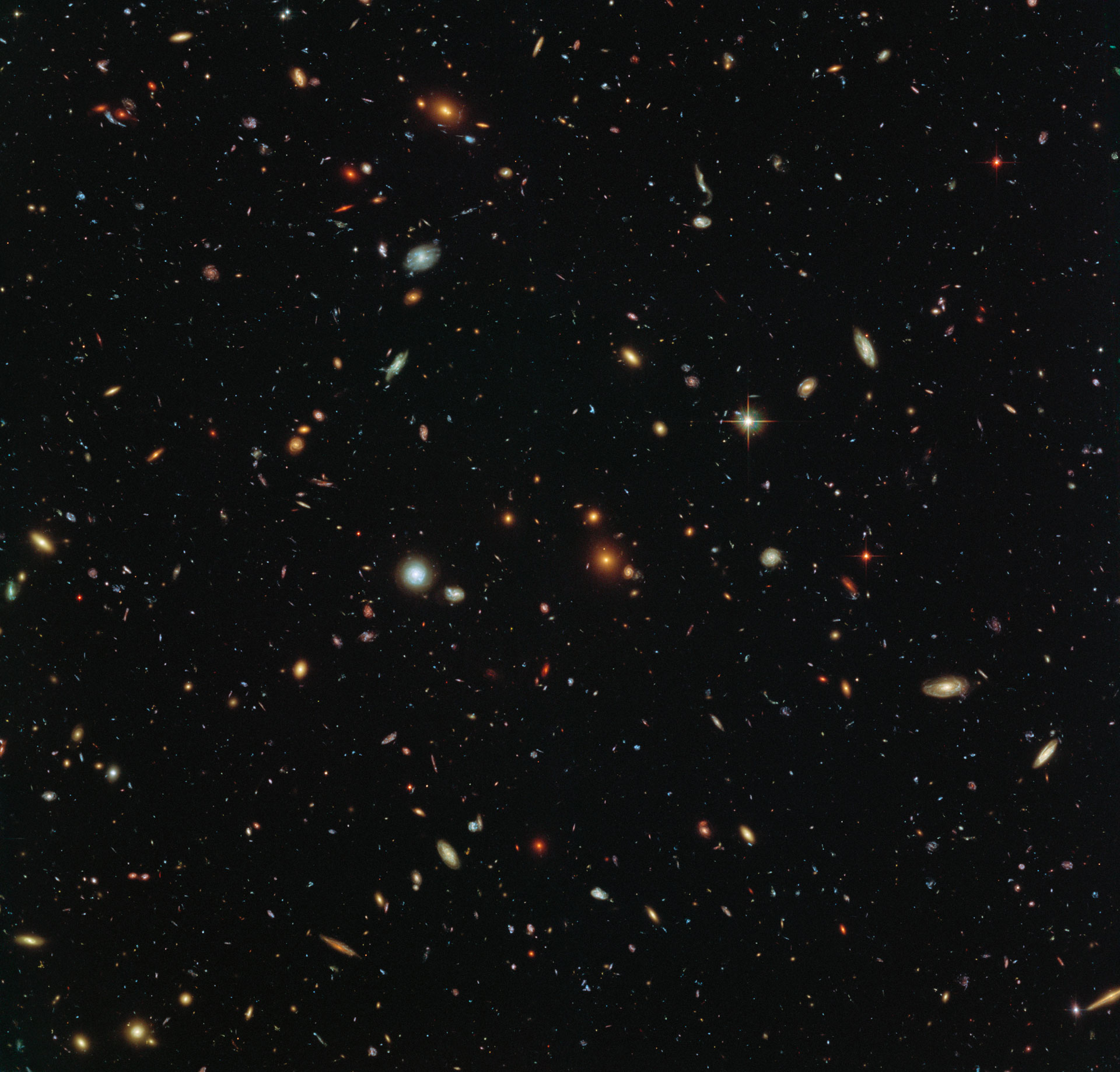
    This stunning image was taken while studying the enormous galaxy cluster Abell 2744, also known as Pandora’s Box. As Hubble focused on Abell 2744, its other camera captured this beautiful view of the neighboring sky. Credit: NASA, ESA and the HST Frontier Fields team (STScI) Acknowledgement: Judy Schmidt

    This newly released Hubble image shows thousands of colorful galaxies.

    Peering deep into the early Universe, this picturesque parallel field observation from the NASA/ESA Hubble Space Telescope reveals thousands of colorful galaxies swimming in the inky blackness of space. A few foreground stars from our own galaxy, the Milky Way, are also visible.

    In October 2013 Hubble’s Wide Field Camera 3 (WFC3) and Advanced Camera for Surveys (ACS) began observing this portion of sky as part of the Frontier Fields program. This spectacular skyscape was captured during the study of the giant galaxy cluster Abell 2744, otherwise known as Pandora’s Box. While one of Hubble’s cameras concentrated on Abell 2744, the other camera viewed this adjacent patch of sky near to the cluster.

    Containing countless galaxies of various ages, shapes, and sizes, this parallel field observation is nearly as deep as the Hubble Ultra-Deep Field. In addition to showcasing the stunning beauty of the deep Universe in incredible detail, this parallel field — when compared to other deep fields — will help astronomers understand how similar the Universe looks in different directions


    Never miss a breakthrough: Join the SciTechDaily newsletter.
    Follow us on Google and Google News.

    Astronomy Cosmology Hubble Space Telescope NASA
    Share. Facebook Twitter Pinterest LinkedIn Email Reddit

    Related Articles

    Astronomers Discover a 17 Billion Solar-Mass Black Hole in an Unlikely Place

    Hubble Image of the Week – Dwarf Galaxy Leo A

    Astronomers Measure the Farthest Galaxy Ever Seen in the Universe

    Hubble Image of the Week – Peculiar Galaxy NGC 1487

    Hubble Image of the Week: Infant Star’s Artistic Outburst

    Hubble Views Turbulent Birthing Ground Orion B Molecular Cloud Complex

    Magnified Image Reveals the Faintest Known Galaxy from the Early Universe

    Hubble Image of the Week: Quadruple Star System DI Cha

    Hubble Image of the Week – Evolution in Slow Motion

    1 Comment

    1. rotfogel on March 8, 2016 12:49 pm

      What I’ve always wanted to know is if Hubble were to point anywhere in the sky, would there always be countless galaxies in all directions? Or did astronomers know which particular direction to point Hubble in order to see the vast majority of galaxies which make up the universe. It’d be interesting to know the density of galaxies by direction your looking, or if it is indeed all the same with equal galaxies in all directions from our perspective.

      Reply
    Leave A Reply Cancel Reply

    • Facebook
    • Twitter
    • Pinterest
    • YouTube

    Don't Miss a Discovery

    Subscribe for the Latest in Science & Tech!

    Trending News

    “I Couldn’t Do It Anymore” – Antarctic Guides Quit Their Dream Jobs After Witnessing Tourism’s Damage

    Scientists Say Eating Less Protein May Help You Live Longer

    Scientists Solve a Long-Standing Mystery About Bird and Dinosaur Eggs

    Belly Fat and Low Vitamin D May More Than Double the Risk of Early Death

    Lost in Space: Rare Cosmic Flare Exposes a Wandering Black Hole Far From Its Galaxy’s Center

    Dark Matter May Be Leaving a Signal in Earth’s Atmosphere

    Scientists Discover a 300-Million-Year-Old Geological Time Capsule Inside Fossilized Wood

    Oral Weight Loss Pill Helps Patients Lose up to 12% of Body Weight

    Follow SciTechDaily
    • Facebook
    • Twitter
    • YouTube
    • Pinterest
    • Newsletter
    • RSS
    SciTech News
    • Biology News
    • Chemistry News
    • Earth News
    • Health News
    • Physics News
    • Science News
    • Space News
    • Technology News
    Recent Posts
    • Industrial Chicken Farming Is Supercharging the Spread of a Dangerous Foodborne Bacterium
    • Honeybee Queens May Pass Toxic Chemicals to the Next Generation
    • This Common Amino Acid May Help the Body Fight Cancer and Viruses
    • Schizophrenia’s Brain Damage May Start in One Key Region
    • A Simple Treatment Could Save Extremely Premature Babies From Blindness
    Copyright © 1998 - 2026 SciTechDaily. All Rights Reserved.
    • Science News
    • About
    • Contact
    • Editorial Board
    • Privacy Policy
    • Terms of Use

    Type above and press Enter to search. Press Esc to cancel.