
Close Menu
    Facebook X (Twitter) Instagram
    SciTechDaily
    • Biology
    • Chemistry
    • Earth
    • Health
    • Physics
    • Science
    • Space
    • Technology
    Facebook X (Twitter) Pinterest YouTube RSS
    SciTechDaily
    Home»Space»Hubble Image of the Week – Tangled NGC 6240
    Space

    Hubble Image of the Week – Tangled NGC 6240

    By Hubble Space TelescopeMay 18, 20152 Comments2 Mins Read
    Facebook Twitter Pinterest Telegram LinkedIn WhatsApp Email Reddit
    Share
    Facebook Twitter LinkedIn Pinterest Telegram Email Reddit
    Hubble Views NGC 6240
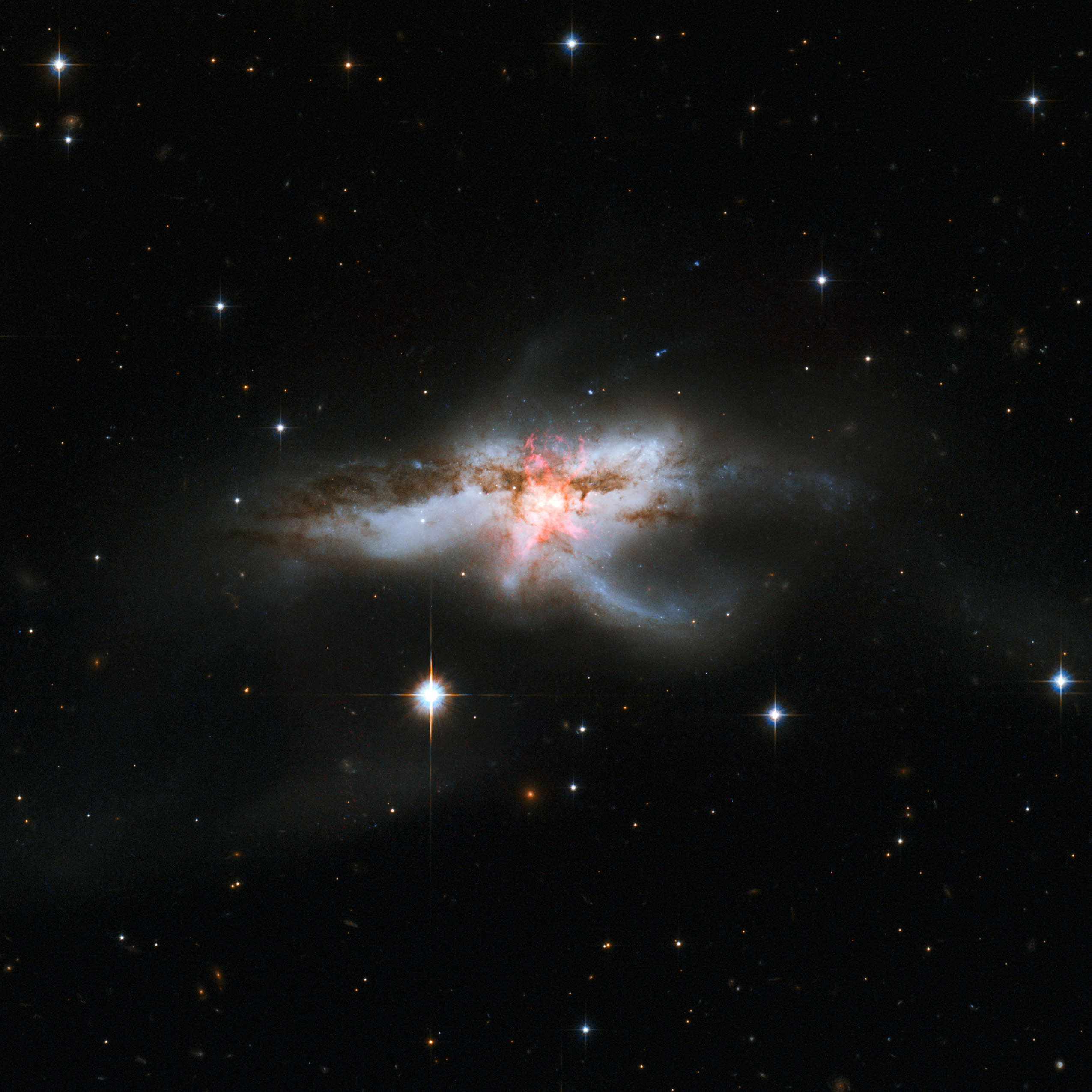
    NGC 6240 lies 400 million light-years away in the constellation of Ophiuchus (The Serpent Holder).  Credit: NASA, ESA, the Hubble Heritage (STScI/AURA)-ESA/Hubble Collaboration, and A. Evans (University of Virginia, Charlottesville/NRAO/Stony Brook University)

    First viewed in 2008, this Hubble image shows galaxy NGC 6240.

    Not all galaxies are neatly shaped, as this new NASA/ESA Hubble Space Telescope image of NGC 6240 clearly demonstrates. Hubble previously released an image of this galaxy back in 2008, but the knotted region, shown here in a pinky-red hue at the center of the galaxies, was only revealed in these new observations from Hubble’s Wide Field Camera 3 and Advanced Camera for Surveys.

    NGC 6240 lies 400 million light-years away in the constellation of Ophiuchus (The Serpent Holder). This galaxy has an elongated shape with branching wisps, loops, and tails. This mess of gas, dust, and stars bears more than a passing resemblance to a butterfly and, though perhaps less conventionally beautiful, a lobster.

    This bizarrely-shaped galaxy did not begin its life looking like this; its distorted appearance is a result of a galactic merger that occurred when two galaxies drifted too close to one another. This merger sparked bursts of new star formation and triggered many hot young stars to explode as supernovae. A new supernova was discovered in this galaxy in 2013, named SN 2013dc. It is not visible in this image, but its location is indicated here.

    At the center of NGC 6240, an even more interesting phenomenon is taking place. When the two galaxies came together, their central black holes did so too. There are two supermassive black holes within this jumble, spiraling closer and closer to one another. They are currently only some 3000 light-years apart, incredibly close given that the galaxy itself spans 300,000 light-years. This proximity secures their fate as they are now too close to escape each other and will soon form a single immense black hole.


    Never miss a breakthrough: Join the SciTechDaily newsletter.
    Follow us on Google and Google News.

    Astronomy Black Hole Hubble Space Telescope
    Share. Facebook Twitter Pinterest LinkedIn Email Reddit

    Related Articles

    Mystery in the Stars: Hubble Unveils Omega Centauri’s Hidden Monster

    Supermassive Spectacle: Hubble Captures a Galaxy With a Voracious Black Hole

    Star Swarms Reveal a Hidden Beast: NASA’s Hubble Hunts for Black Hole Close to Earth

    Cosmic Monster on the Loose: Runaway Supermassive Black Hole Is “Not Like Anything Seen Before”

    Black Hole’s Deep Gravitational Sinkhole Twists Unlucky Star Into Donut Shape

    Hubble Finds Phantom Imprint in Space Revealing Black Hole Roaming Our Milky Way Galaxy

    Breaking News From the Dawn of the Universe: The Ancestor of a Supermassive Black Hole

    Spiral Snapshot Hides an Astronomical Monstrosity

    Milky Way’s Supermassive Black Hole Still Smoldering Long After Powerful “Death-Ray” Beam Outburst

    2 Comments

    1. tarzan on May 18, 2015 10:10 am

      “This proximity secures their fate as they are now too close to escape each other and will soon form a single immense black hole.” And maybe it will not – there is a limit on the size of SMBHs. You are looking at a fission system making 2 galaxies.

      Reply
      • charity idle on May 19, 2015 1:42 am

        please explain I am infinitely interested.

        Reply
    Leave A Reply Cancel Reply

    • Facebook
    • Twitter
    • Pinterest
    • YouTube

    Don't Miss a Discovery

    Subscribe for the Latest in Science & Tech!

    Trending News

    Breakthrough Parkinson’s Drug Targets Disease at Its Genetic Roots

    Just 4 Weeks of Simple Diet Changes Reversed Signs of Aging in Older Adults

    Scientists May Have Finally Solved Why Humans Are Right-Handed

    NASA’s Hubble Accidentally Witnesses a Comet Shattering in Space

    Researchers Discover the Body’s Hidden “Off Switch” for Inflammation

    Scientists Discover Metformin Doesn’t Work the Way We Thought

    Tea or Coffee? Your Daily Choice Could Affect Osteoporosis Risk

    Vitamin C May Fight Cancer in a Surprising Way

    Follow SciTechDaily
    • Facebook
    • Twitter
    • YouTube
    • Pinterest
    • Newsletter
    • RSS
    SciTech News
    • Biology News
    • Chemistry News
    • Earth News
    • Health News
    • Physics News
    • Science News
    • Space News
    • Technology News
    Recent Posts
    • Scientists Stunned by Hybrid California Bees That Beat Deadly Mites
    • Scientists Discover Terrifying Giant Crocodile That Hunted Human Ancestors
    • Scientists Finally Think They Know Why T. rex Had Tiny Arms
    • Scientists Are Turning Ocean Trash Into Roads – and It’s Actually Working
    • This Alien Planet Has Rock Clouds That Vaporize Before Sunset
    Copyright © 1998 - 2026 SciTechDaily. All Rights Reserved.
    • Science News
    • About
    • Contact
    • Editorial Board
    • Privacy Policy
    • Terms of Use

    Type above and press Enter to search. Press Esc to cancel.