
Close Menu
    Facebook X (Twitter) Instagram
    SciTechDaily
    • Biology
    • Chemistry
    • Earth
    • Health
    • Physics
    • Science
    • Space
    • Technology
    Facebook X (Twitter) Pinterest YouTube RSS
    SciTechDaily
    Home»Space»Hubble Reveals Evidence of Active Nucleus Driving Hot Bubbles of Gas
    Space

    Hubble Reveals Evidence of Active Nucleus Driving Hot Bubbles of Gas

    By Harvard-Smithsonian Center For AstrophysicsDecember 11, 2018No Comments3 Mins Read
    Facebook Twitter Pinterest Telegram LinkedIn WhatsApp Email Reddit
    Share
    Facebook Twitter LinkedIn Pinterest Telegram Email Reddit
    Stormy Weather in 3C196.1
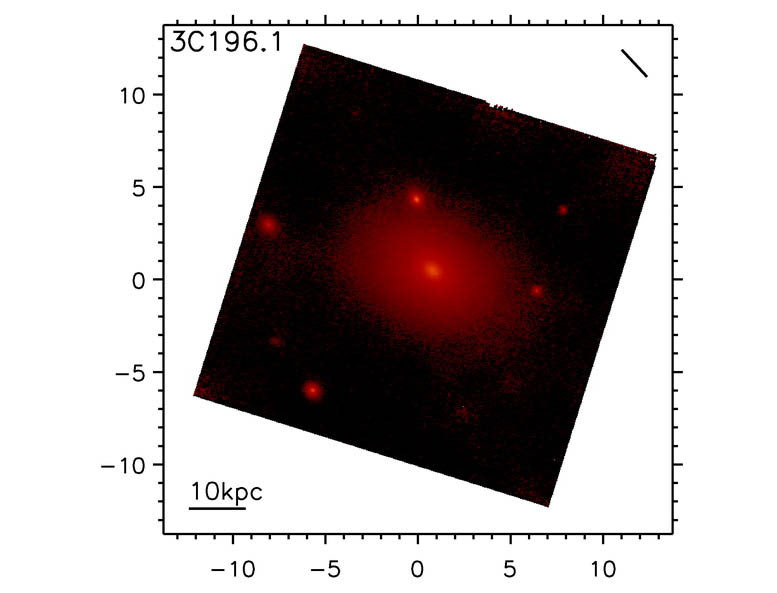
    A Hubble image of the galaxy 3C129.1, a massive elliptical galaxy in a bright cluster. Astronomers have used Chandra, Hubble and VLA facilities to study the hot gas and found clear evidence that the active nucleus is driving hot bubbles of gas and jets. NASA/Hubble, J. Madrid et al. 2006

    3C196.1 is a massive elliptical galaxy, the brightest member of a cluster of galaxies about three billion light-years away that is notable for its strong X-ray and radio emission. The radiation is a characteristic signature of accretion processes around a supermassive black hole at the galaxy’s nucleus. Supporting this interpretation is the galaxy’s disturbed shape, which indicates the galaxy has undergone a recent merger, perhaps triggering such accretion onto the black hole and thus powering the emission. Active galactic nuclei (AGN) are seen in many similar galaxies, and they power massive outflows of material thought to disrupt and quench star formation in the galaxies, but astronomers do not understand very well when or how these processes happen.

    CfA astronomers Frederica Ricci, Lorenzo Lovisari, Ralph Kraft, Grant Tremblay, Bill Forman, and Belinda Wilkes led a team that for the past eight years has used the Chandra X-ray Observatory, Hubble, and the VLA radio facility to probe nuclear outbursts and merger activity in the galaxy 3C196.1 through the analysis of the distribution and excitation of its hot gas. Their images show that the gas lies in hot bubbles rising outward from the nuclear region into zones of cooler material, along with shocks arising from the creation of the bubbles that (like stormy weather) shape its environment. The team finds evidence for multiple episodes of outburst activity based on the radio images, and compelling evidence for a past merger. The optical images tie the hot emission lines directly to the AGN activity. They even see a jet from the nucleus extending outward about thirty light-years and closely aligned with the larger radio jet that extends over thousands of light-years. From the temperatures, pressures, and other properties of the hot bubbles and their environments, the scientists estimate the lifetimes of the cavities, the inner one being about 12 million years old and the outer one being about 280 million years old. The results help to reveal the physical processes at work in powering the emission from this galaxy and to offer insight into the wider family of active galactic nuclei.

    Reference: “Stormy Weather in 3C 196.1: Nuclear Outbursts and Merger Events Shape the Environment of the Hybrid Radio Galaxy 3C 196.1” by F. Ricci, L. Lovisari, R. P. Kraft, F. Massaro, A. Paggi, E. Liuzzo, G. Tremblay, W. R. Forman, S. Baum, C. O’Dea and B. Wilkes, 29 October 2018, The Astrophysical Journal.
    DOI: 10.3847/1538-4357/aae487DOI:

    Never miss a breakthrough: Join the SciTechDaily newsletter.
    Follow us on Google and Google News.

    Astronomy Chandra X-ray Observatory Harvard-Smithsonian Center for Astrophysics Hubble Space Telescope VLA
    Share. Facebook Twitter Pinterest LinkedIn Email Reddit

    Related Articles

    How Habitable Are Planets That Orbit Red Dwarfs – The Most Common Type of Stars in the Galaxy?

    New Image Reveals Colliding Galaxy Clusters

    Magnetic Winds From a Young Star in the Orion Nebula

    Astronomers View Superheated Gas Swirling Around a Black Hole

    Diagnosing the X-Ray Variability in Active Galaxy NGC 4507

    Accretion Around TW Hydrae – A Relatively Young Star

    Black Hole Ejected from Home Galaxy, Moving at 3 Million MPH

    Supernova Shock Wave Breaks Through a Cocoon of Gas

    Hubble Observes Rare Blue Stars in Andromeda’s Core

    Leave A Reply Cancel Reply

    • Facebook
    • Twitter
    • Pinterest
    • YouTube

    Don't Miss a Discovery

    Subscribe for the Latest in Science & Tech!

    Trending News

    Scientists Uncover Potential Brain Risks of Popular Fish Oil Supplements

    Scientists Discover a Surprising Way To Make Bread Healthier and More Nutritious

    After 60 Years, Scientists Uncover Unexpected Brain Effects of Popular Diabetes Drug Metformin

    New Research Uncovers Hidden Side Effects of Popular Weight-Loss Drugs

    Scientists Rethink Extreme Warming After Surprising Ocean Discovery

    Landmark Study Links Never Marrying to Significantly Higher Cancer Risk

    Researchers Discover Unknown Beetle Species Just Steps From Their Lab

    Largest-Ever Study Finds Medicinal Cannabis Ineffective for Anxiety, Depression, PTSD

    Follow SciTechDaily
    • Facebook
    • Twitter
    • YouTube
    • Pinterest
    • Newsletter
    • RSS
    SciTech News
    • Biology News
    • Chemistry News
    • Earth News
    • Health News
    • Physics News
    • Science News
    • Space News
    • Technology News
    Recent Posts
    • Researchers Uncover Source of Strange Deformation in Earth’s Largest Continental Rift
    • Scientists Solve Mystery of Where the Colorado River Vanished Millions of Years Ago
    • Not Just Alzheimer’s: Scientists Uncover Clues to a Second, Overlooked Disorder
    • Scientists Uncover Dangerous Connection Between Serotonin and Heart Valve Disease
    • Scientists Discover a “Protector” Protein That Could Help Reverse Hair Loss
    Copyright © 1998 - 2026 SciTechDaily. All Rights Reserved.
    • Science News
    • About
    • Contact
    • Editorial Board
    • Privacy Policy
    • Terms of Use

    Type above and press Enter to search. Press Esc to cancel.