
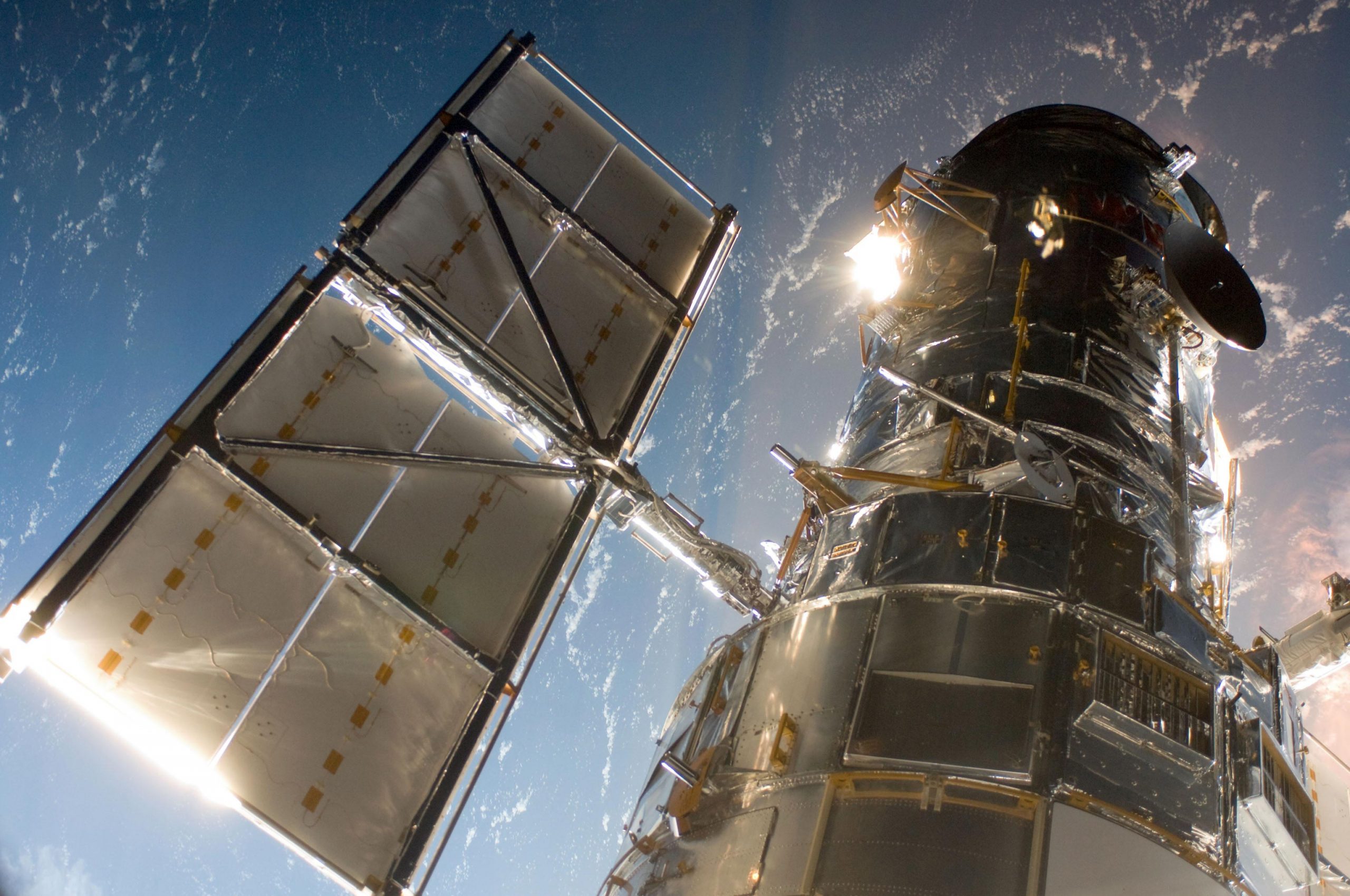
Hubble’s launch and deployment in April 1990 marked the most significant advance in astronomy since Galileo’s telescope. Thanks to five servicing missions and more than 30 years of operation, our view of the universe and our place within it has never been the same.
Video transcript:
CARL SAGAN “Space Telescope is a kind of grand intellectual adventure, for all of us, which will cast light not just on the cosmos but also on ourselves.”
Exploration is hardwired into our brains.
And when we see the horizon, we want to know what’s beyond it. We want to break the barriers, we want to make the unknown known, because our curious nature propels us forward.
Looking up beyond the moon and the stars, past our own Milky Way Galaxy, and deep into the corners of our universe.
Generations before our own could only wonder what we might see veiled above our murky atmosphere.
They drafted plans, laid out the framework that would uncover the truths hidden in the space around us once thought to only be science fiction.
STORY MUSGRAVE: “We’re gonna have to move out on the EVA.”
And in the face of difficulty and setbacks…
DOUGLAS BROOME: “There’s a significant spherical aberration.”
DR. JOHN CAMPBELL: “The fourth of six gyros that are onboard Hubble, failed.”
SM3B ASTRONAUT: “Monitoring John’s suit and there’s a large bit of water down here.”
They kept fighting and now we continue – unrelenting.
We desire to keep pushing the limits of the unattainable.
And with every discovery, every encounter with the heavens, we begin to scratch the surface of what it means to truly be human.
We keep exploring to know what is outside of our galaxy, but also what is inside of each and every one of us.
And we won’t stop, we won’t be satisfied with what-ifs, or possibilities, because we have been given a taste too sweet to ignore.
Grasping at the stars within an arm’s reach, and mapping the space balancing between.
Observing the nature of the unusual, diving deep into the fabric of our universe.
Being witnesses to gloriously painted galaxies, and the spectacular birth of new stars.
Now, all within the possible, the conceivable, and the believable.
And still, with that, a more glorious dawn awaits, pushing back the frontiers of our explored space.
Our mission is not to supplement our present ideas of the universe we live in, but rather to uncover new phenomena not yet imagined.
Never miss a breakthrough: Join the SciTechDaily newsletter.
Follow us on Google and Google News.
4 Comments
Amazing! Can’t wait to see even more incredible images and new information arrive from James Webb!
… okay, but how did it transform the world? Did it change the world for a better place? Is the Earth better place for living? Did the Humans evolve in some way, and now we are all smarter and better people?
In short, what are its benefits beside new data?
This is not simply telescope or observations alone can credit to establish a theory,say coevolution of super massive black hole and galaxy.In this context,this can be mentioned that no single observation can complete this theory or predict this with correct mathematical description.But JWST after Hubble Telescpe can create a lot of scopes to observe many much examples of early coevolving galaxies with each at their center having super massive black hole, beyond simple mathematical imagination to real universe phenomena.Thus this takes a lot of long term continuous hard works but not just single attempt to corelate or define such theory.
Real universe phenomena often critical that can not be described need observations to know.One such observation is that of GNz7q,an early forming galaxy has neither clear observation nor any solid theory by astronomers to account for the mathematical description of the phenomena simultaneously of coevolution.So,in such process to establish the theory of coevolution of super massive black hole and galaxis simply more examples of such events are to added.In this direction Hubble Telescope and coming JWST observations specificly are helpful and important.These future observations can verify and establish the theory of coevolution.