
Close Menu
    Facebook X (Twitter) Instagram
    SciTechDaily
    • Biology
    • Chemistry
    • Earth
    • Health
    • Physics
    • Science
    • Space
    • Technology
    Facebook X (Twitter) Pinterest YouTube RSS
    SciTechDaily
    Home»Space»Hubble Space Telescope Spies a Cosmic Keyhole
    Space

    Hubble Space Telescope Spies a Cosmic Keyhole

    By ESA/HubbleOctober 23, 202211 Comments2 Mins Read
    Facebook Twitter Pinterest Telegram LinkedIn WhatsApp Email Reddit
    Share
    Facebook Twitter LinkedIn Pinterest Telegram Email Reddit
    Reflection Nebula NGC 1999
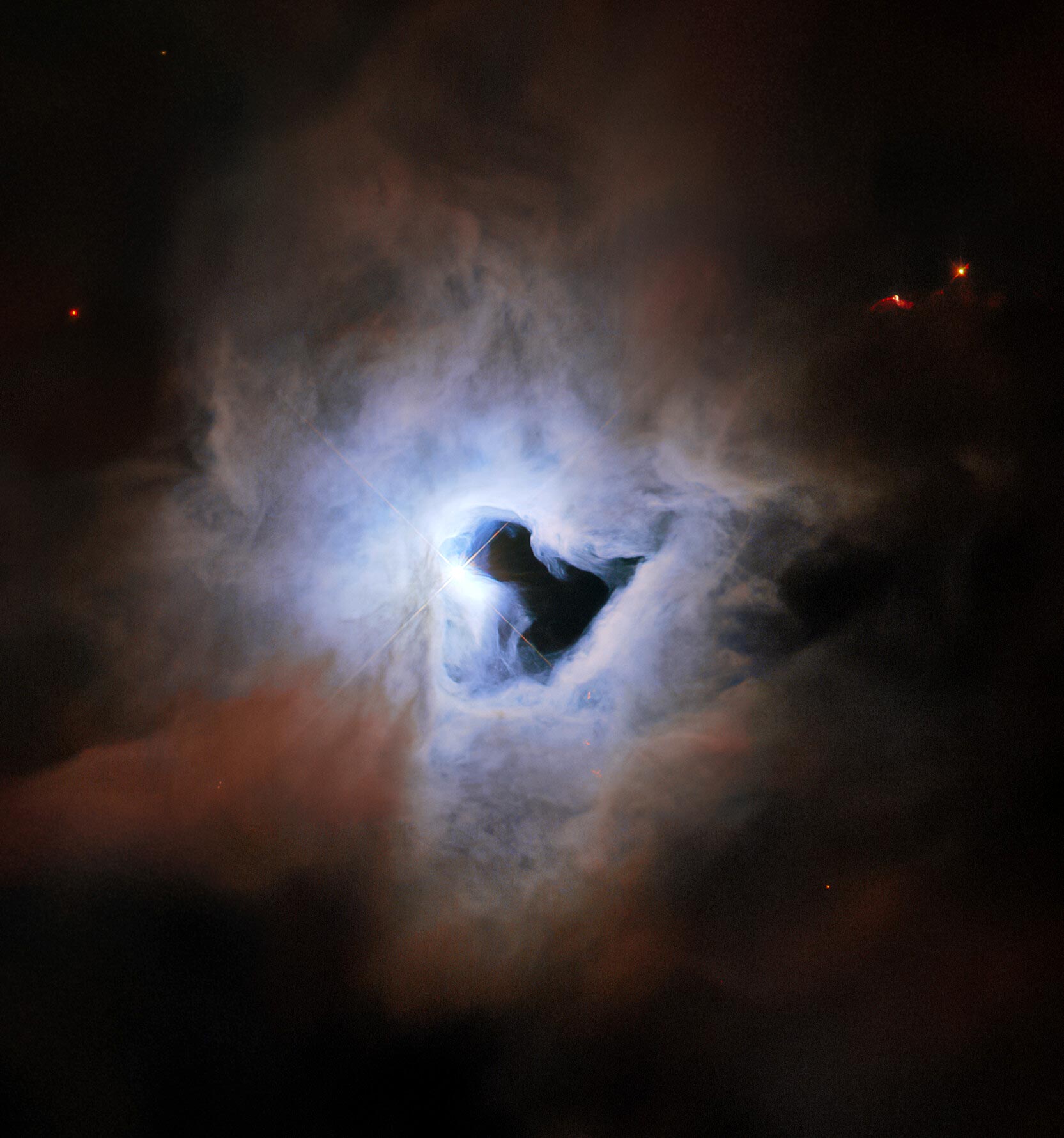
    Hubble Space Telescope portrait showcases NGC 1999, a reflection nebula in the constellation Orion. NGC 1999 is around 1350 light-years from Earth and lies near the Orion Nebula, the closest region of massive star formation to Earth. Credit: ESA/Hubble & NASA, K. Noll

    NGC 1999, a reflection nebula located in the Orion constellation, is detailed in images from the Hubble Space Telescope.

    Positioned about 1350 light-years away, near the Orion Nebula, NGC 1999 owes its luminosity to a young star named V380 Orionis. Notably, this nebula features a dark, keyhole-shaped gap, originally thought to be a dense Bok globule but later identified as an empty space, with its origins still a mystery

    Cosmic Portrait of NGC 1999

    NGC 1999, a reflection nebula in the constellation Orion is showcased in this peculiar portrait from the NASA/ESA Hubble Space Telescope. Located approximately 1350 light-years from Earth, NGC 1999 lies near the Orion Nebula, which is the closest region of massive star formation to Earth. In fact, NGC 1999 itself is a relic of recent star formation — it is composed of detritus left over from the formation of a newborn star.

    Just like fog curling around a street lamp, reflection nebulae like NGC 1999 only shine because of the light from an embedded source. In the case of NGC 1999, this source is the aforementioned newborn star which is visible at the center of this image. Named V380 Orionis, this star is thought to be somewhere between 1 and 3 million years old. The most notable aspect of NGC 1999’s appearance, however, is the conspicuous hole in its center, which resembles an inky-black keyhole of cosmic proportions.

    The Mysterious Core of NGC 1999

    This image was created from archival Wide Field Planetary Camera 2 (WFC2) observations that date from shortly after Servicing Mission 3A in 1999. At the time, astronomers believed that the dark patch in NGC 1999 was something called a Bok globule — a dense, cold cloud of gas, molecules, and cosmic dust that blots out background light. However, follow-up observations using a collection of telescopes including ESA’s Herschel Space Observatory revealed that the dark patch is actually an empty region of space. The origin of this unexplained rift in the heart of NGC 1999 remains unknown.

    Never miss a breakthrough: Join the SciTechDaily newsletter.
    Follow us on Google and Google News.

    Astronomy Astrophysics European Space Agency
    Share. Facebook Twitter Pinterest LinkedIn Email Reddit

    Related Articles

    Feared Apophis Impact Ruled Out – Asteroid Will Pass Close Enough to Earth to See With Naked Eye

    Tantalizing Evidence: Is the Nearest Star Cluster to the Sun Being Destroyed?

    Tantrums of a Baby Star: Herbig-Haro Objects

    Unexpected Discovery: Hubble Space Telescope Uncovers Concentration of Small Black Holes

    Unique Planetary System With Rhythmic Orbital Resonance Revealed by Exoplanet Watcher Cheops

    Cosmic Neon Lights: Strange New Type of Star Revealed in X-ray Light

    “Unprecedented” – Unusual Planetary Nebula Fades Mere Decades After It Arrived

    Hubble Captures Unprecedented Fading of Stingray Nebula – “This Is Very, Very Dramatic, and Very Weird”

    To the Milky Way’s Anticenter and Beyond: Gaia’s New Detailed Data From More Than 1.8 Billion Stars

    11 Comments

    1. Eric M. Jones on October 24, 2022 7:30 am

      A funny shape in space. Who knew? Hardly science news.

      Reply
    2. JP on October 24, 2022 10:08 pm

      Ouch! Tough crowd!

      Reply
    3. M on October 25, 2022 7:10 am

      Rather reminds me of the net alien in Herbert’s Chapter House dune.

      Reply
    4. Anthony C. Belfield on October 25, 2022 10:36 am

      Lol..
      The was left by the force of the star birth

      Reply
    5. Theresa on October 25, 2022 12:54 pm

      It looks like a Hand with a hole in it .

      Reply
    6. Single Lady on October 25, 2022 6:25 pm

      Looks more like a cosmic pee hole

      Reply
    7. Keymaster11 on October 25, 2022 6:59 pm

      It look like the key hole to something important guarded my big red glowing eyes in the darkness.. is this the light in the dark? Or is it out way out of a prison world? Are we being kept in or keeping things out???

      Reply
    8. Keymaster11 on October 25, 2022 7:01 pm

      Definitely should have proof read before I left my comment:/

      Reply
    9. Dick detrick on October 25, 2022 9:02 pm

      It’s shaped like a c*ck n balls, but that’s peradolia for ya!

      Reply
    10. Albert Person on October 26, 2022 3:03 pm

      This proves electrical formation of stars and disproves accretion by gravity, which was disproved many years ago.

      Reply
    11. Kindle Sam on October 26, 2022 10:54 pm

      Soooo…. For being 1350 light yrs away .. how does our technology give us this birds eye view!?? 👁

      Reply
    Leave A Reply Cancel Reply

    • Facebook
    • Twitter
    • Pinterest
    • YouTube

    Don't Miss a Discovery

    Subscribe for the Latest in Science & Tech!

    Trending News

    Scientists Just Discovered a Hidden Freshwater World Beneath the Great Salt Lake

    Why Your Daily Shower Could Be Worsening the Water Crisis

    Scientists Discover New “Magic Mushroom” Species That Rewrites Evolutionary History

    Mystery Deepens: Astrophysicists Say Dark Matter May Not Be One Thing

    Your BMI Might Be Wrong: Study Finds Millions Are Misclassified

    A Simple Blood Test Could Predict Dementia Risk 25 Years Early

    3.5-Billion-Year-Old Rocks Rewrite the Story of Plate Tectonics

    Why Aging Lungs Turn Mild Infections Into Life-Threatening Illness

    Follow SciTechDaily
    • Facebook
    • Twitter
    • YouTube
    • Pinterest
    • Newsletter
    • RSS
    SciTech News
    • Biology News
    • Chemistry News
    • Earth News
    • Health News
    • Physics News
    • Science News
    • Space News
    • Technology News
    Recent Posts
    • This Alga Rewrites the Rules of Photosynthesis To Survive in the Dark
    • Are Humans Naturally Violent? Scientists Challenge Long-Held Assumptions
    • Scientists Say This Popular Food Could Help Your Body Get Rid of Microplastics
    • Scientists Build Five-in-One “Super Molecule” for Next-Gen Electronics
    • Physicists Discover Magnetic Mechanism That Challenges a 300-Year-Old Law of Friction
    Copyright © 1998 - 2026 SciTechDaily. All Rights Reserved.
    • Science News
    • About
    • Contact
    • Editorial Board
    • Privacy Policy
    • Terms of Use

    Type above and press Enter to search. Press Esc to cancel.