
Close Menu
    Facebook X (Twitter) Instagram
    SciTechDaily
    • Biology
    • Chemistry
    • Earth
    • Health
    • Physics
    • Science
    • Space
    • Technology
    Facebook X (Twitter) Pinterest YouTube RSS
    SciTechDaily
    Home»Space»Hubble Spies a Galactic Gem: Unusual Multi-Armed Galaxy Merger
    Space

    Hubble Spies a Galactic Gem: Unusual Multi-Armed Galaxy Merger

    By ESA/HubbleJuly 3, 20221 Comment2 Mins Read
    Facebook Twitter Pinterest Telegram LinkedIn WhatsApp Email Reddit
    Share
    Facebook Twitter LinkedIn Pinterest Telegram Email Reddit
    Galaxy CGCG 396-2
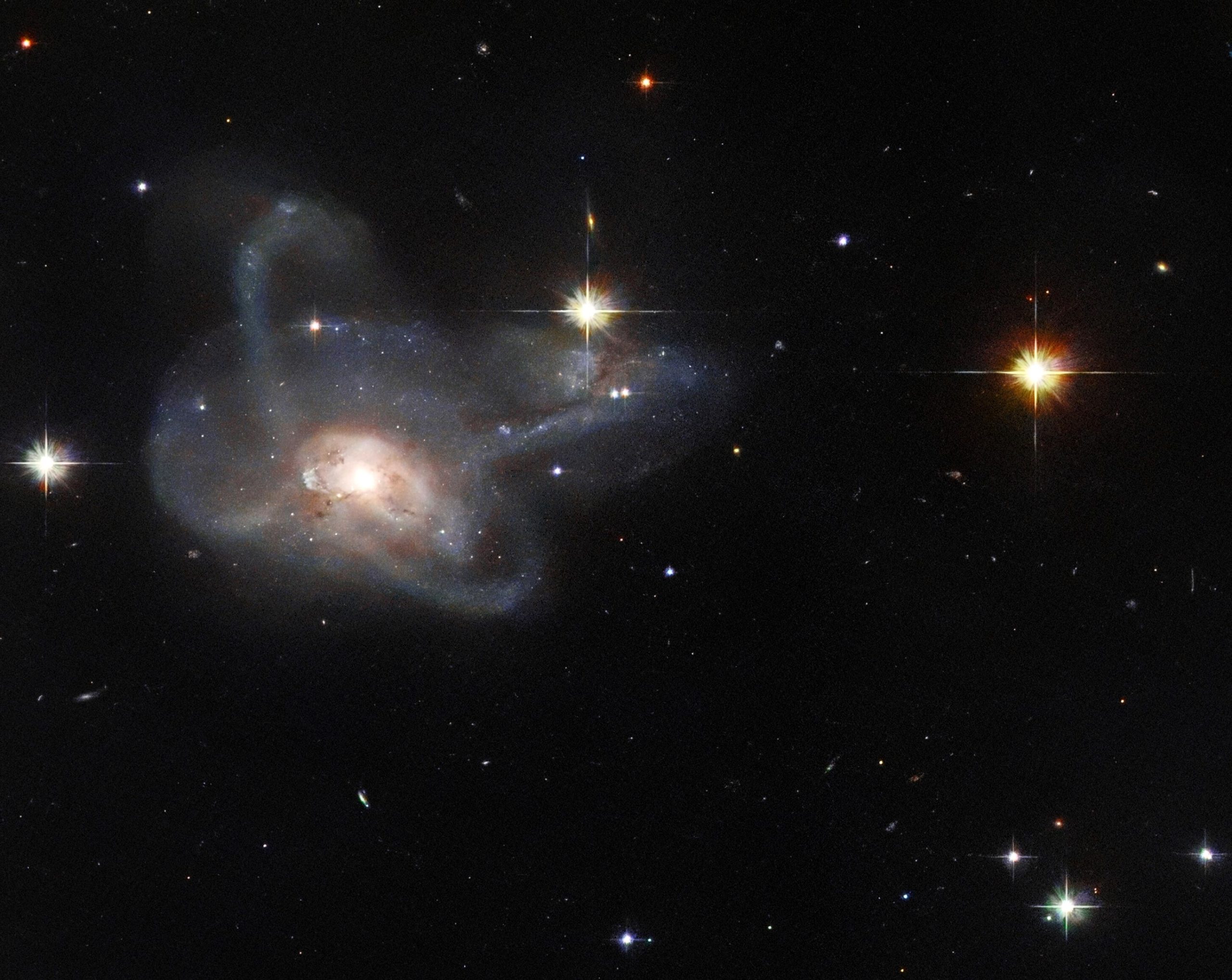
    Galaxy CGCG 396-2, an unusual multi-armed galaxy merger that lies around 520 million light-years from Earth in the constellation Orion, as captured by the Hubble Space Telescope. Credit: ESA/Hubble & NASA, W. Keel

    Galaxy CGCG 396-2, an unusual multi-armed galaxy merger that lies around 520 million light-years from Earth in the constellation Orion, is captured in this stunning NASA/ESA Hubble Space Telescope observation.

    This observation is a gem from a citizen science project, known as the Galaxy Zoo project, in which hundreds of thousands of volunteers classified galaxies to help scientists solve a problem of astronomical proportions — how to sort through the vast amounts of data generated by robotic telescopes. Following a public vote, a selection of the most astronomically intriguing objects from the Galaxy Zoo was chosen for follow-up observations with Hubble. CGCG 396-2 is one of the objects selected, and it was captured in this image by Hubble’s Advanced Camera for Surveys.

    The Galaxy Zoo project originated when an astronomer was given the impossibly mind-numbing task of classifying more than 900,000 galaxies by eye. By making a web interface and inviting citizen scientists to contribute to the challenge, the Galaxy Zoo team was able to crowdsource the analysis. It was an incredible success: within six months a legion of 100,000 volunteer citizen astronomers had contributed more than 40 million galaxy classifications.

    Since its initial success, the Galaxy Zoo project and its successor projects have contributed to more than 100 peer-reviewed scientific articles and led to a rich variety of intriguing astronomical discoveries above and beyond their initial goals. The success of the project also inspired more than 100 citizen science projects on the Zooniverse portal, ranging from analyzing data from the ESA Rosetta spacecraft’s visit to Comet 67P/Churyumov–Gerasimenko to counting killer whales around remote Alaskan islands!

    Never miss a breakthrough: Join the SciTechDaily newsletter.
    Follow us on Google and Google News.

    Astronomy European Space Agency Hubble Space Telescope
    Share. Facebook Twitter Pinterest LinkedIn Email Reddit

    Related Articles

    A Diamond Necklace of Cosmic Proportions

    Hubble Snaps a Stunning Close-Up of a Magnificent Spiral Galaxy

    Extraordinary Hubble Image: Light Bends From the Beyond

    Hubble Space Telescope Sees Volcanic Activity Reforming the Atmosphere on a Rocky Exoplanet

    Hubble Spies a Luminous Heart With Dark Tendrils

    Spectacular Return to the Veil Nebula

    Hubble Spots a Peculiar Sight: Unusual Spiral Galaxy With a Heavy Arm

    A Flash of Life: Hubble Spies an Unusual Planetary Nebula

    Through the Cosmic Clouds: Hubble Spots a Beautiful Stellar Nursery

    1 Comment

    1. Mr. Ali Dib )) on July 6, 2022 5:01 pm

      Interesting, but sure there many ways to keep my real own business running even u need my device information results.

      Reply
    Leave A Reply Cancel Reply

    • Facebook
    • Twitter
    • Pinterest
    • YouTube

    Don't Miss a Discovery

    Subscribe for the Latest in Science & Tech!

    Trending News

    The Strange “Spacetime Crystal” That Can Suddenly Turn Into a Black Hole

    The Surprising Way Asteroids May Have Helped Life Begin on Earth

    Vast Hidden Structure Discovered Under Miles of Ice in East Antarctica

    A Surprising Discovery Suggests Autism Is Not One Condition

    New Alzheimer’s Discovery Could Change How Scientists Fight the Disease

    Yale Discovery Overturns Long-Held “Evolutionary Dead End” Theory

    UCLA Scientists Uncover a “Hidden Weakness” in Some of the World’s Deadliest Cancers

    Humpback Whale Stuns Scientists With 15,000 Kilometer Journey Across Oceans

    Follow SciTechDaily
    • Facebook
    • Twitter
    • YouTube
    • Pinterest
    • Newsletter
    • RSS
    SciTech News
    • Biology News
    • Chemistry News
    • Earth News
    • Health News
    • Physics News
    • Science News
    • Space News
    • Technology News
    Recent Posts
    • Meet the Artemis III Astronauts Preparing for NASA’s Boldest Moon Mission Yet
    • Scientists Develop a New Way To Measure Gravitational Waves in the Expanding Universe
    • MIT’s New Dual-Mode Rocket System Could Send Tiny Satellites to Mars
    • Scientists Discover a Biological Clock Unlike Anything Seen Before
    • This “Zombie” Sea Creature Keeps Growing After Being Cut Apart
    Copyright © 1998 - 2026 SciTechDaily. All Rights Reserved.
    • Science News
    • About
    • Contact
    • Editorial Board
    • Privacy Policy
    • Terms of Use

    Type above and press Enter to search. Press Esc to cancel.