
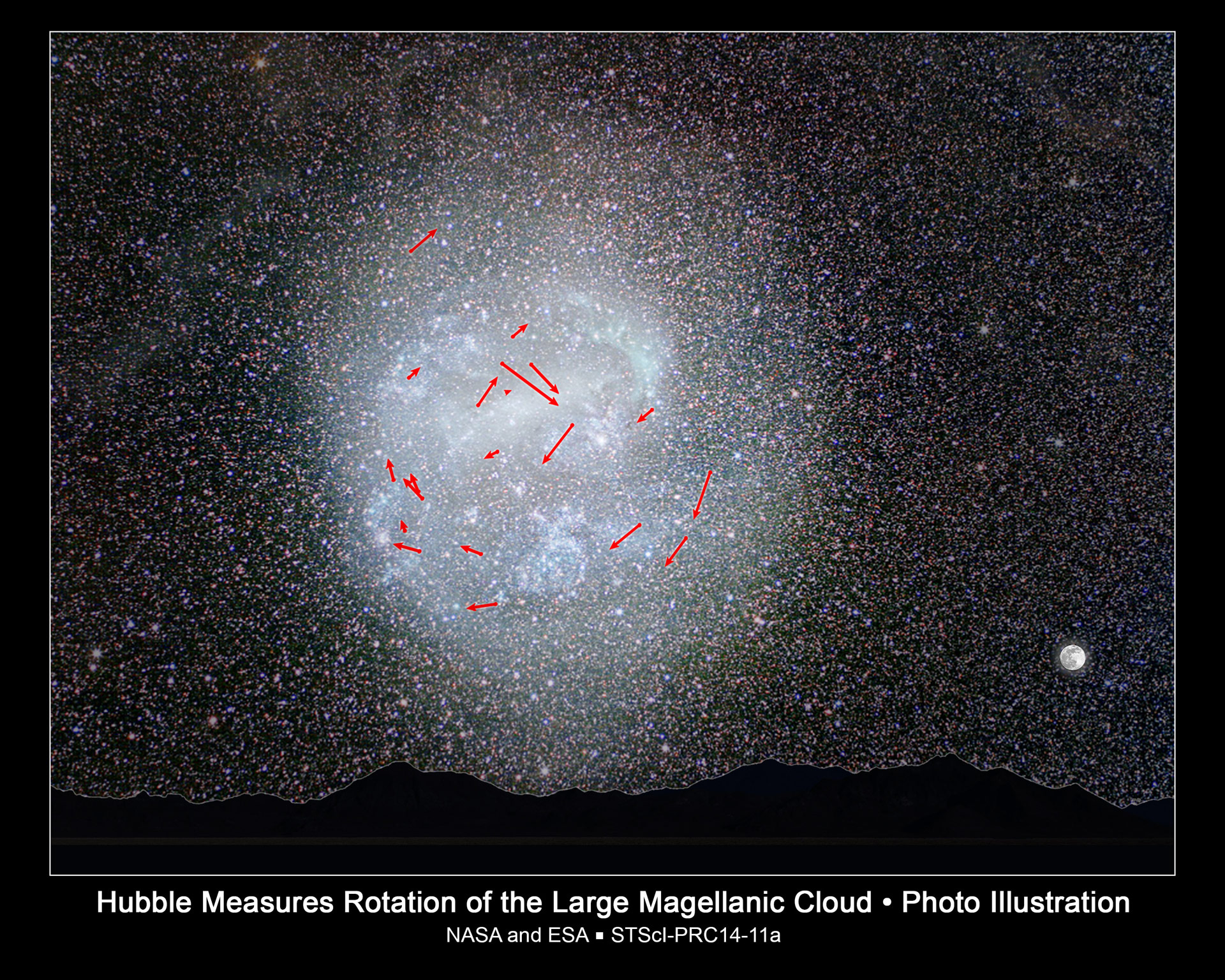
The arrows represent the highest-quality Hubble measurements of the motion of the LMC’s stars to show how this galaxy rotates. Each arrow reveals the predicted motion over the next 7 million years. The motion of each star measured by Hubble over a few years’ time is a million times smaller than the length of each arrow. The LMC completes a rotation every 250 million years. Credit: NASA, ESA, A. Feild and Z. Levay (STScI), Y. Beletsky (Las Campanas Observatory), and R. van der Marel (STScI)
A team of astronomers used the Hubble Space Telescope to measure the average motion of hundreds of individual stars over a seven-year period, revealing for the first time the rotation rate of a galaxy based on the clock-like movement of its stars.
Using the sharp-eyed NASA Hubble Space Telescope, astronomers have for the first time precisely measured the rotation rate of a galaxy based on the clock-like movement of its stars.
According to their analysis, the central part of the neighboring galaxy, called the Large Magellanic Cloud (LMC), completes a rotation every 250 million years. Coincidentally, it takes our Sun the same amount of time to complete a rotation around the center of our Milky Way galaxy.
The Hubble team, composed of Roeland van der Marel of the Space Telescope Science Institute in Baltimore, Maryland, and Nitya Kallivayalil of the University of Virginia in Charlottesville, Virginia, used Hubble to measure the average motion of hundreds of individual stars in the LMC, located 170,000 light-years away. Hubble recorded the stars’ slight movements over a seven-year period.
Disk-shaped galaxies, like the Milky Way and the LMC, generally rotate like a carousel. Hubble’s precision tracking offers a new way to determine a galaxy’s rotation by the “sideways” proper motion of its stars, as seen in the plane of sky. Astronomers have long measured the sideways motions of nearby celestial objects, but this is the first time that the precision has become sufficient to see another distant galaxy rotate.
For the past century astronomers have calculated galaxy rotation rates by observing a slight shift in the spectrum — called the Doppler effect — of its starlight. On one side of a galaxy’s spinning stellar disk, the stars swinging in the direction of Earth will show a spectral blueshift (the compression of light waves due to motion toward the observer). Stars swinging away from Earth on the opposite side of a galaxy will show a spectral redshift (the stretching of light to redder wavelengths due to motion away from the observer).
The newly measured Hubble sideways motions and the Doppler motions measured previously each provide complementary information about the LMC’s rotation rate. By combining the results, the Hubble team for the first time obtained a fully three-dimensional view of stellar motions in another galaxy.
“Determining a galaxy’s rotation by measuring its instantaneous back and forth motions doesn’t allow one to actually see things change over time,” said van der Marel, the lead author on a paper in the February 1 issue of the Astrophysical Journal describing and interpreting the results. “By using Hubble to study the stars’ motions over several years, we can actually for the first time see a galaxy rotate in the plane of the sky.”
Kallivayalil, who led the data analysis, added: “Studying this nearby galaxy by tracking the stars’ movements gives us a better understanding of the internal structure of disk galaxies. Knowing a galaxy’s rotation rate offers insight into how a galaxy formed, and it can be used to calculate its mass.”
Hubble is the only telescope that can make this kind of observation because of its sharp resolution, its image stability, and its 24 years in space. “If we imagine a human on the Moon,” van der Marel explained, “Hubble’s precision would allow us to determine the speed at which the person’s hair grows.”
“This precision is crucial, because the apparent stellar motions are so small because of the galaxy’s distance,” he said. “You can think of the LMC as a clock in the sky, on which the hands take 250 million years to make one revolution. We know the clock’s hands move, but even with Hubble we need to stare at them for several years to see any movement.”
The research team used Hubble’s Wide Field Camera 3 and Advanced Camera for Surveys to observe stars in 22 fields spread across the vast disk of the LMC, which appears in the southern night sky as an object about 20 times the angular diameter of the full moon. Arrows on the accompanying image show the predicted motion over the next 7 million years, based on the Hubble measurements.
Each field was chosen to contain not only dozens of LMC stars, but also a background quasar, a brilliant beacon of light powered by a black hole in the core of a distant active galaxy. The astronomers needed the quasars as fixed background reference points to measure the extremely subtle motion of the LMC stars.
This measurement is the culmination of ongoing work with Hubble by van der Marel and another team to refine the LMC’s rotation rate. Van der Marel began analyzing the galaxy’s rotation in 2002 by creating detailed predictions, now confirmed by Hubble, of what the rotation should look like.
“The LMC is a very important galaxy because it is very near to our Milky Way,” he said. “Studying the Milky Way is very hard because everything you see is spread all over the sky. It’s all at different distances, and you’re sitting in the middle of it. Studying structure and rotation is much easier if you view a nearby galaxy from the outside.”
“Because the LMC is so nearby, it is a benchmark for studies of stellar evolution and populations. For this, it’s important to understand the galaxy’s structure,” Kallivayalil said. “Our technique for measuring the galaxy’s rotation rate using fully three-dimensional motions is a new way to shed light on that structure. It opens a new window to our understanding of how stars in galaxies move.”
In addition to the LMC’s own rotation, it is also moving around the Milky Way as a whole. In earlier science papers, the team and its collaborators used Hubble data to show that the LMC moves faster around the Milky Way than previously believed. This research has revised our understanding of how many times these neighboring galaxies might have met and interacted in the past.
The team next plans to use Hubble to measure the stellar motions in the LMC’s diminutive cousin, the Small Magellanic Cloud, using the same technique. The galaxies are interacting, and that study should also yield improved insight into how the galaxies are moving around each other and around the Milky Way.
Reference: “Third-Epoch Magellanic Cloud Proper Motions II: The Large Magellanic Cloud Rotation Field in Three Dimensions” by Roeland P. van der Marel and Nitya Kallivayalil, 16 January 2014, The Astrophysical Journal.
DOI: 10.1088/0004-637X/781/2/121
arXiv:1305.4641
Never miss a breakthrough: Join the SciTechDaily newsletter.
Follow us on Google and Google News.