
Close Menu
    Facebook X (Twitter) Instagram
    SciTechDaily
    • Biology
    • Chemistry
    • Earth
    • Health
    • Physics
    • Science
    • Space
    • Technology
    Facebook X (Twitter) Pinterest YouTube RSS
    SciTechDaily
    Home»Space»Hubble Views the Hidden Depths of Spiral Galaxy Messier 77
    Space

    Hubble Views the Hidden Depths of Spiral Galaxy Messier 77

    By Hubble Space TelescopeMarch 29, 20131 Comment4 Mins Read
    Facebook Twitter Pinterest Telegram LinkedIn WhatsApp Email Reddit
    Share
    Facebook Twitter LinkedIn Pinterest Telegram Email Reddit
    Hubble Views Spiral Galaxy Messier 77
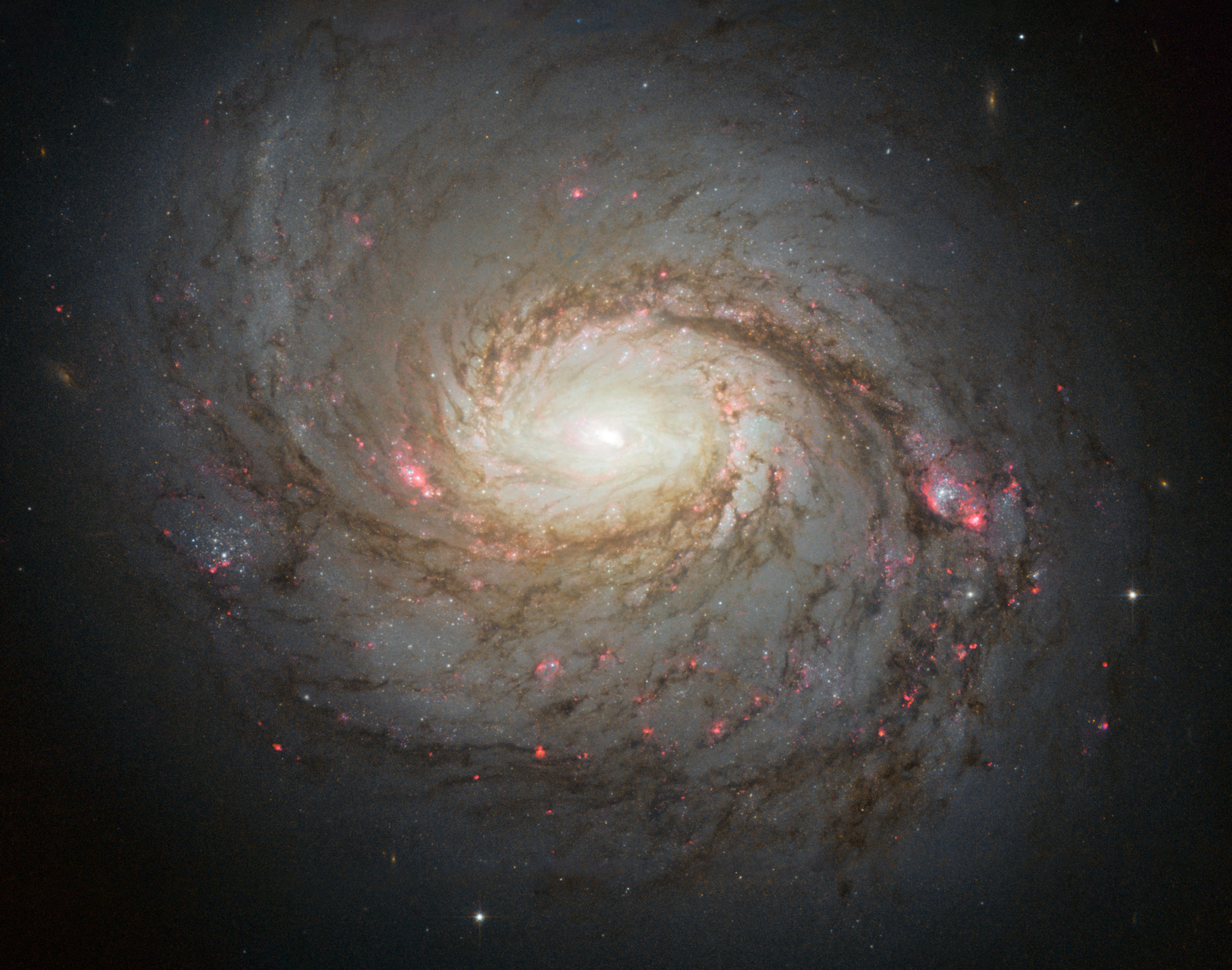
    The NASA/ESA Hubble Space Telescope has captured this vivid image of spiral galaxy Messier 77 — a galaxy in the constellation of Cetus, some 45 million light-years away from us. The streaks of red and blue in the image highlight pockets of star formation along the pinwheeling arms, with dark dust lanes stretching across the galaxy’s starry center. The galaxy belongs to a class of galaxies known as Seyfert galaxies, which have highly ionized gas surrounding an intensely active center. Credit: NASA, ESA & A. van der Hoeven

    NASA’s Hubble Space Telescope views spiral galaxy Messier 77, also known as NGC 1068.

    The NASA/ESA Hubble Space Telescope has captured this vivid image of spiral galaxy Messier 77, one of the most famous and well-studied galaxies in the sky. The patches of red across this image highlight pockets of star formation along the pinwheeling arms, with dark dust lanes stretching across the galaxy’s energetic center.

    Messier 77 is a galaxy in the constellation of Cetus, some 45 million light-years away from us. Also known as NGC 1068, it is one of the most famous and well-studied galaxies. It is a real star among galaxies, with more papers written about it than many other galaxies put together!

    Despite its current fame and striking swirling appearance, the galaxy has been a victim of mistaken identity a couple of times; when it was initially discovered in 1780, the distinction between gas clouds and galaxies was not known, causing finder Pierre Méchain to miss its true nature and label it as a nebula. It was misclassified again when it was subsequently listed in the Messier Catalog as a star cluster.


    This video pans across the sky near to spiral galaxy Messier 77 in the constellation of Cetus, ending on a view of the famous object itself. M 77 is a highly-studied galaxy, with an active black hole at its center and regions of bright star formation dotted along its loosely-wound arms. Credit: NASA, ESA, Digitized Sky Survey 2. Acknowledgment: A. van der Hoeven

    Now, however, it is firmly categorized as a barred spiral galaxy, with loosely wound arms and a relatively small central bulge. It is the closest and brightest example of a particular class of galaxies known as Seyfert galaxies — galaxies that are full of hot, highly ionized gas that glows brightly, emitting intense radiation.

    Strong radiation like this is known to come from the heart of Messier 77 — caused by a very active black hole that is around 15 million times the mass of our Sun. Material is dragged towards this black hole and circles around it, heating up and glowing strongly. This region of a galaxy alone, although comparatively small, can be tens of thousands of times brighter than a typical galaxy.

    Although no competition for the intense center, Messier 77’s spiral arms are also very bright regions. Dotted along each arm are knotty red clumps — a signal that new stars are forming. These baby stars shine strongly, ionizing nearby gas which then glows a deep red color as seen in the image above. The dust lanes stretching across this image appear as a rusty, brown-red color due to a phenomenon known as reddening; the dust absorbs more blue light than red light, enhancing its apparent redness.

    A version of this image won second place in the Hubble’s Hidden Treasures Image Processing Competition, entered by contestant Andre van der Hoeven.


    This video zooms in on spiral galaxy Messier 77. The sequence begins with a view of the night sky near the constellation of Cetus. It then zooms through observations from the Digitized Sky Survey 2, and ends with a view of the galaxy obtained by Hubble. Credit: NASA, ESA, Digitized Sky Survey 2. Acknowledgment: A. van der Hoeven

    Never miss a breakthrough: Join the SciTechDaily newsletter.
    Follow us on Google and Google News.

    Astronomy Hubble Space Telescope Popular
    Share. Facebook Twitter Pinterest LinkedIn Email Reddit

    Related Articles

    Astronomers Puzzled by Dark Storm’s U-Turn on Neptune, Appearance of New Dark Spot

    Rings of Relativity: A Truly Strange and Very Rare Phenomenon

    Hubble Discovers a Strange Exoplanet That Resembles the Long-Sought “Planet Nine”

    Ethereal Orange Glow Radiates From Heart of Stellar Forge

    Hubble Captures Unprecedented Fading of Stingray Nebula – “This Is Very, Very Dramatic, and Very Weird”

    Hubble Space Telescope Explains Oddball Galaxy’s Missing Dark Matter

    ULLYSES: Hubble Embarks on Largest Observing Program of Its Career

    Hubble Spots a Gorgeous Waterfall of Stars

    Hubble Spots Giant Space “Pumpkin” [Video]

    1 Comment

    1. GeoffG on March 29, 2013 12:49 pm

      Don’t tell me there isn’t life out there! What on earth (no pun intended) is it there for if not for life to evolve?

      Reply
    Leave A Reply Cancel Reply

    • Facebook
    • Twitter
    • Pinterest
    • YouTube

    Don't Miss a Discovery

    Subscribe for the Latest in Science & Tech!

    Trending News

    Artificial Sweeteners May Harm Future Generations, Study Suggests

    Splashdown! NASA Artemis II Returns From Record-Breaking Moon Mission

    What If Consciousness Exists Beyond Your Brain

    Scientists Finally Crack the 100-Million-Year Evolutionary Mystery of Squid and Cuttlefish

    Beyond “Safe Levels”: Study Challenges What We Know About Pesticides and Cancer

    Researchers Have Found a Dietary Compound That Increases Longevity

    Scientists Baffled by Bizarre “Living Fossil” From 275 Million Years Ago

    Your IQ at 23 Could Predict Your Wealth at 27, Study Finds

    Follow SciTechDaily
    • Facebook
    • Twitter
    • YouTube
    • Pinterest
    • Newsletter
    • RSS
    SciTech News
    • Biology News
    • Chemistry News
    • Earth News
    • Health News
    • Physics News
    • Science News
    • Space News
    • Technology News
    Recent Posts
    • What if Dark Matter Has Two Forms? Bold New Hypothesis Could Explain a Cosmic Mystery
    • Researchers Expose Hidden Chemistry of “Ore-Forming” Elements in Biology
    • Geologists Reveal the Americas Collided Earlier Than We Thought
    • 20x Difference: Study Reveals True Source of Airborne Microplastics
    • Scientists Uncover Hidden Force Powering Yellowstone’s Supervolcano
    Copyright © 1998 - 2026 SciTechDaily. All Rights Reserved.
    • Science News
    • About
    • Contact
    • Editorial Board
    • Privacy Policy
    • Terms of Use

    Type above and press Enter to search. Press Esc to cancel.