
Close Menu
    Facebook X (Twitter) Instagram
    SciTechDaily
    • Biology
    • Chemistry
    • Earth
    • Health
    • Physics
    • Science
    • Space
    • Technology
    Facebook X (Twitter) Pinterest YouTube RSS
    SciTechDaily
    Home»Space»Hubble’s View of Stephan’s Quintet
    Space

    Hubble’s View of Stephan’s Quintet

    By Hubble Space TelescopeJuly 23, 2013No Comments4 Mins Read
    Facebook Twitter Pinterest Telegram LinkedIn WhatsApp Email Reddit
    Share
    Facebook Twitter LinkedIn Pinterest Telegram Email Reddit
    Hubble Image of Stephans Quintet
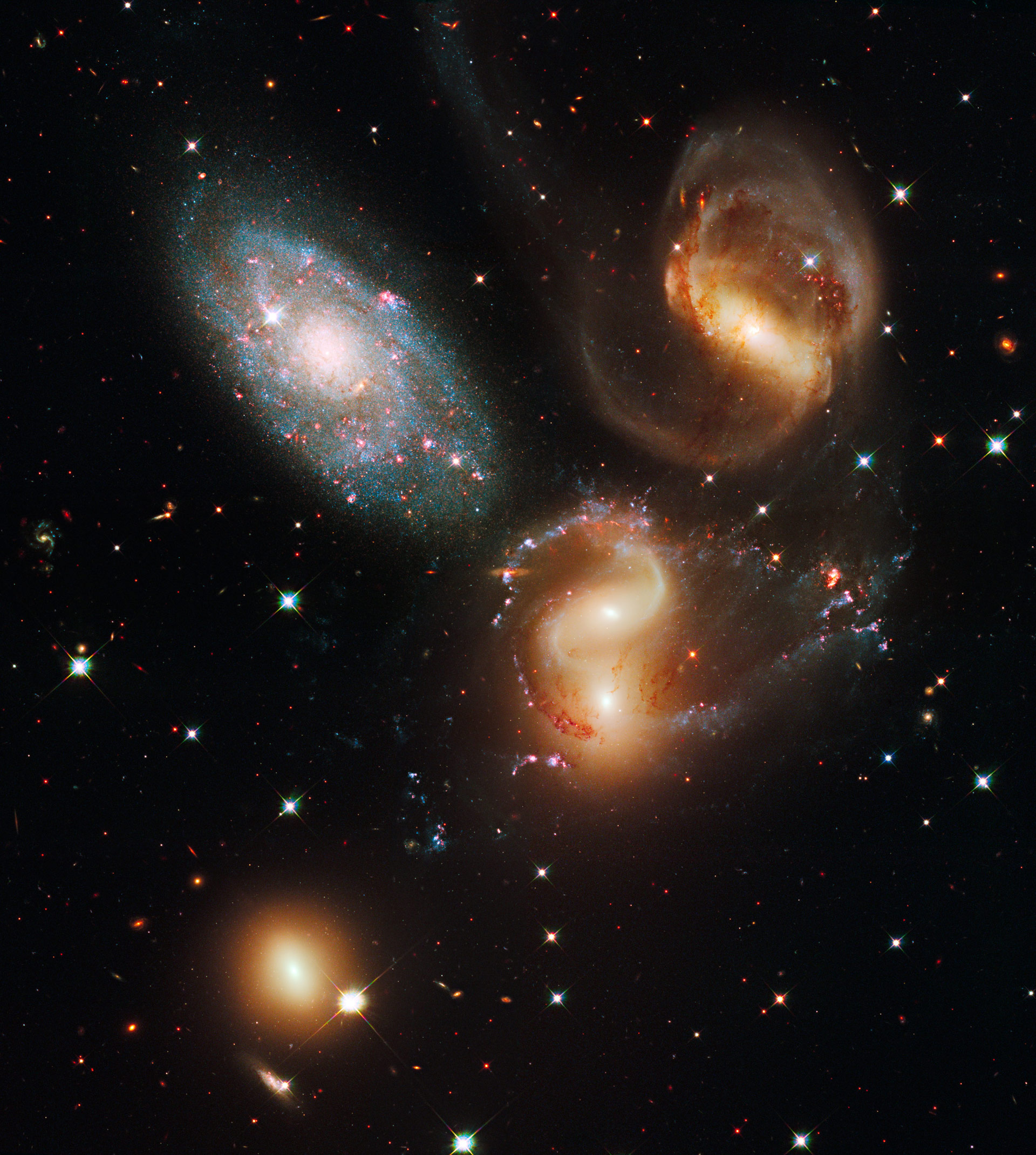
    Stephan’s Quintet, also known as Hickson Compact Group 92. Credit: NASA, ESA, and the Hubble SM4 ERO Team

    This popular image from the Hubble Space Telescope shows Stephan’s Quintet. NGC 7320 is 40 million light-years from Earth and the other four members of the quintet reside 290 million light-years away in the constellation Pegasus.

    A clash among members of a famous galaxy quintet reveals an assortment of stars across a wide color range, from young, blue stars to aging, red stars.

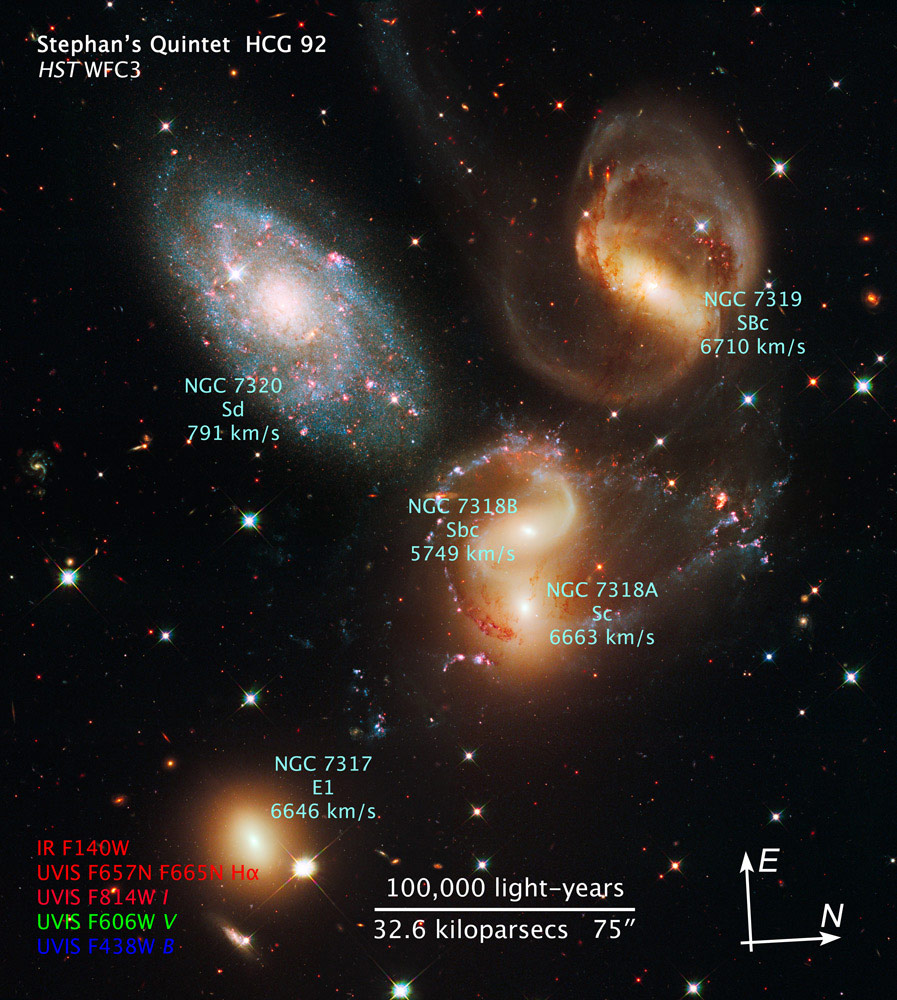
    This portrait of Stephan’s Quintet, also known as Hickson Compact Group 92, was taken by the new Wide Field Camera 3 (WFC3) aboard NASA’s Hubble Space Telescope. Stephan’s Quintet, as the name implies, is a group of five galaxies. The name, however, is a bit of a misnomer. Studies have shown that group member NGC 7320, at upper left, is actually a foreground galaxy about seven times closer to Earth than the rest of the group.

    Three of the galaxies have distorted shapes, elongated spiral arms, and long, gaseous tidal tails containing myriad star clusters, proof of their close encounters. These interactions have sparked a frenzy of star birth in the central pair of galaxies. This drama is being played out against a rich backdrop of faraway galaxies.

    The image, taken in visible and near-infrared light, showcases WFC3’s broad wavelength range.

    The colors trace the ages of the stellar populations, showing that star birth occurred at different epochs, stretching over hundreds of millions of years. The camera’s infrared vision also peers through curtains of dust to see groupings of stars that cannot be seen in visible light.

    NGC 7319, at top right, is a barred spiral with distinct spiral arms that follow nearly 180 degrees back to the bar. The blue specks in the spiral arm at the top of NGC 7319 and the red dots just above and to the right of the core are clusters of many thousands of stars. Most of the quintet is too far away even for Hubble to resolve individual stars.

    Continuing clockwise, the next galaxy appears to have two cores, but it is actually two galaxies, NGC 7318A and NGC 7318B. Encircling the galaxies are young, bright blue star clusters and pinkish clouds of glowing hydrogen where infant stars are being born. These stars are less than 10 million years old and have not yet blown away their natal cloud. Far away from the galaxies, at right, is a patch of intergalactic space where many star clusters are forming.
    Stephans Quintet
    The image is a composite of separate exposures made by the WFC3 instrument on the Hubble Space Telescope. Six filters were used to sample broad and narrow wavelength ranges. The color results from assigning different hues (colors) to each monochromatic image.

    NGC 7317, at the bottom left, is a normal-looking elliptical galaxy that is less affected by the interactions.

    Sharply contrasting with these galaxies is the dwarf galaxy NGC 7320 at the upper left. Bursts of star formation are occurring in the galaxy’s disk, as seen by the blue and pink dots. In this galaxy, Hubble can resolve individual stars, evidence that NGC 7320 is closer to Earth.

    NGC 7320 is 40 million light-years from Earth. The other members of the quintet reside 290 million light-years away in the constellation Pegasus.

    These farther members are markedly redder than the foreground galaxy, suggesting that older stars reside in their cores. The stars’ light also may be further reddened by dust stirred up in the encounters.

    Spied by Edouard M. Stephan in 1877, Stephan’s Quintet is the first compact group ever discovered.

    WFC3 observed the quintet in July and August 2009. The composite image was made by using filters that isolate light from the blue, green, and infrared portions of the spectrum, as well as emission from ionized hydrogen.


    Never miss a breakthrough: Join the SciTechDaily newsletter.
    Follow us on Google and Google News.

    Astronomy Hubble Space Telescope
    Share. Facebook Twitter Pinterest LinkedIn Email Reddit

    Related Articles

    A Morphing Spiral Galaxy Amongst Friends

    Hubble Views Magnificent Lopsided Galaxy NGC 2276

    Hubble Captures Fantastic Detail of Eponymous Spiral Galaxy NGC 691

    Spectacular Image Captured by Hubble Shows a Strangely Contorted Spiral Galaxy

    A Distant Spiral in Virgo: Extraordinary Detail Seen in a Galaxy 150 Million Light-Years Away From Earth

    Magnetic Monsters: Hubble Tracks Down Location of Mysterious Radio Signals From Intergalactic Space

    A Menagerie of Galaxies: Hubble Captures a Cluster With Galaxies of All Shapes and Sizes

    How Habitable Are Planets That Orbit Red Dwarfs – The Most Common Type of Stars in the Galaxy?

    Cosmic Silver Lining: Hubble Spots V565 Surrounded by Four Prominent Diffraction Spikes

    Leave A Reply Cancel Reply

    • Facebook
    • Twitter
    • Pinterest
    • YouTube

    Don't Miss a Discovery

    Subscribe for the Latest in Science & Tech!

    Trending News

    Scientists Warn That This Common Pet Fish Can Wreck Entire Ecosystems

    Scientists Make Breakthrough in Turning Plastic Trash Into Clean Fuel Using Sunlight

    This Popular Supplement May Interfere With Cancer Treatment, Scientists Warn

    Scientists Finally Solved One of Water’s Biggest Mysteries

    Could This New Weight-Loss Pill Disrupt the Entire Market? Here’s What You Should Know About Orforglipron

    Earth’s Crust Is Tearing Open in Africa, and It Could Form a New Ocean

    Breakthrough Bowel Cancer Trial Leaves Patients Cancer-Free for Nearly 3 Years

    Natural Compound Shows Powerful Potential Against Rheumatoid Arthritis

    Follow SciTechDaily
    • Facebook
    • Twitter
    • YouTube
    • Pinterest
    • Newsletter
    • RSS
    SciTech News
    • Biology News
    • Chemistry News
    • Earth News
    • Health News
    • Physics News
    • Science News
    • Space News
    • Technology News
    Recent Posts
    • Kratom Use Explodes in the US, With Life-Changing Consequences
    • Scientists Uncover Fatal Weakness in “Zombie Cells” Linked to Cancer
    • World-First Study Reveals Human Hearts Can Regenerate After a Heart Attack
    • Why Your Dreams Feel So Real Sometimes and So Strange Other Times
    • Scientists Debunk 100-Year-Old Belief About Brain Cells, Rewriting Textbooks
    Copyright © 1998 - 2026 SciTechDaily. All Rights Reserved.
    • Science News
    • About
    • Contact
    • Editorial Board
    • Privacy Policy
    • Terms of Use

    Type above and press Enter to search. Press Esc to cancel.