
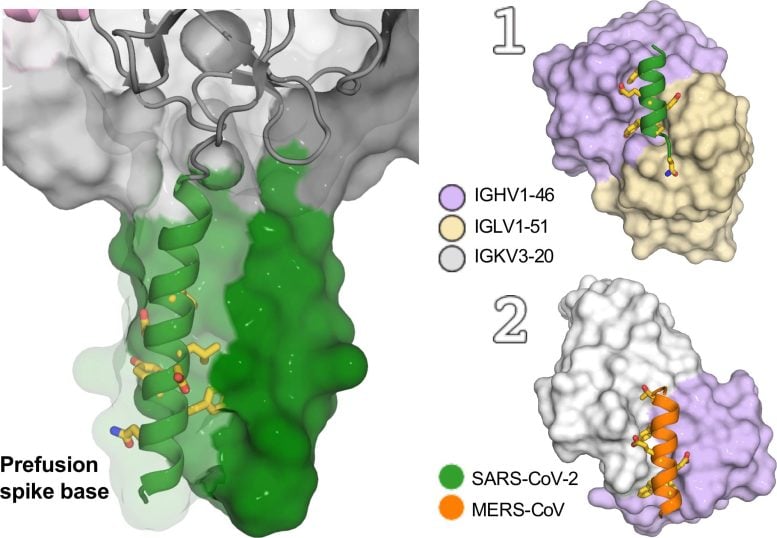
Results from a Scripps Research and UNC team pave the way for a vaccine and therapeutic antibodies that could be stockpiled to fight future coronavirus pandemics.
A team of scientists from Scripps Research and the University of North Carolina (UNC) has found antibodies in the blood of certain COVID-19 donors that can block infection from a broad set of coronaviruses—specifically, in people who have recovered from the virus and were then vaccinated. They found this includes not only the COVID-19-causing SARS-CoV-2, but also SARS-CoV-1 and MERS-CoV.
The scientists’ detailed study of the antibodies and their virus binding sites, reported on February 15, 2023, in the journal Immunity, could lead to the development of a broad coronavirus vaccine and related antibody therapeutics. Both could be used against future coronavirus pandemics as well as any future variants of SARS-CoV-2.
“We show here that there are individual human monoclonal antibodies that can be found that protect against all three recent deadly coronaviruses: SARS-CoV-1, SARS-CoV-2 and MERS-CoV,” says study co-senior author Raiees Andrabi, PhD, institute investigator in the Department of Immunology and Microbiology at Scripps Research.
The other Scripps Research co-senior authors were Dennis Burton, PhD, professor and James and Jessie Minor Chair of the Department of Immunology and Microbiology, and Ian Wilson, PhD, Hansen Professor of Structural Biology and chair of the Department of Integrative Structural and Computational Biology. The co-senior authors from UNC were professor Ralph Baric, PhD, and assistant professor Lisa Gralinski, PhD.
SARS-CoV-2, along with SARS-CoV-1 (the cause of the 2002-04 SARS outbreak) and MERS-CoV (the cause of deadly Middle East Respiratory Syndrome), belong to a broad grouping of coronaviruses known as betacoronaviruses. These viruses mutate at a modestly high rate, creating a significant challenge for the development of vaccines and antibody therapies against them. Thus, in the case of SARS-CoV-2, although existing vaccines have been very helpful in limiting the toll of disease and death from the pandemic, new SARS-CoV-2 variants have emerged that can spread even among vaccine recipients.
Focus on the S2 Region of the Spike Protein
Over the past two years, however, the Andrabi/Burton and Wilson laboratories have been finding evidence that SARS-CoV-2 and other betacoronaviruses have a vulnerable site that does not mutate much. This site, which is in the S2 region (or base) of the viral spike protein, is relatively conserved on betacoronaviruses that infect a variety of animal species. By contrast, current SARS-CoV-2 vaccines mainly target the viral spike protein’s relatively mutable S1 region, with which the virus binds to host-cell receptors.
The S2 site plays a key role in how betacoronaviruses progress from receptor-binding to the membrane fusion that enables entry into host cells in the respiratory tract. In a study reported last year, the Andrabi/Burton and Wilson laboratories found that some human antibodies can bind to this site on SARS-CoV-2 in a way that apparently disrupts viral fusion and blocks infection. The existence of such a vulnerable site raises the possibility of targeting it to provide both long-lasting and broad protection against betacoronaviruses. Therefore, the researchers, for the new study, made a more comprehensive search for anti-S2 antibodies in blood samples from human volunteers.
These volunteers were individuals who had recovered from COVID-19, had been vaccinated, or had recovered from COVID-19 and then had been vaccinated. Somewhat to the researchers’ surprise, they found that antibodies to the vulnerable S2 site were present in the vast majority of volunteers in the latter group—people who had recovered from COVID-19 and then had been vaccinated—but at a much lower frequency in the others. Overall, the researchers identified and characterized 32 of these S2-targeting antibodies.
In lab virus neutralization studies and in virus-challenge studies with mice at UNC, the researchers found that several of these antibodies provide protection of unprecedented breadth— not only against SARS-CoV-2 but also SARS-CoV-1 and MERS-CoV betacoronaviruses.
“In principle, a vaccination strategy that can induce such antibodies is likely to provide broad protection against a diverse spectrum of betacoronaviruses,” says Burton.
Pan-Betacoronavirus Vaccines
Structural studies of several of the antibodies when bound to S2 illuminated their common binding sites and modes of binding, providing key information that should aid the development of future vaccines targeting this region.
“Targeted rational vaccine strategies could take advantage of this molecular information of the interactions of these antibodies with the S2 domain to inform the design of pan-betacoronavirus vaccines,” says Wilson.
Indeed, the researchers have already applied their findings to the initial design and testing of a potential “pan-betacoronavirus” vaccine candidate, which if successful could be stockpiled to limit future pandemics. The investigators also envision a therapeutic mix of different S2-targeting antibodies, perhaps as a cocktail with antibodies to other spike regions, that could be taken to prevent infection by a novel betacoronavirus or to reduce disease in those already infected.
Reference: “Broadly neutralizing anti-S2 antibodies protect against all three human betacoronaviruses that cause deadly disease” by Panpan Zhou, Ge Song, Hejun Liu, Meng Yuan, Wan-ting He, Nathan Beutler, Xueyong Zhu, Longping V. Tse, David R. Martinez, Alexandra Schäfer, Fabio Anzanello, Peter Yong, Linghang Peng, Katharina Dueker, Rami Musharrafieh, Sean Callaghan, Tazio Capozzola, Oliver Limbo, Mara Parren, Elijah Garcia, Stephen A. Rawlings, Davey M. Smith, David Nemazee, Joseph G. Jardine, Yana Safonova, Bryan Briney, Thomas F. Rogers, Ian A. Wilson, Ralph S. Baric, Lisa E. Gralinski, Dennis R. Burton and Raiees Andrabi, 15 February 2023, Immunity.
DOI: 10.1016/j.immuni.2023.02.005
“Broadly neutralizing anti-S2 antibodies protect against all three human betacoronaviruses that cause deadly disease” was co-authored by Panpan Zhou, Ge Song, Hejun Liu, Meng Yuan, Wan-ting He, Nathan Beutler, Xueyong Zhu, Longping Tse, David Martinez, Alexandra Schäfer, Fabio Anzanello, Peter Yong, Linghang Peng, Katharina Dueker, Rami Musharrafieh, Sean Callaghan, Tazio Capozzola, Oliver Limbo, Mara Parren, Elijah Garcia, Stephen Rawlings, Davey Smith, David Nemazee, Joseph Jardine, Yana Safonova, Bryan Briney, Thomas Rogers, Ian Wilson, Ralph Baric, Lisa Gralinski, Dennis Burton, and Raiees Andrabi.
The research was supported by the National Institutes of Health (UM1 AI44462, AI036214, 5T32AI007384, U54 CA260543, U54 CA260543, AI157155, R21 AI145372), IAVI, the Bill and Melinda Gates Foundation (INV-004923), the John and Mary Tu Foundation, and the James B. Pendleton Charitable Trust.
Never miss a breakthrough: Join the SciTechDaily newsletter.
Follow us on Google and Google News.
2 Comments
I have not been vaccinated.i have had multiple exposures to COVID-19 with no infection. I think I am immune. Can I or others like me be of help?
I have not been vaccinated.i have had multiple exposures to COVID-19 with no infection. I think I am immune. Can I or others like me be of help?