
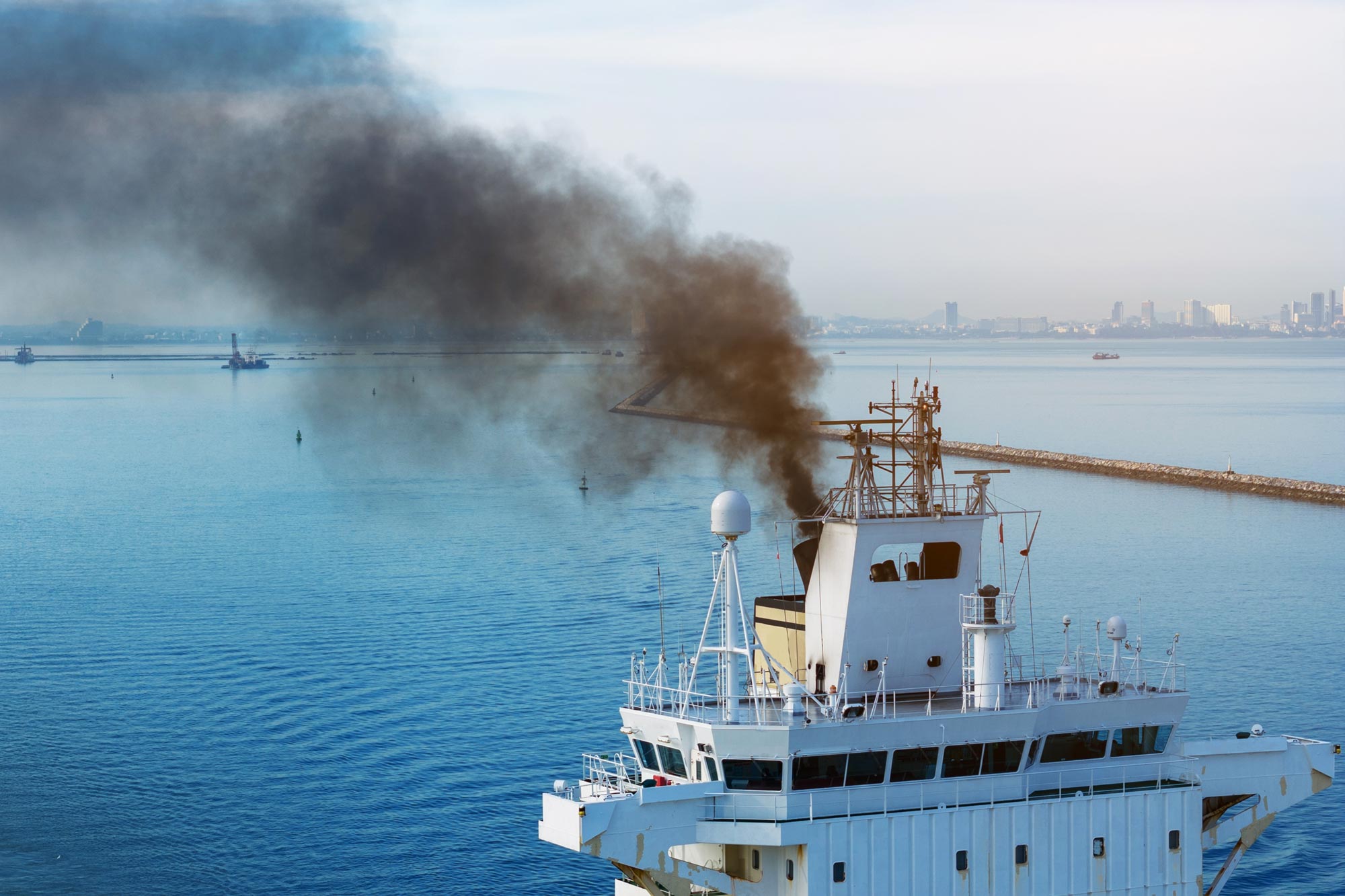
Carbon released by the Industrial Revolution has left a chemical fingerprint nearly everywhere scientists looked in the North Atlantic, including waters thousands of feet below the surface.
Scientists have traced carbon from fossil fuel emissions deep into the North Atlantic by measuring shifts in the natural balance between the isotopes C-12 and C-13, revealing how industrial activity is changing water masses far below the ocean surface.
When coal, oil, and natural gas are burned, their carbon enters the atmosphere and lowers the ratio of C-13 to C-12. This change, known as the Suess effect, gives scientists a way to distinguish carbon from fossil fuels from much of the carbon already circulating naturally through the planet.
Industrial Carbon Reaches the Deep Ocean
The ocean absorbs carbon dioxide as its surface exchanges gases with the atmosphere. Currents, vertical mixing, and the formation of deep water can then transport that carbon into the ocean interior, where it may remain separated from the atmosphere for decades or centuries.
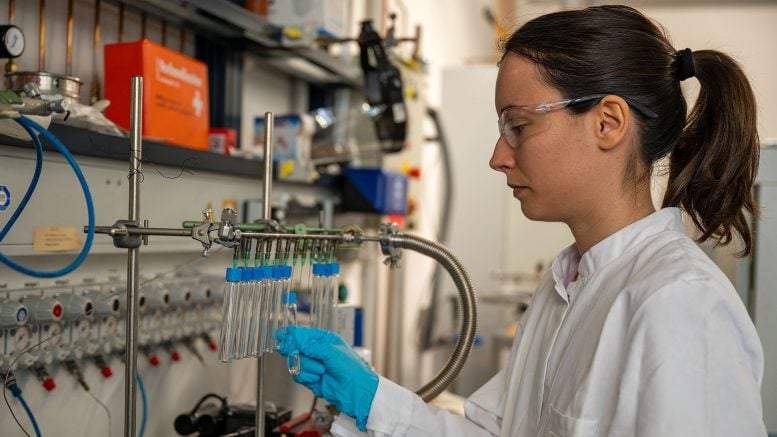
To determine how far the industrial signature has traveled, Emma Bavoux and her colleagues analyzed carbon isotope ratios in North Atlantic water samples. The samples were collected aboard the research vessel MARIA S. MERIAN during expeditions in 2017 and 2018 along a route near 48° North that crossed the entire ocean basin.
The study, published in Geophysical Research Letters, also incorporated earlier measurements of sulfur hexafluoride (SF₆). Because this trace gas is produced by human activities and enters the ocean from the atmosphere, it can help researchers estimate when water was last exposed to the surface and calculate the human contribution to its carbon isotope signature.
A Chemical Clock for Ocean Water
“We were surprised by how significant the Suess effect already is in the deep-water masses of the North Atlantic,” says Emma Bavoux. The researchers detected the signal in nearly every water mass they examined, although its strength varied according to how recently the water had contacted the atmosphere.
Young subsurface waters carried the clearest evidence of fossil fuel carbon. The signal was extremely weak or absent in ancient water masses such as Northeast Atlantic Deep Water, which probably has remained isolated from the atmosphere for several hundred years.
Western North Atlantic waters showed a different pattern. Labrador Sea water and currents passing through the Denmark Strait before sinking into the deep ocean displayed Suess effect changes of about 0.3 to 0.6 per mille compared with preindustrial conditions. The team also tracked a large eddy in the Labrador Sea that carried a recognizable industrial carbon signature to depths of 2,000 meters (6,562 feet).
Human Activity Enters the Geological Record
The findings show that industrial emissions are altering not only the atmosphere and surface ocean, but also remote water masses far below. The same chemical shift is being preserved in the shells of foraminifera, microscopic marine organisms whose remains have accumulated on the seafloor during recent decades.
Because foraminifera build their shells using carbon from the surrounding seawater, their fossils can record changes in ocean chemistry. Successive layers of sediment may therefore preserve the rise of fossil fuel emissions as a measurable marker for future geologists.
“Through the Suess effect, the ocean floor preserves signals of human origin that now mark the beginning of the Anthropocene in these long-term geological archives,” says Stefan Mulitza, co-author of the study. “How clearly this stratigraphic boundary will be defined depends primarily on the future trajectory of carbon dioxide emissions.”
Scientists participating in the Cluster of Excellence “The Ocean Floor—Earth’s Uncharted Interface” are continuing to investigate how the ocean, its ecosystems, and the seafloor shape the global carbon cycle.
Reference: “Anthropogenic Carbon Isotope Signals in North Atlantic Water Masses at 48°N” by E. Bavoux, S. Mulitza, R. Steinfeldt, H. Kuhnert, G. Martinez-Mendez and H. Pälike, 5 June 2026, Geophysical Research Letters.
DOI: 10.1029/2025GL121339
Never miss a breakthrough: Join the SciTechDaily newsletter.
Follow us on Google and Google News.
7 Comments
“We were surprised by how significant the Suess effect already is in the deep-water masses of the North Atlantic,”
Perhaps that should have been a hint to consider alternative working hypotheses, such as that there are other physical processes — for example, out-gassing of CO2, and chemical reactions such as precipitation of CaCO3 in warming oceans and pH buffering that involves the bicarbonate ion — that result in isotopic fractionation. That is, terrestrial photosynthesis isn’t the only activity that favors the lighter carbon isotope, 12C. The fact that petroleum, derived from marine organisms, is blamed for contributing to the change in 13C concentration, strongly suggests that marine photo-synthesizers behave similarly to terrestrial plants. Until such time as they have done the calculations, and verified the predictions with sampling, their claim about the anthropogenic influence is only conjecture because they have assumed that ancient terrestrial photosynthesis is the only major variable in the isotopic fraction of carbon dioxide in the oceans. Actually, it appears that even that assumption is skewed because NASA has shown that Earth is ‘greening’ with the areal expansion of terrestrial plants. Surely photosynthetic marine organisms are also increasing in abundance as CO2 increases. That means that photo-synthesizers in the Photic Zone (near the surface) will concentrate 12C just as the plants that made coal or marine organisms that made crude oil did. When they die, they start being decomposed, releasing CO2 enriched in 12C, above the concentrations in volcanic CO2. The authors state, “Young subsurface waters carried the clearest evidence of fossil fuel carbon.” During the night, marine photo-synthesizers will respire CO2, mimicking oxidized fossil fuels that have already selected for the light isotope. Somebody needs to run the numbers. It is the unexamined assumptions that usually get otherwise honest scientists into trouble.
The oceans have taken up about 25% of the excess CO2 from AGW, and it’s acidifying the oceans. There is no net off-gassing of CO2 from the oceans.
“The fact that petroleum, derived from marine organisms, is blamed for contributing to the change in 13C concentration, strongly suggests that marine photo-synthesizers behave similarly to terrestrial plants.”
CO2 emissions from burning fossil fuels the only CO2 that lacks carbon 14. That isotope of carbon is radioactive and breaks down in about 5,500 years, when exposed to the atmosphere. Petroleum has been deep inside Earth for 100s of millions of years, so the carbon 14 is long gone.
It is being directly observed that there has been a huge decrease in carbon 14 CO2 in the atmosphere. It’s an indisputable fingerprint of AGW..
I meant to delete that comment. But I guess I can’t.
My question would be how much carbon 14 did they find in ocean CO2.
That would be a clue as to whether it’s from petroleum
There are a number of things in your first comment that are wrong. Do you want to retract any before I critique them?
14C does NOT “break down in about 5,500 years.” Like all radioactive isotopes, it experiences a logarithmic decay with a half-life of about 5,500 years; that means half has decayed to nitrogen during that period, and half of the remainder will similarly decay in the next half-life. Any organic material older than about 60,000 years only has 14C currently below the detection limits; Burning fossil fuels is NOT the only CO2 that lacks 14C. Volcanic emissions are lacking 14C; unfortunately, we only have good estimates from terrestrial volcanoes and calderas. We know very little about the number or activity of submarine volcanoes. Melting ice caps are contributing 14C-free CO2. The CO2 coming from melting permafrost has very little 14C, being near the maximum detection limit and older. Methane given off by the permafrost only has a lifetime of about 10 years after which time the hydrogen will be replaced by oxygen, giving 14C-free CO2.
The oceans are very old and have a volume much larger than the atmosphere. Thus, there was little 14C in the oceans (equivalent to atmospheric background partial pressure at the surface) prior to nuclear weapons testing in the atmosphere. Thus, it is a little trickier to calculate the composition in seawater, as one has to specify location and temperature. The deep abyssal currents that start at the poles, and move towards the equator before up-welling, are as much as 1,000 years old so some natural 14C will have decayed. However, everything that succumbs to its mortality in the oceans falls to the bottom and is decomposed by bacteria; the ultimate product is some dissolved organic carbon and a lot of CO2 held in solution by the great pressure and cold water — which largely out-gases when it reaches the warm surface at 1 atmosphere pressure after up-welling.
I asked Copilot, “What is the apparent age of the oceans based on the 14C abundance?” It’s reply was (short version), “Modern ocean waters contain significantly depleted ¹⁴C, giving them an apparent radiocarbon age of roughly 400–1500 years, depending on depth and basin. Deep waters can exceed 2000 years, and under glacial conditions some basins reached >5000 ¹⁴C years.” If you want the verbose response, ask it the same question I did.
“The oceans have taken up about 25% of the excess CO2 from AGW, and it’s acidifying the oceans.”
You have to realize that while isotopic fractionation happens when under-saturated seawater is in contact with the atmosphere, thus favoring the lighter 12C for absorption and dissolution into the water, and inhibiting the loss of the heavier 13C, the oceans can’t tell which individual molecule is natural and which is anthropogenic. According to my reading, summarized here:
https://wattsupwiththat.com/2021/06/07/carbon-cycle/
It is clear that the monthly variation in atmospheric CO2 concentrations is driven by biogenic fluxes, particularly microbial and fungal decomposition, Fall through early-Spring, and in the Winter in the Arctic when trees respire in the absence of sunlight; terrestrial plants and marine plankton withdraw the atmospheric CO2 in late-Spring through early-Fall. The anthropogenic contribution to this seasonal see-saw is a fairly constant 4%, albeit it is increasing slowly. Again, the sinks can’t individually tell the source of a molecule and as a first-order approximation will withdraw atmospheric CO2 in proportion to the partial pressure. Anthro’ CO2 is only about 4% of the total annual flux, so it plays a minor role — one might say, negligible.
Compared to your 25% estimate, quoted above, a NOAA publication says, “The ocean acts as a ‘carbon sink’ and absorbs about 31% of the CO2 emissions released into the atmosphere according to a study published by NOAA and international partners in Science.” It is typical that alarmists either ignore numerical uncertainty, or show an optimism that isn’t supported by the data. Despite relatively small declared uncertainties (1-sigma?) for the two different Carbon Cycle studies that I cited above, there is about an 11 Pg difference between the two studies in the estimated oceanic CO2 out-gassing. Considering the vastness of the oceans, they are probably the least well-sampled of the sources and sinks. I suspect that they have been adjusted to give a net-zero release for pre-Industrial Revolution times.
As to your claim about “Ocean Acidification,” please read the following:
http://wattsupwiththat.com/2015/09/15/are-the-oceans-becoming-more-acidic/
“Perhaps that should have been a hint to consider alternative working hypotheses, such as that there are other physical processes… ” -Clyde
You seem to have missed that sulfur hexafluoride (SF₆) was used as a tracer. SF₆ production has been increasing exponentially since the 80’s, and it is a heavy gas much like CO2. Both are diffusing into the ocean because of their increasing atmospheric concentrations ala Henry’s Law (although ocean water acts as more of a sponge for CO₂ because of further chemical reactions). Thus the concentration of SF₆ (above baseline values) can be used to estimate how much of a local δ¹³C signal is due to freshly added atmospheric carbon.
It does not seem accidental that all of your putative CO2 sources lead to light carbon. You have neglected to mention that inorganic carbonate precipitates in the ocean have high δ¹³C and are subject to dissolution into bicarbonate because of the increasing acidity, thanks to increasing CO₂ infiltration. Perhaps most amusing is your greening claim (itself doubtful, satellite-measured ocean chlorophyll levels at low to mid latitudes are decreasing, and CO2 is typically not the limiting nutrient) relies on CO₂ flux from the atmosphere, but somehow once it has been processed by phytoplankton, it didn’t come from the atmosphere. Regardless, the competing signals from organic and inorganic carbon processes are constantly being diluted by the incoming atmospheric carbon.
“Thus the concentration of SF₆ (above baseline values) can be used to estimate how much of a local δ¹³C signal is due to freshly added atmospheric carbon.”
Such an assertion without an explanation or citation is useless. Measurements at a parts per trillion level of something that is virtually chemically inert only tells us that the human production is increasing and accumulating. It tells us nothing about the isotopic fractionation and distribution of carbon which has both natural and anthropogenic sources and sinks. At best, it suggests that human production of CO2 is increasing, although taxing agents follow sales of fossil fuels very closely to be sure that the Devil gets his due. Estimates indicate that anthro’ sources of CO2 are remarkably constant. [ See Fig. 2 here: https://wattsupwiththat.com/2022/03/22/anthropogenic-co2-and-the-expected-results-from-eliminating-it/ ] They only amount to about 4% of the total annual flux.
“You have neglected to mention that inorganic carbonate precipitates in the ocean have high δ¹³C and are subject to dissolution into bicarbonate because of the increasing acidity, thanks to increasing CO₂ infiltration.”
Do you have a citation to support your claim that the inorganic carbonate precipitates in the ocean have high δ¹³C? High levels of bicarbonate make it easiest for calcifiers to make carbonate; bicarbonate is at its highest in seawater (see “Bjerrum diagram”) for ranges of pH that seawater is likely to have. Adult calcifiers protect their shells/tests with mucous and keratin and constantly repair their shells. It is the rain of carbonate tests from dead plankton that are at risk of being dissolved; also juveniles in up-welling zones are at risk from abyssal waters rich in CO2. The waters are not acidic. Solubility of the carbonate tests varies with temperature, pressure, pH, and the mineral species — aragonite and calcite. Water is sometimes called the “Universal Solvent,” being able to dissolve even gold. One has to consider the solubility of the solute for a given temperature and pH. The buffered ocean waters are remarkably constant in their pH. More than 60 years ago, the Father of Geochemistry, Stanford Professor Konrad Krauskopf, stated in his text book that the range in pH of the oceans was essentially the same as what it is today.
“… satellite-measured ocean chlorophyll levels at low to mid latitudes are decreasing, …”
Over what period of time? Do you have a citation for that claim?