

The Study Highlights the Significance of Organic Sulfur Compounds in the Biogeochemical Cycle
Geochemist Alexandra Phillips has sulfur on her mind. The yellow element is a vital macronutrient, and she’s trying to understand how it cycles through the environment. Specifically, she’s curious about the sulfur cycle in Earth’s ancient ocean, some 3 billion years ago.
Fortunately, the nutrient-poor waters of Lake Superior offer a welcome glimpse into the past. “It’s really hard to look back billions of years,” said Phillips, a former postdoctoral researcher at UC Santa Barbara and University of Minnesota, Duluth. “So this is a great window.” She and her co-authors discovered a new type of sulfur cycle in the lake. Their findings, published in Limnology and Oceanography, focus attention on the role organic sulfur compounds play in this biogeochemical cycle.
Understanding Sulfate and Hydrogen Sulfide
The sulfate ion (SO4) is the most common form of sulfur in the environment, and a major component of seawater. In the bottoms of oceans and lakes, where oxygen becomes unavailable, some microbes make their living by turning sulfate into hydrogen sulfide (H2S). The fate of this hydrogen sulfide is complex; it can be consumed quickly by microorganisms during respiration, or it can be retained in sediments for millions of years. Converting sulfate into hydrogen sulfide is a time-honored profession; genomic evidence suggests microbes have been doing it for at least 3 billion years.
But scientists believe sulfate didn’t become abundant until around 2.7 to 2.4 billion years ago, when the photosynthetic activity of newly evolved cyanobacteria began pumping massive amounts of oxygen into the ocean and atmosphere. So where were these ancient microbes getting their sulfate?
Alexandra Phillips is a marine and climate scientist with expertise in oceanography, geochemistry, and geobiology. Her research focuses on organic sulfur in oceans and lakes as well as how social media can display diverse role models for women in STEM. Phillips also serves as a science communicator and policy officer.
Organic Sulfur’s Significance
Mulling over this quandary, Phillips turned her attention toward organic sulfur, molecules in which sulfur is bound to a carbon compound. These include sulfo-lipids, and sulfur amino acids. In the modern ocean, sulfate is almost a million times more abundant than organic sulfur. “But in a system where there’s not very much sulfate, all of a sudden organic sulfur matters a lot more,” she said.
“For a long time, our thinking was dominated by what we could learn from modern oceans, which are sulfate-rich,” said senior author Sergei Katsev, a professor at University of Minnesota’s Large Lakes Observatory. Katsev served as the senior scientist of the National Science Foundation-funded project. “Understanding early Earth, however, requires looking at processes that emerge when sulfate is scarce, and this is where organic sulfur can change the whole paradigm.”
Lake Superior as a Model for Ancient Oceans
It just so happens that Lake Superior has very little sulfate, nearly a thousand times less than the modern ocean. “In terms of sulfate, Lake Superior looks a lot closer to the ocean billions of years ago and may help us understand processes we can’t go back in time to observe directly,” Phillips said. The early oceans had very little sulfate because there was much less free oxygen available to form SO4.
The Great Lake serves as an analog for the ancient ocean, enabling Phillips to see how the sulfur cycle may have been playing out back then under similar chemistries. She had three questions in mind:
- If sulfate reduction is happening, which microbes are responsible?
- If organic sulfur is fueling this process, what types of compounds do microbes prefer?
- And, what happens to the hydrogen sulfide that’s produced?
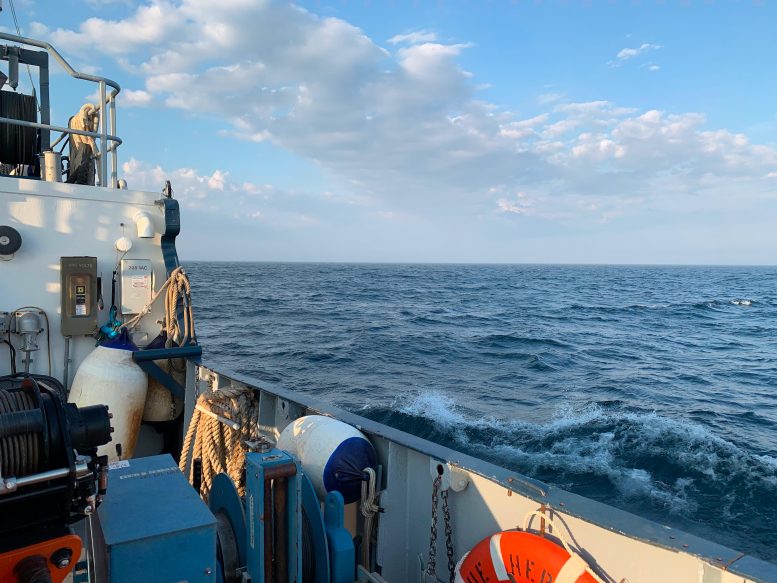
Phillips and her collaborators headed out to Lake Superior to trace organic sulfur from source to sink. The team took water and sediment samples back to the lab for analysis from two sites: one with plentiful oxygen in the sediment and one without. Sulfate reduction usually occurs in anoxic parts of the environment. Oxygen is a great resource, so organisms prefer to use oxygen instead of sulfate when they can. The team used shotgun metagenomics to look for microbes with genes involved in sulfate reduction. And they found plenty, precisely in the layer where sulfate levels peaked in the sediment. In all, they identified eight sulfate-reducing taxa.
Investigating Organic Sulfur Preferences
The researchers then set off to determine what variety of organic sulfur the microbes preferred. They gave different forms of organic sulfur to separate microbial communities and observed the results. The authors found the microbes produced most of their sulfate from sulfo-lipids, rather than the sulfur amino acids. Although this process takes some energy, it’s much less than the microbes can get from the subsequent reduction of sulfate to hydrogen sulfide.
Not only were the sulfo-lipids preferred for this process, they were also more abundant in the sediment. Sulfo-lipids are produced by other microbial communities, and drift to the lake bottom when they die.
With the “who” and the “how” answered, Phillips turned her attention to the fate of the hydrogen sulfide. In the modern ocean, hydrogen sulfide can react with iron to form pyrite. But it can also react with organic molecules, producing organic sulfur compounds. “And we found that there is a ton of organic matter sulfurization in the lake, which is really surprising to us,” she said. “Not only is organic sulfur fueling the sulfur cycle as a source, but it’s also an eventual sink for the hydrogen sulfide.”
The Novel Sulfur Cycle
This cycle — from organic sulfur to sulfate to hydrogen sulfide and back — is completely new to researchers. “Scientists studying aquatic systems need to start thinking about organic sulfur as a central player,” Phillips said. These compounds can drive the sulfur cycle in nutrient-poor environments like Lake Superior, or even the ancient ocean.
This process may also be important in systems with high sulfate. “Organic sulfur cycling, like what we see in Lake Superior, is probably ubiquitous in marine and freshwater sediments. But in the ocean sulfate is so abundant that its behavior swamps out most of our signals,” said senior author Morgan Raven, a biogeochemist at UC Santa Barbara. “Working in low-sulfate Lake Superior lets us see how dynamic the sedimentary organic sulfur cycle really is.” Organic sulfur seems to serve as an energy source for microbial communities as well as preserve organic carbon and molecular fossils. Combined, these factors could help scientists understand the evolution of early sulfur-cycling microorganisms and their impact on Earth’s chemistry.
Some of the earliest biochemical reactions likely involved sulfur, Phillips added. “We’re pretty sure that sulfur played an important role in really early metabolisms.” A better understanding of the sulfur cycle could provide insights on how early lifeforms harnessed this type of redox chemistry.
Reference: “Organic sulfur from source to sink in low-sulfate Lake Superior” by Alexandra A. Phillips, Imanol Ulloa, Emily Hyde, Julia Agnich, Lewis Sharpnack, Katherine G. O’Malley, Samuel M. Webb, Kathryn M. Schreiner, Cody S. Sheik, Sergei Katsev and Morgan Reed Raven, 9 November 2023, Limnology and Oceanography.
DOI: 10.1002/lno.12454
Never miss a breakthrough: Join the SciTechDaily newsletter.
Follow us on Google and Google News.
2 Comments
“Her research focuses on organic sulfur in oceans and lakes as well as how social media can display diverse role models for women in STEM.”
What do these two have to do with each other? In particular, what does the latter have to do with the subject of this research? The statement reminds me of an old joke: “Why is a mouse?”
“Why is a mouse?”
Wonder what the punchline might be.