
Close Menu
    Facebook X (Twitter) Instagram
    SciTechDaily
    • Biology
    • Chemistry
    • Earth
    • Health
    • Physics
    • Science
    • Space
    • Technology
    Facebook X (Twitter) Pinterest YouTube RSS
    SciTechDaily
    Home»Space»Large Synoptic Survey Telescope Headed to the Final Design Stage
    Space

    Large Synoptic Survey Telescope Headed to the Final Design Stage

    By National Science FoundationJuly 19, 2012No Comments3 Mins Read
    Facebook Twitter Pinterest Telegram LinkedIn WhatsApp Email Reddit
    Share
    Facebook Twitter LinkedIn Pinterest Telegram Email Reddit
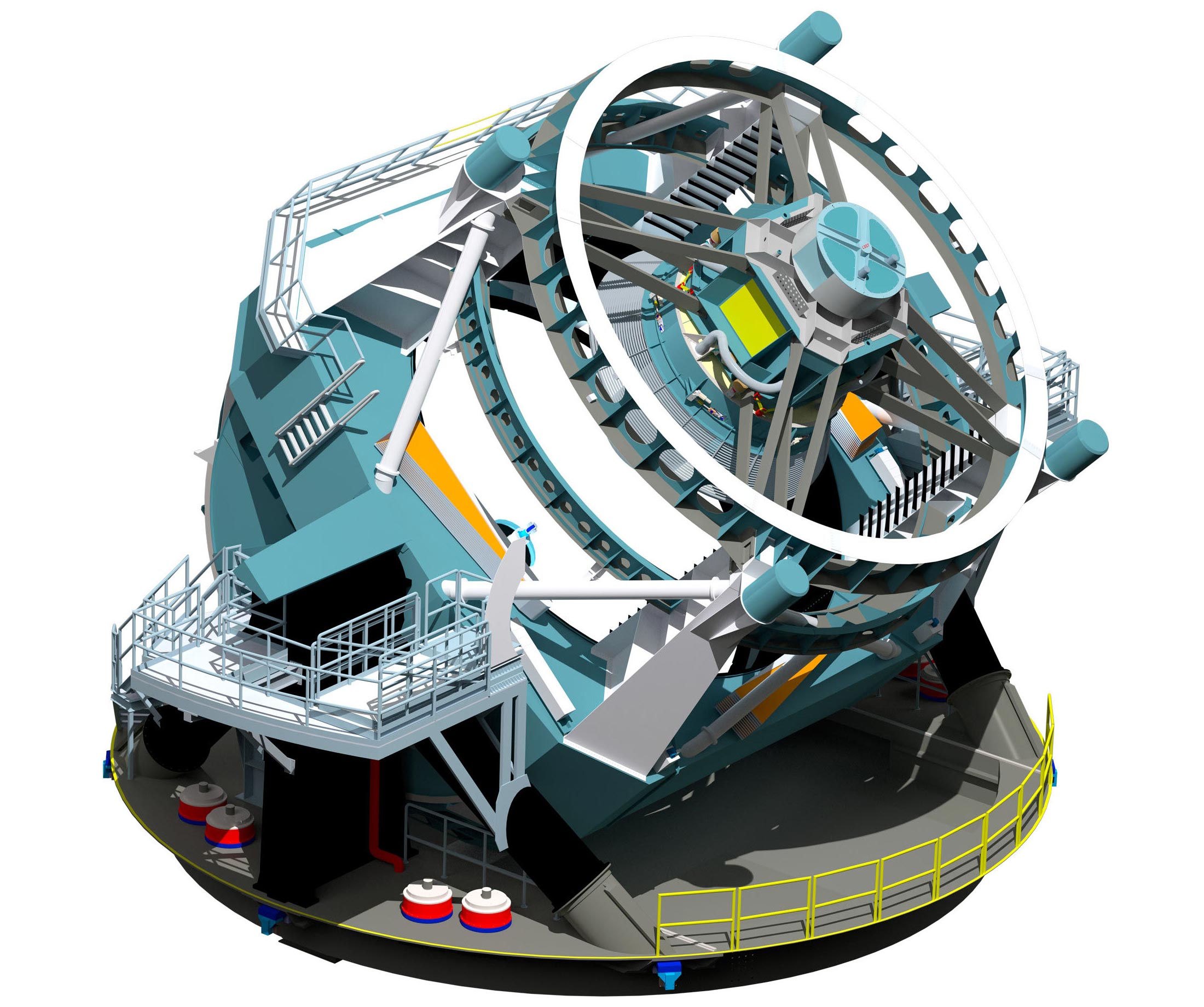
    Large Synoptic Survey Telescope (LSST)
    An artist’s rendering of the proposed Large Synoptic Survey Telescope. The 8.4-meter LSST will use a special three-mirror design, creating an exceptionally wide field of view, and will have the ability to survey the entire sky in only three nights. Credit: LSST Corporation

    With an estimated construction cost of $665M and a five-year build time, the Large Synoptic Survey Telescope (LSST) received approval from the National Science Board and is headed to the final design stage.

    With approval from the National Science Board, the National Science Foundation (NSF) Director will advance the Large Synoptic Survey Telescope (LSST) to the final design stage. This action permits the NSF Director to include funds for LSST construction in a future budget request. To be located in Chile, the LSST is a proposed 8-meter (26-foot) wide-field survey telescope that will survey the entire sky approximately twice per week, delivering a large and comprehensive data set that will transform astronomical research.

    The LSST was the first-ranked ground-based large initiative in the 2010 National Academy of Sciences decadal survey in astronomy and astrophysics. The project is a partnership among the NSF, the Department of Energy (DOE), and a number of private contributors.

    “LSST will provide an unprecedented view of the sky while leading the emerging discipline of data-enabled science,” said NSF Director Subra Suresh. “The project will foster international collaboration and offer unique methods for discovery in this new age of Big Data.”

    Equipped with a 3-billion-pixel digital camera, the LSST will propel astronomy ever further into the era of data-enabled science. By charting objects that change or move, and tracing billions of remote galaxies, LSST will provide multiple probes of the mysterious dark matter and dark energy, provide insight into short-lived transient events such as astronomical explosions or collisions, and create a more detailed map of the Milky Way and our own solar system.

    “LSST will transform how scientists detect and analyze astronomical events,” said Edward Seidel, assistant director for the NSF’s Mathematical and Physical Sciences Directorate. “The potential to deepen our understanding of the universe and its constituents, from distant exploding stars to nearby asteroids, is enormous.”

    NSF and DOE have recently signed a formal Memorandum of Understanding delineating the scope of the agencies’ responsibilities throughout the lifetime of the project. NSF will be responsible for development of the site and telescope, as well as the extensive data management system. DOE, through a collaboration led by its SLAC National Accelerator Laboratory, will be responsible for the development and delivery of the large-format camera. The Republic of Chile, through an agreement with Universidad de Chile, will make available the observing site for the LSST telescope.

    The total construction cost of LSST is estimated to be about $665M, approximately 70 percent from NSF, 24 percent from DOE, and 6 percent from private donors to the project. The construction is anticipated to last five years, followed by a two-year commissioning period before the start of the survey.

    Never miss a breakthrough: Join the SciTechDaily newsletter.
    Follow us on Google and Google News.

    Astronomy Astrophysics Large Synoptic Survey Telescope National Science Foundation
    Share. Facebook Twitter Pinterest LinkedIn Email Reddit

    Related Articles

    World’s Largest Space Camera Snaps Breathtaking First Photos of the Universe

    Gravitational Waves Detected Using “Cosmic Clocks” and Unseen Spatial Distortions

    Cracking the Magnetic Code: Distant Radio Signals Reveal Earth-Like Exoplanets’ Hidden Force

    Ruins of Ancient Star Cluster Discovered at the Fringes of Our Galaxy

    Surprising Insights Into Star Formation From Unprecedented Survey of the “Nurseries” Where Stars Are Born

    Unusual Comet – 1000 Times More Massive Than Typical – Discovered in Outer Solar System by Dark Energy Survey

    NSF’s LIGO Detects Gravitational Waves

    Simulations Re-Create the Complex Dynamics Near a Black Hole

    Simulations Shed Light on the Formation of Stars in the Earliest Galaxies

    Leave A Reply Cancel Reply

    • Facebook
    • Twitter
    • Pinterest
    • YouTube

    Don't Miss a Discovery

    Subscribe for the Latest in Science & Tech!

    Trending News

    Mezcal “Worm” in a Bottle Mystery: DNA Testing Reveals a Surprise

    New Research Reveals That Your Morning Coffee Activates an Ancient Longevity Switch

    This Is What Makes You Irresistible to Mosquitoes

    Shockingly Powerful Giant Octopuses Ruled the Seas 100 Million Years Ago

    Scientists Stunned by New Organic Molecules Found on Mars

    Rewriting Dinosaur Evolution: Scientists Unearth Remarkable 150-Million-Year-Old Stegosaur Skull

    Omega-3 Supplements Linked to Cognitive Decline in Surprising New Study

    First-of-Its-Kind Discovery: Homer’s Iliad Found Embedded in a 1,600-Year-Old Egyptian Mummy

    Follow SciTechDaily
    • Facebook
    • Twitter
    • YouTube
    • Pinterest
    • Newsletter
    • RSS
    SciTech News
    • Biology News
    • Chemistry News
    • Earth News
    • Health News
    • Physics News
    • Science News
    • Space News
    • Technology News
    Recent Posts
    • Male Birth Control Breakthrough: Scientists Find Way To Turn Sperm Production Off and Back On
    • A Common Vitamin Could Hold the Key to Treating Fatty Liver Disease
    • New Research Shows Vitamin B12 May Hold the Key to Healthy Aging
    • Scientists Map Thousands of Brain Connections With RNA Barcodes
    • This Gene Tweak Turns Strawberries Into Healthier, Tastier Superfruit
    Copyright © 1998 - 2026 SciTechDaily. All Rights Reserved.
    • Science News
    • About
    • Contact
    • Editorial Board
    • Privacy Policy
    • Terms of Use

    Type above and press Enter to search. Press Esc to cancel.